Categories
Blog

Right to a Jury Trial in ERISA Cases

Right to a Jury Trial in ERISA Cases

Charles C. Shulman, Esq.
cshulman@ebeclaw.com
201.357.0577

June, 2025

See link below to article.

There is a recent trend in some federal cases to allow requests for
jury trials for ERISA claims, such as claims for benefits or breach of
fiduciary duty claims, even though historically such claims were treated as
equitable claims, not entitled to a jury trial. Three district cases allowing
jury trials are in the Second Circuit and relate to excessive fee cases.  Jury trial verdicts are unpredictable,
particularly in complex ERISA fiduciary cases. 
In light of the possibility of a jury trial in excessive fee cases,
increased emphasis and care should be taken in the selection and overseeing of
service providers, bids from multiple recordkeepers should be compared and 401(k)
plan investment funds should be selected and monitored based on advice of
independent financial advisors.

1.    Right
to Jury Trial in ERISA Legal Claims

ERISA
does not explicitly address a plaintiff’s right to a jury trial, and its
legislative history provides no clarification. Federal courts have looked to
the Seventh Amendment to the U.S. Constitution, which guarantees the right to a
jury trial in federal common law cases, but not in equitable cases.
Historically, most ERISA claims have been viewed as equitable or partially
equitable and not entitled to a jury trial. However, some recent cases granted
jury trial requests for ERISA claims that seek benefits under the plan or seek
to make the plan whole for monetary losses due to fiduciary breaches.


2.    Jury Trials in Legal but Not Equitable Claims

Federal Caselaw
Holds that the
Right to a Jury Trial is for Legal but Not Equitable Claims. The Supreme Court has addressed
the issue of the right to a jury trial for legal but not equitable claims on a
number of occasions. For example, in the recent case of Securities and Exchange
Commission v. Jarkesy, 603 U.S. 109 (2024), the Court held that that the SEC’s
pursuit of civil penalties in securities fraud cases even within an
administrative setting, was still considered a legal claim, not an equitable
claim, and therefore the defendants could assert their right to a jury trial.  

Two-Part Test to Determine if Right to Jury Trial Exists.
To determine whether a particular action will resolve legal rights or
equitable rights, courts examine both the nature of the issues involved and the
remedy sought. See, e.g., Granfinanciera, S.A. v. Nordberg, 492
U.S. 33, 42 (1989), holding that Granfinanciera, S.A. had the right
to a jury trial when sued by the trustee in bankruptcy to recover
allegedly fraudulent monetary transfer, stated that there are two tests to
determine if a jury trial is allowed: (i) the court compares the statutory
action to 18th-century actions brought in the courts of England prior to the
merger of the courts of law and equity; and (ii) the court examines the remedy
sought and determine whether it is legal or equitable in nature.  The
Court noted here and in other cases that the second test is more important than
the first.

3.    Jury Trial for ERISA § 502(a)(1)(B) Denial of Benefits Claims

Cases Denying Jury Trial for ERISA
§ 502(a)(1)(B) Claims for Benefits under the Plan.
Most cases have denied jury trials
for an ERISA denial of benefits claim under ERISA § 502(a)(1)(B), viewing such
claims as equitable, similar to enforcing a trust. Under ERISA § 502(a)(1)(B), a
civil action may be brought by a participant or beneficiary to recover benefits
due under the terms of his plan, to enforce his or her rights under the terms
of the plan, or to clarify his or her rights to future benefits under the terms
of the plan. For examples of cases that have denied jury trials in §
502(a)(1)(B) denial of benefits claims because they involve primarily equitable
claims, see, e.g., Kramer v. American Electric Power Executive Severance Plan,
128 F.4th 739 (6th Cir. 2025) (employee brought action under ERISA §
502(a)(1)(B) for denial of severance benefits under executive severance plan and
interference under ERISA; plaintiff asserted constitutional right to a jury
trial for ERISA § 502(a)(1)(B) denial of benefits claim; court held that ERISA
claim for denial-of-benefits is equitable in nature; thus, plaintiff was not
entitled to a jury trial on ERISA claim for benefits); Graham v. Hartford Life
& Accident Ins. Co., 589 F.3d 1345 (10th Cir. 2009) (the Seventh Amendment
guarantees no right to a jury trial in an ERISA § 502(a)(1)(B) action for
benefits because the relief is equitable rather than legal); Wilkins v. Baptist
Healthcare Sys. Inc., 150 F.3d 609, 616 (6th Cir. 1998) (former employee
brought ERISA claim against employer and benefit plan administrator, alleging
that the administrator’s denial of disability benefits violated ERISA; court
held that a claim for denial of benefits was not a case for money damages and
therefore plaintiff was not entitled to a jury trial); Biggers v. Wittek
Industries, Inc., 4 F.3d 291 (4th Cir. 1993) (claim for benefits under an ERISA
welfare plan was covered by ERISA, and because ERISA preempts his common law
contract claim, the claim should have been tried by the court under the
principles of ERISA); Bair v. General Motors Corp., 895 F.2d 1094 (6th
Cir. 1990) (former employee sued former employer under ERISA, seeking special
early retirement benefit; court rejected appellant’s argument that he was
entitled to a jury merely because issues of contract law are involved in his
claim).

Some Cases Allowing Jury Trials for ERISA § 502(a)(1)(B) Denial
of Benefits Claims.
Some cases have held that jury trial requests were
allowed even in claims for benefits under ERISA § 502(a)(1)(B), as they were
held to involve legal claims, like claims for damages. See, e.g., Cox v.
Keystone Carbon Co., 861 F.2d 390 (3d Cir.1988) (court acknowledged the
difference between the relief provided ERISA § 502(a)(1)(B), which is “legal,”
and the relief provided ERISA § 502(a)(3)(A) & (B), which is “equitable,” citing
Tull v. United States, 481 U.S. 412 (1987); remanded to district court to determine
whether the § 502(a)(1)(B) claim was presented to it and if so, whether he was
entitled to a jury trial thereunder); Rhodes v. Piggly Wiggly Alabama
Distributing Co., Inc., 741 F. Supp. 1542 (N.D. Ala. 1990) (an action under
ERISA § 502(a)(1) is legal in nature and there is a Seventh Amendment right to
jury trial).

4.    Fiduciary Breach Claims under ERISA § 502(a)(2) are Held by Most
Courts to be Equitable Claims Not Entitled to a Jury Trial

With regard to ERISA fiduciary claims under ERISA §
502(a)(2) to remedy fiduciary breaches under ERISA § 409(a), most courts have
held that ERISA fiduciary claims are equitable in nature and are not entitled
to a jury trial. See,
e.g., Acument Global Technologies, Inc.. v. Towers Watson & Co., 998 F. Supp.
2d 111 (S.D.N.Y. 2014) (rejecting jury demand in ERISA fiduciary breach case
because the remedy sought was the classic remedy against a fiduciary, namely, a
surcharge to repair the damage his breach of duty inflicted upon the corpus that
the fiduciary was charged to protect, which is an equitable claim); Bauer-Ramazani
v. Teachers Insurance and Annuity Association of America-College Retirement and
Equities Fund, No.
1:09–CV–190, 2013 WL 6189802 (D. Vermont 2013) (granting motion to strike jury
demand in ERISA claim for breach of fiduciary duty, because the remedy plaintiffs
seek under ERISA, the value of the use of the plan assets and disgorgement of
any investment profits made through the use of plaintiffs’ funds, are equitable
in nature); Carver v. Bank of New York Mellon, No.
15-CV-10180, 2017 WL 1208598 (S.D.N.Y. 2017) (court
concludes that the remedy sought by plaintiffs for defendants’ alleged breach
of fiduciary duty is equitable in nature; defendants’ motion to strike plaintiffs’
demand for a jury trial was therefore granted); Divane v. Northwestern
University, 953 F.3d 980 (7th Cir. 2020), vacated on other grounds, 142 S. Ct.
737 (2022) (court stated there would be no right to jury trial for fiduciary
claim); In Re First American Corp. ERISA Litigation,
No. SACV
07-01357-JVS, 2009 WL 536254
(C.D. Cal. 2009) (overwhelming weight of authority in the federal courts holds
that actions under ERISA § 502(a)(2) by participant, beneficiaries or
fiduciaries to remedy alleged fiduciary violations of ERISA § 409(a) are
equitable in nature and have no 7th Amendment jury trial right); Harmon v.
Shell Oil Co.,
No. 3:20-cv-00021, 2023 WL 2474503 (S.D. Tex. Mar. 13, 2023) (given the equitable nature
of the claims and relief that plaintiffs seek, court denied jury request); Popovchak
v. UnitedHealth Group Inc., 692 F.Supp.3d 392, (S.D.N.Y. Sept. 19, 2023)  (suit against claims administrators alleging failure
to adequately reimburse beneficiaries for medical services in violation of plan
and their fiduciary duties; court held beneficiaries adequately alleged that
claims administrators breached their fiduciary duty of loyalty; beneficiaries
adequately alleged losses resulting from administrators’ alleged conduct; and
beneficiaries did not have Seventh Amendment right to jury trial with regard to
breach-of-fiduciary-duty claims, because it was not clear whether plaintiffs
sought legal damages for their fiduciary duty claims, and the Second Circuit
has long held that ERISA benefits claims do not trigger the right to a jury
trial, the court grants defendants’ motion to strike plaintiffs’ jury demand
without prejudice).

5.    Several Recent District Court Cases in the Second Circuit Have Allowed
Jury Trials even for Fiduciary Breach Claims under ERISA § 502(a)(2)

Three recent district court decisions in the Second Circuit have
granted jury trials in ERISA fiduciary breach cases.

a.    Jury Trial Allowed in Garthwait v. Eversource
Energy Service Company (D. Conn.) and rather than go to Jury Trial, Defendants
Settled for $15 Million
.  In Garthwait
v. Eversource Energy Service Company, No. 3:20-CV-00902, 2022 WL 17484817 (JCH)
(D. Conn. Dec. 7, 2022), the court allowed a jury trial for the plaintiffs’
claim for Eversource to restore (“make good”) any losses caused by breaches of
fiduciary duty related to the company’s 401(k) plan. In that case, participants
in the 401(k) plan alleged breach of fiduciary duty by allowing underperforming
investments in the 401(k) plan’s choice of funds. The court held that the make-good
claim was a legal remedy rather than an equitable remedy because it sought
monetary damages to compensate for the losses caused by the alleged breaches,
and therefore plaintiffs request for a jury trial with respect to the make-good
claims was valid.  The case was
subsequently prepared for a jury trial scheduled for April 2023, but as a
result of the risks of a jury trial the parties reached a $15 million
settlement in September, 2023.

b.    Jury Trial Allowed in Vellali v. Yale
University (D. Conn.) but Jury Acquitted on Basis of “Could Have” Standard; Plaintiffs
Appealing to Second Circuit
. In Vellali v. Yale University, 662 F.Supp.3d
238 (D. Conn. Mar. 17, 2023), a class of participants in Yale University’s
403(b) Retirement Account Plan brought suit under ERISA § 502(a)(2) against the
plan fiduciaries for breach of fiduciary duties and other ERISA claims in
connection with alleged excessive recordkeeping and administrative fees, noting
that the plan used multiple recordkeepers, and selected an imprudent choice of investment
funds. The plaintiffs made a jury request. The district court stated that the
remedy is legal in nature since they seek to recover damages out of the
defendant’s assets rather than to recover specifically identifiable funds, and
the court therefore held that the plaintiffs have the right to a jury trial in
this case on their claims for money damages.

       The jury in the Vellali v. Yale
University case
found in June 2023 that Yale University fiduciaries had
breached their fiduciary duty of prudence by allowing unreasonable
recordkeeping and administrative fees, but that the plaintiffs didn’t prove any
resulting damages since Yale University demonstrated that a prudent fiduciary
“could have” made the same decisions as to recordkeeping and
administrative fees. The jury also sided with Yale University on the
appropriateness of investment monitoring and share class selection. The
plaintiffs appealed to the Second Circuit claiming that the jury instructions
in the trial did not adequately guide the jury on how to assess damages,
specifically regarding the “could have” versus “would have”
standard for determining if a prudent fiduciary would have made the same
decisions as the defendants. The appeal is pending.

c.    Jury Trial Allowed in Khan v. Board of
Directors of Pentegra Defined Contribution Plan (S.D.N.Y.) and Jury Awarded $38
million for Unreasonable Recordkeeping and Administrative Fees.
In Khan v.
Board of Directors of Pentegra Defined Contribution Plan, No. 20-CV-07561, 2023
WL 6237862 (S.D.N.Y. Sept. 26, 2023), participants in the Pentegra Defined
Contribution Plan for Financial Institutions (a pooled 401(k) plan) brought
suit under ERISA § 502(a)(2)
alleging that plan fiduciaries at Pentegra and the Board breached their ERISA
fiduciary duties by allowing unreasonable recordkeeping and administrative fees.
The plaintiffs amended their claim to request a jury trial. The Southern
District of New York in the 2023 case found that the ERISA § 502(a)(2) claim against the fiduciaries
involves legal and equitable claims, and therefore held that the case should be
bifurcated with the claim for money damages being tried before a jury, and the
remaining equitable claims and prohibited transaction claims should be tried
before the court.

       On April 23, 2025, a jury in the U.S. District
Court for the Southern District of New York rendered a unanimous verdict in
Khan v. Board of Directors of Pentegra Defined Contribution Plan, that the
defendants breached their fiduciary duties under ERISA in connection with
administration and fees charged for participation in the Pentegra pooled 401(k)
plan, and as a result, the jury awarded the plaintiffs damages exceeding $38
million. A court decision regarding the equitable and prohibited transaction
claims had not yet been issued, and according to a May 2, 2025 S.D.N.Y. court
order, the parties in Khan v. Board of Directors of Pentegra Defined
Contribution Plan, have reached a settlement in principle for the remaining
claims.

6.    Points to Consider in Light of Possibility of Jury Trials for
Excessive Fee Cases

●    The intricacies of ERISA excessive fee cases
make jury trials particularly unpredictable.

●    In light of the possibility of a jury trial
in excessive fee cases, increased emphasis and care should be taken in the
selection and overseeing of service providers and in reviewing the fee
structures from time to time.

●    RFPs from multiple recordkeepers should be
compared.

●    401(k) plan investment funds should be
selected and monitored based on advice of independent financial advisors, and
the funds’ returns and risks should be benchmarked.

●    Recordkeepers with a relationship with the plan
sponsor should be avoided.

●    It should be interesting to see if this
trend to allow jury trials in ERISA fiduciary excessive fee cases spreads
beyond the Second Circuit.

Also Published in Journal of Pension Planning & Compliance (WK, Winter 2026) 

at https://drive.google.com/file/d/11PU_wpBJNl-PZmAMO3bfVLphahKqzMlI/

Categories
Blog

ERISA’s “Controlled Group” Rules – A Timely Review


 ERISA’s “Controlled Group” Rules –

A Timely Review

                                                                                                                Oct. 12, 2025 (updated)

 Charles C. Shulman, Esq.*

Printed in 51 Journal of Pension Planning and
Compliance no. 1 at 1 (WK, Fall 2025).  
https://drive.google.com/file/d/1UyhCIi1Oa_-gZwZcnRcShBShEZLvQXFQ/


* Charles C. Shulman, Esq.,
Teaneck, New Jersey, cshulman@ebeclaw.com, 201-357-0577, has extensive experience
in employee benefits and executive compensation law, including employee
benefits compliance and M&A work, advising on various issues relating to
qualified and nonqualified plans, welfare plans, ERISA liability, fiduciary
issues, executive compensation issues and negotiations and employment issues.
He is admitted to the NY & NJ bar, a fellow of the American College of
Employee Benefits Counsel and a Contributing Editor of the Journal of Deferred
Compensation. He has a J.D. & LL.M from N.Y.U. School of Law
.  

       Under the
Internal Revenue Code (“Code”) and the Employee Retirement Income Security Act
(“ERISA”), employees of certain related “controlled group” entities, as defined
in §§ 414(b) & (c) of the Code, are treated as employed by a single
employer, for purposes of liability under Title IV of ERISA, for qualified plan
nondiscrimination testing under the Code and for other purposes listed below
.

            These rules are not new, but this
article includes changes made by the SECURE 2.0 Act of 2022, first effective in
2024, and an August 2025 case and other recent cases regarding private equity
investment-plus ownership and potential partnership-in-fact ownership.

            This article is broken into four
parts: (i) applicability of controlled group rules and parent-child and
brother-sister tests; (ii) controlled group attribution rules for option
holders, 5% owners and family members; (iii) controlled group liability issues
re individual owners with an unincorporated trade or business; and (iv)
controlled group liability issues with portfolio companies of multiple private
equity owners.

            Note that under Code § 414(m), employees
of certain entities that are part of an “affiliated service group” are also
treated as employed by a single employer, for purposes of nondiscriminatory
coverage testing under the Code (but not for liability under Title IV of
ERISA). These rules were also amended by the SECURE 2.0 Act. The “affiliated
service group” rules under Code § 414(m) will be discussed in a separate upcoming
article.

 1. Applicability of Controlled Group Rules and
Parent-Child and Brother-Sister Tests

Controlled
Group Tests  

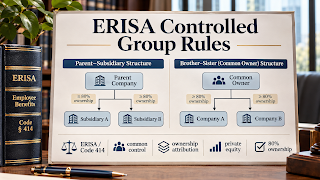
             There are two alternate tests to
determine controlled group status under the Code and ERISA: (i) a
parent-subsidiary controlled group test; and (ii) a brother-sister controlled
group test.

 Applicability
of Controlled Group Rules

             It is often incorrectly assumed that
the ERISA controlled group rules are only applicable for purposes of ERISA
Title IV (defined benefit plan) liability; but, in fact, controlled group rules
are also relevant in a host of contexts (some affecting defined contribution
plans or nonqualified plans as well).

             Controlled group rules
under ERISA and related laws apply for: (i) Title IV pension termination
liability under ERISA § 4062(a); (ii) ERISA § 4069(a) (transaction with a
principal purpose to evade pension termination liability); (iii) PBGC premiums
under ERISA §§ 4006 & 4007 (§ 4007(e)(2)); (iv) minimum funding obligations
under Code § 412 (§ 412(c)(11)(B)); (v) Code § 4971 excise tax for failure to
meet minimum funding (§ 4971(e)(2)); (vi) PBGC lien for unpaid contributions
exceeding $1 million (ERISA § 303(k)); (vii) single employer plan distress
termination where all members of the controlled group must be in financial
distress under ERISA § 4041; (viii) multiemployer pension plan withdrawal
liability (ERISA §§ 4201(a) & 4001(b)(1)); (ix) Code § 404(a) limits on
deductions (Code § 404(a) & (g)); (x) qualified plan nondiscrimination
rules, primarily with respect to the minimum coverage tests under Code § 410(b),
the defined benefit plan minimum participation tests under Code § 401(a)(26),
the general test for contributions and benefits under Code § 401(a)(4)
regulations, the benefits, rights and features under Treas. Reg. § 1.401(a)(4)-4
and certain other nondiscrimination  and
qualification rules that could be affected by a controlled group affiliate (Code
§§ 414(b) & (c)); (xi)
simplified employee pension nondiscrimination
test under
Code § 408(k)(3); (xii) Code § 409A limitations on
nonqualified deferred compensation plans (for purposes of the definition of
service recipient, the determination of when a separation from service occurs, plan
aggregation rules, and the six-month delay for specified employees of public
companies) (Code § 409A(d)(6)); (xiii) COBRA continuation coverage (ERISA § 607(4);
Code § 414(t)); (xiv) cafeteria plan
nondiscrimination tests
of Code § 125, self-insured medical reimbursement
nondiscrimination test of Code § 105(h),
and certain fringe benefit
nondiscrimination tests in Code
§ 132 (Code §§ 414(t), 105(h)(8) & 125(g)(4)); and (xv) Affordable Care Act
mandated coverage rules for employers with 50 or more employees on a controlled
group basis, to provide affordable healthcare benefits or pay certain penalties
under Code § 4980H(a) & (b).[1]
The WARN Act also has inter-corporate liability if companies are so intertwined
in their affairs that they appear separate but are actually part of a single
enterprise (caselaw interpreting 29 U.S.C. § 2101(a)(1)).[2]

         ERISA
controlled group rules would NOT apply to, e.g., (i) prohibited transactions, (ii)
other excise taxes, (iii) consequences of plan disqualification,
[3]
(iv) Title I reporting and disclosure obligations, or (v) contractual
liabilities for promised benefits, etc.

 Parent-Subsidiary
Controlled Group Test

          Parent-subsidiary
test.
A parent-subsidiary controlled group will exist if there is a chain
of entities conducting trades or businesses that are connected through a ”controlling
interest” with a common parent, with controlling interest defined: (i) in the
case of corporation as at least 80% of the total combined voting power of all
classes entitled to vote OR at least 80% of the total value of all shares of
the subsidiary; (ii) in the case of a trust or estate an 80% actuarial interest
in the trust or estate; (iii) in the case of a partnership (or other entity
taxed as a partnership) an 80% interest in profits OR capital of the
partnership; and (iv) in the case of a sole proprietorship 100% ownership of
the trade or business. Code § 1563(a)(1) referenced by Code § 414(b); Treas.
Reg. § 1.414(c)-2(b)(2).

             Voting power. Voting power under
Code §§ 414(b) & 1563(a)(1) means the power to control the corporation’s
business through the election of the board of directors, as illustrated in various
cases and rulings.
[4]

             Parent-child controlled group not
applicable if individual owns the other entities, but there is no entity that
owns the other entities
. Parent-child controlled group would not apply if
an individual (not a trade or business) owns the other entities. If an
individual owns individually 80% in several entities, but there is no entity
that owns the other entities, and it’s not the individual’s trade or business
that owns the other entities but rather the individual. However, the
brother-sister controlled group, discussed below, would likely pull the
entities owned by the individual into a single controlled group.

             Section 415 50% Standard.  For purposes of the Code § 415 limitations on
qualified plan benefits and contributions, the controlling interest for
purposes of the parent-subsidiary test is reduced from 80% to 50%. Code § 415(h);
Treas. Reg. § 1.415(a)-1(f).

             Examples of parent-subsidiary
control groups

             Parent-subsidiary example 1: Partnership
A owns stock having 80% of the total combined voting power of all classes of
stock entitled to vote of Corporation B. Partnership A also owns 80% of the
profits interest in Partnership C. Partnership A is the common parent of a
parent-subsidiary controlled group of trades or businesses consisting of
Partnership A, Corporation B, and Partnership C. See Treas. Reg. § 1.414(c)-2(e)
Ex. 1. See also, Treas. Reg. § 1.1563-l(a)(2)(ii) Ex. 1 & 2.

            Parent-subsidiary example 2: Corporation
A owns 80% of the only class of stock Corporation S1 and of Corporation S2.
Corporations S1 and S2 each own 40% of the only class of stock of Corporation
S3. Corporation A is the common parent of a parent-subsidiary controlled
group consisting of corporations A, S1, S2 and S3 (with the indirect 40%
ownership interests of Corporation S3 combined). See diagram below. See also, Treas.
Reg. § 1.414(c)-2(e) Ex. 2, and Treas. Reg. § 1.1563-l(a)(2)(ii) Ex. 3.


             Exclusion of certain remaining ownership
interests in parent-subsidiary test for 50% owned entities.
Certain
ownership interests are excluded in determining the parent-subsidiary
controlled group. Specifically, if the parent owns (a) 50% or more of the vote
or value of subsidiary corporation, (b) 50% or more of the actuarial interest
of subsidiary trust or (c) 50% or more of the profits or capital of subsidiary
partnership, then any remaining ownership interest in the subsidiary will be
ignored if the remaining interest is held by (i) principal owner, officers,
partners or fiduciaries of the parent, (ii) employees of the subsidiary if
subject to a “put” to employer on termination of employment or other
substantial restriction, (iii) a trust which is part of
  a deferred compensation plan of foreign
affiliates or (iv) controlled tax-exempt organizations. Ignoring the remaining
ownership interest will have the effect of increasing the parent’s ownership
interest in the entity, and if the increased ownership interest is 80% or more
of the entity, it could bring the parent and subsidiary entity it into a
parent-subsidiary controlled group. Code § 1563(c)(2)(A); Treas. Reg. § 1.414(c)-3(b).

 Brother Sister Controlled Group Test

             Brother-sister
test.
A brother-sister controlled group exists where there are two or more
trades or businesses which meet two tests: (i) the same five or fewer persons
who are individuals, estates or trusts[5]
commonly own together 80% or more of “control,” as defined above, in each of
the entities; and (ii) these five or fewer individuals, estates or trusts also
own together 50% or more of the “identical” ownership (effective control) in
the entities, with identical ownership meaning that ownership is taken into
account only to the extent it is identical with respect to each of the entities
(i.e., one looks only at the lowest percentage ownership in any of the common
entities and count only that lowest percentage ownership).
Code § 1563(a)(2);
Treas. Reg. § 1.414(c)-2(c).

             Thus,
the brother-sister test includes an 80% common (combined) control component and
a 50% identical ownership component.
Under the identical ownership component, if corporations X, Y and Z are partially
owned by individual A with a 20%, 30% and 40% interest, respectively, the
identical ownership interest that is counted for individual A is only 20%.

             Example of brother-sister test. Record
the ownership percentage of each person in the group across all companies. Determine
each person’s
lowest ownership percentage across all of the
companies (the identical ownership).


Individuals

Company A

Company B

Identical Ownership

Alex

40%

50%

40%

Ben

50%

30%

30%

Total

90%

(common
control equals or exceeds 80%)

80%

(common
control equals or exceeds 80%)

70%

(identical ownership exceeds 50%)


Company
A and B are in a brother-sister controlled group since (1) five or fewer
individuals commonly own at least 80% of each of the entities (in the above
example Company A is commonly owned 90% by Alex and Ben, and Company B is
commonly owned 80% by Alex and Ben, both of which equal or exceed 80%); and (2)
when adding up identical ownership in each entity, i.e., the lowest percentage ownership
by each individual in each company, the identical ownership exceeds 50% (in the
above example Alex’s identical ownership in both companies A & B is 40% and
Ben’s identical ownership in both companies A & B is 30%, thus yielding
identical ownership by Alex and Ben of 70% of both companies, which exceeds
50%). See diagram below. See also, examples in Treas. Reg. § 1.414(c)-2(e) Ex.
4 and Treas. Reg. § 1.1563-l(a)(3)(iii) Ex. 1.


             Brother-sister test excludes
stock ownership of individuals who do not hold an interest in each of the
entities under Vogel Rule.
Under the Supreme Court case of U.S. v. Vogel
Fertilizer Company, 455 U.S. 16 (1982), stock ownership of individuals who do
not hold an interest in all of the entities is disregarded even for the 80% component of the brother-sister test. The
Court in Vogel found that the statutory term “brother-sister
controlled group” connotes a close horizontal relation between the
corporations, suggesting the same persons must satisfy the 80% ownership
requirement for each corporation. Analyzing the structure of the statute, the
Court noted that “five or fewer persons” is the conjunctive subject
for both the 80% test and the 50% test. This structural parallel led the Court
to deduce that the 80% test must also require common ownership among the
shareholders used for the 50% test. The Court invalidated prior Treas. Reg. §
1.1563-1(a)(3), rejecting its “singly or in combination” language.
The Court highlighted that the Treasury Department’s representations before
Congress explicitly included a common ownership requirement in the 80% test,
making the “singly or in combination” language of those regulation
contradictory to those initial proposals. This Vogel clarification has
been incorporated into the more recent version of Treas. Reg. § 1.1563-1(a)(3),
which provides in § 1.1563-1(a)(3)(ii)(C) that the five or fewer
persons whose stock
ownership is considered for purposes of the 80% requirement must be the same persons whose stock ownership is considered for purposes of the more-than-50%
identical ownership requirement.

             Example of application of Vogel
Rule.
For example, if the above example were expanded to include a third shareholder,
Cathy, with a 20% interest in Company B but a 0% ownership in Company A, and
other changes as shown below, we exclude Cathy’s ownership in both companies,
even in Company B, since she does not have any ownership in Company A, and without
counting Cathy’s 20% interest in Co. B, there is not common (combined) control
of 80% or more in Company B, and therefore the brother-sister test for companies
A and B is not met.


Individuals

Company A

Company B

Identical Ownership

Alex

70%

70%

70%

Ben

30%[not counted under Vogel]

0%

0%

Cathy

0%

30%
[not counted under Vogel]

0%

Total

70% (not including 30% of Ben since he does not have any
identical ownership), so common control does not equal or exceed
80%)

70% (not including 30% of Cathy under “Vogel” since she
does not have identical ownership in the other entities, so common control
does not
equal or exceed 80%)

70%
(identical ownership exceeds
50%)

 The regulations as amended in Treas. Reg. § 1.414(c)-2(c)(1),
53 Fed. Reg. 6603 (March 2, 1988) provide, incorporating Vogel: “The term ‘brother-sister
group of trades or businesses under common control’ means two or more
organizations conducting trades or businesses if (i) the same five or fewer
persons who are individuals, estates, or trusts own (
directly and with the
application of § 1.414(c)-4
) a controlling interest [80% or more] in each
organization, and (ii) taking into account the ownership of each such person
only to the extent such ownership is identical with respect to each such
organization, such persons are in effective control [more than 50%] of each
organization. The five or fewer persons whose ownership is considered for
purposes of the controlling interest requirement for each organization must be
the same persons whose ownership is considered for purposes of the effective
control requirement.”
 

 Note that if Cathy was married to Alex, and ownership
takes into account spousal ownership under Treas. Reg. § 1.414(c)-4(c), Alex
may be deemed to own Cathy’s interest in Company B, but if Cathy had no
interest, employment, management or restriction on sale role in Company B and
Company B majority passive investments, Cathy’s ownership would not be
attributed to Alex. Also, since Cathy has no interest in Company A, there would
not be 80% common ownership in Company A, and therefore Companies A and B would
not be brother-sister entities.

 Exclusion of certain remaining
ownership interests in brother-sister test for 50% owned entities

             Certain
ownership interests are excluded in determining brother-sister controlled
group. Specifically, if five or fewer persons own 50% or more of an entity, the
remaining ownership is ignored if held by (i) a qualified plan, (ii) employees
of the entity if it is subject to substantial conditions (e.g., an asymmetrical
right of first refusal), or (iii) controlled exempt organizations.

 Combined Controlled
Group Rule

             Combined Controlled Group. There
is also a combined group test under which a group of three or more
organizations consists of at least one parent-subsidiary group, the parent of
which is a member of a brother-sister group. Code § 1563(a)(2); Treas. Reg. § 1.414(c)-2(d).
[6]

             Example of combined controlled
group.
For example, Walter, an individual, owns a controlling interest in
Partnership X and Partnership Y, and Partnerships X and Y together meet the
requirements for the brother-sister controlled group. Partnership X also owns a
controlling interest in Company Z meeting the requirements for the
parent-subsidiary controlled group. Since Partnership X is the parent of a
parent-subsidiary controlled group and is also a member of a brother-sister
controlled group, Partnership X, Partnership Y and Company Z are members of the
same combined controlled group. See Treas. Reg. § 1.414(c)-2(e) Ex. 8.

 Other
Issues Relating to Controlled Group Rules

             Treasury stock and nonvoting
preferred stock disregarded
. In determining control for the
parent-subsidiary or brother-sister controlled group tests, stock does not
include treasury stock or nonvoting preferred stock. Code § 1563(c)(1)(A);
Treas. Reg. § 1.414(c)-3(a). Thus, stock does not include (i) treasury stock reacquired
and held by the company, or (ii) nonvoting stock that is limited and preferred
as to dividends.
[7]

             Controlled group for tax-exempt
organizations
. In testing common control for tax-exempt organizations
(where there is no ownership control), 2007 regulations provide that common
control exists between tax-exempt organizations if at least 80% of the
directors or trustees of one organization are either representative of, or
directly or indirectly controlled by the other organization.
Treas. Reg. § 1.414(c)-5(b),
72 Fed. Reg. 41128 (July 22, 2007) (revised § 403(b) regulations).[8]

            Anti-Abuse rule in regulations. There
is also an anti-abuse provision in the regulations for in the section dealing
with tax-exempt organizations, but which would apply to other abuses in the
controlled group area.[9]


            Bankruptcy.
On occasion courts have disregarded stock ownership in a bankruptcy context
where there was no actual ownership.[10]

2. Controlled
Group Attribution Rules for Option Holders, 5% Owners and Family Members

             Attribution
Rules for Option Holders.
Constructive ownership in an entity can exist if
there is an option to acquire a controlling interest of the entity. Code § 1563(e)(1);
Treas. Reg. § 1.414(c)-4(b)(1).
[11]

             Courts split on whether option
attribution rules can be used to diminish other shareholders’ interests
. Courts
are divided on the issue of whether the option attribution rule can be used to
diminish other shareholder interests. Some courts and the PBGC hold that option
attribution can be used to dilute other shareholder interests.[12] Other
courts have taken the view that the option attribution rule may only be used to
increase ownership of the optionee but not to dilute ownership of other
shareholders
.[13]

             Attribution
rules for 5% owners
. For purposes of the parent-subsidiary and
brother-sister tests, the following ownership attribution rules apply to
corporations, partnerships and estates and trusts: If an individual owns 5% or
more of an entity, the individual is deemed to own a proportionate part of any
interests owned by that entity. Code § 1563(e)(2), (3) & (4) and Treas.
Reg. § 1.414(c)-4(b)(2), (3) & (4).
[14]

             Spousal attribution rules and SECURE 2.0 Changes. For purposes of the
parent-subsidiary and brother-sister tests, the following family attribution
rules apply: an individual is deemed to own the interest in an entity that his
or her spouse owns, provided that they are not divorced or legally separated.
However, the spousal attribution rule does not apply where all of the
following conditions are met: (i) the individual does not actually own any
interest of the entity in which the spouse has an interest (hereinafter
referred to as “such entity”), (ii) the individual is not a director or
employee of such entity, (iii) the individual does not participate in the
management of such entity, (iv) not more than 50% of such entity’s income is
derived from passive sources (such as royalties, rents, dividends, interest and
annuities), and (v) the spouse’s ownership in such entity is not subject to conditions
which substantially restrict or limit the spouse’s right to dispose of such interest
and which run in favor of the individual (or his or her minor children).
Code
§ 1563(e)(5); Treas. Reg. § 1.414(c)-4(b)(5).
Amendments
made by the SECURE 2.0 Act of 2022 § 315 adding Code § 414(b)(2)(A), effective
for plan years
beginning
after December 31, 2023, provide
that where the individual and his
or her spouse reside in community property states, the community property laws
can be disregarded for purposes of the § 414(b) controlled-group rules.[15]

             Minor child attribution rules and
SECURE 2.0 Changes.
An individual is deemed to own stock owned by his
children under age 21.
Code § 1563(e)(6); Treas. Reg. § 1.414(c)-4(b)(5). However, as provided by the SECURE 2.0 Act of 2022 § 315
adding Code § 414(b)(2)(B) & (C), effective for plan years beginning after
December 31, 2023, despite the normal attribution of ownership to a minor
child, a business owned by one parent and a business owned by the other parent (not
subject to spousal attribution, e.g., by reason of legal separation or divorce
or other reason) will not be considered to be in the same controlled group
solely by reason of attribution to the minor child.[16]

             Parent/child attribution rules.
If an individual owns more than 50% of an entity, he or she is deemed to own
any interests owned in that entity by his adult children, grandchildren,
parents and grandparents.
Code § 1563(e)(6)(B); Treas. Reg. § 1.414(c)-4(b)(6)(ii). There is no attribution rule for siblings.

3. Controlled Group Liability
Issues re Individual Owners with an Unincorporated Trade or Business
 

            Individual
owners are generally not liable for a corporation’s ERISA liability
. Generally,
an individual owner or shareholder of a corporation are not liable for the
corporation’s multiemployer withdrawal liability or single employer termination
liability under the controlled group rules.[17]

            Piercing Corporate Veil. One
exception to the above rule, though, would be where the doctrine of piercing
the corporate veil (alter ego) is applicable, for example, where there is
fraud, disregard by the owner of the separate character of the corporation or
shareholders undercapitalize the corporation.
[18]

            Liability
of owner if owner engages in an unincorporated trade or business
.  Another important exception – where an individual
owner (or shareholder if meeting a controlled group test) of a corporation
could be held liable for the corporation’s ERISA termination or withdrawal liability
– would be where the owner also engages in a trade or business as a sole
proprietor (or partnership) and the unincorporated trade or business could make
the owner individually liable for the corporation’s termination or withdrawal liability.
[19]

             Trade or Business. Neither
ERISA nor the Treasury regulations define “trade or business.” Courts have
generally adopted the standard articulated in the1987 Supreme Court case of
C.I.R. v. Groetzinger, where the Court held that in the context of Code § 162, to
be engaged in a trade or business, the taxpayer must be involved in the
activity with continuity and regularity and that the taxpayer’s primary purpose
for engaging in the activity must be for income or profit; sporadic activity, a
hobby, or an amusement diversion does not qualify.
[20]
Several cases have applied Groetzinger in the ERISA context.
[21]

             Personal liability by reason of
having unincorporated home business activity.
A number of courts have found
shareholders liable by reason of some business activity they engaged in as a
sole proprietor, trust or partnership.
[22]
See below regarding private equity funds that engage only in passive investing.

 4. Controlled Group Liability Issues re Portfolio
Companies of Multiple Private Equity Owners  

            Whether
private equity funds are a trade or business.
As discussed further in this
section, only “trades or business” under common control are treated as part of
an ERISA controlled group. As discussed above, under the Groetzinger standard,
to be engaged in a trade or business, the individual must be involved in the
activity with continuity and regularity and that the taxpayer’s primary purpose
for engaging in the activity must be for income or profit; but sporadic
activity, a hobby, or an amusement diversion do not qualify.[23]
With regard to private equity funds, historically, practitioners had generally taken
the view that since they are generally passive investment vehicles with no
employees and minimal involvement in day-to-day operations, they are not trades
or businesses, and therefore separate portfolio companies owned by a private
equity fund would not be in the same ERISA controlled group. However, the PBGC in
a 2007 PBGC Appeals Board Opinion stated that a private equity fund that owned
80% or more of the portfolio company was a trade or business, because it was
engaged in an activity with the primary purpose of income or profit and
conducted business through an agent (the general partner) who managed fund
investments on a regular basis.[24]
According to this ruling, 80%-owned portfolio companies of a private equity
fund would generally be in the same ERISA controlled group, and only in the
unusual case where the facts and circumstances indicate that the private equity
fund does not meet the Groetzinger standard for a trade or business, it would not
be a controlled group.[25]

             Investment plus, e.g., investment
advisory and management services.
A 2010 Eastern District of Michigan case,
Board of Trustees, Sheet Metal Workers
National Pension Fund v. Palladium Equity Partners
, found the 2007 PBGC
Appeals Board Opinion to be persuasive and “investment plus” is a trade or
business. However, since there was more than one private equity investment
funds and neither owned 80% of the portfolio company alone, there was still a
genuine issue of material fact as to whether the three funds constituted a
partnership or joint venture in fact.
[26]
A more recent August 2025 Western District of Missouri case found liability on
the part of limited partnership investor in bankrupt companies, which had triggered
withdrawal liability, since the limited partnership investor was more than a
passive investor, since it actively managed the portfolio companies
(investment-plus).
[27]

             Partnership-in-fact. Regarding
when multiple funds constitute a partnership in fact,
Luna v.
Commissioner, 42 T.C. 1067 (1964) established eight factors to consider: (i)
the agreement of the parties and their conduct in executing its terms; (ii) the
contributions, if any, which each party has made to the venture; (iii) the
parties’ control over income and capital and the right of each to make
withdrawals; (iv) whether each party was a principal and coproprietor, sharing
a mutual proprietary interest in the net profits or losses, or whether one
party was the agent or employee of the other, receiving for his services
contingent compensation in the form of a percentage of income; (v) whether
business was conducted in the joint names of the parties; (vi) whether the
parties filed Federal partnership returns or otherwise represented that they
were joint venturers; and (vii) whether separate books of account were
maintained for the venture; and (viii) whether the parties exercised mutual
control over and assumed mutual responsibilities for the enterprise.[28]

             2013 Sun Capital case. A 2013
First Circuit case,
Sun Capital Partners
III, LP v. New England Teamsters & Trucking Industry Pension Fund,

found the PBGC Appeals Board Opinion to be persuasive, and confirmed that
private equity funds will be engaged in a trade or business for ERISA
controlled group purposes if there is “an investment plus” by the
fund, e.g., by reason of active involvement in management (as well as control)
of the portfolio companies; but there was still an issue of material fact as to
whether the funds would be considered a partnership-in-fact.
[29]

             2016 Sun Capital district court case.
A later district court case of Sun Capital Partners held that (i) both funds
(the Sun Fund IV with a 70% investment and Sun Fund III with a 30% investment)
were trades or businesses, and (ii) there was common control under ERISA by
reason of Fund III and IV being a “partnership in fact.”
[30]

             Reversal by First Circuit in 2019
Sun Capital Case.
The First Circuit overturned this decision, however, in
Sun Capital Partners III, LP v. New England Teamsters & Trucking Industry
Pension Fund, 943 F.3d 49 (1st Cir. 2019), cert. denied, 141 S. Ct. 372 (2020),
holding that there was not a partnership in fact because the fund documents did
not state that they were a partnership, the funds had different investors, the
funds filed separate tax returns and the funds did not always make parallel
investments.
[31]

             Multiple fund structure. Private
equity funds have often structured investment through multiple funds in part to
keep ownership below 80%, and avoid ERISA controlled group liability, but there
is still some uncertainty on the safety of relying on that structure because
they may be trades or business and there may be a partnership-in-fact (although
the 2019 First Circuit Sun Capital Partners case gives some comfort in that
regard).
[32]

 Affiliated
Service Group Rules

             Under Code § 414(m), employees of certain
entities that are part of an “affiliated service group” are also treated as
employed by a single employer, for purposes of nondiscriminatory coverage
testing and other qualified plan rules under the Code (but not for liability
under Title IV of ERISA). The affiliated service group rules will be discussed
in a separate article.


[1]
Regarding
Code §4980H guidance about controlled group, see definition of “applicable
large employer” in Treas. Reg. §54.4980H-1(a)(16) (entity treated as a single “applicable
large employer” with 50 FTEs under Code §§ 414(b), (c), (m) & (o)),
examples in §54.4980H-2(d) (where entities are treated as a single applicable
large employer) and Notice 2011-36 (all entities under Code §§ 414(b), (c) or
(m) are to taken into account in determining whether there is an applicable
large employer with 50 FTE employees)

            When
conducting due diligence about a company, it is important to examine not only
if the company has or participates in Title IV plans, but also if any
controlled group members may have or participate in such plans.

[2] Administaff Companies., Inc. v. New York Joint Board, Shirt &
Leisurewear Division, 337 F.3d 454, 457–58 (5th Cir. 2003); Pearson v. Component
Tech. Corp., 247 F.3d 471, 477 (3d Cir. 2001); Adams v. Erwin Weller Co., 87
F.3d 269, 271 (8th Cir. 1996); Chauffeurs, Sales Drivers, Warehousemen &
Helpers Union Local 572 v. Weslock Corp., 66 F.3d 241, 245 (9th Cir. 1995).

[3]
However, because the applicable sections relate to qualification of a
retirement plan, failure to recognize the common or related ownership with the
retirement plan sponsor and other corporations or businesses could result in
disqualification of the plan from inception or in operation.

[4] Voting power under Internal Revenue
Code §§ 414(b) & 1563(a)(1) and analogizing to Code § 1504 re 80% or 50% of
the total combined voting power of all classes entitled to vote – means the
power to control the corporation’s business through the election of the board
of directors, as illustrated in numerous Federal case decisions. See,
e.g., Yaffe Iron & Metal Corp. v. U.S., 78-1 U.S. Tax Cas. (CCH) ¶9314, 41
A.F.T.R.2d 78-1057 (W.D. Ark. 1978), affirmed, 593 F.2d 832 (8th Cir. 1979),
cert. denied, 444 U.S. 843 (with regard to the § 1563 requirement of 80%
control as part of brother-sister test, Tax Court held that a stockholder’s
voting agreement is relevant where the effect of an agreement is to vest to two
individuals with over 80% of the combined voting power of all classes of stock;
Eighth Circuit affirmed and cert. was denied); Central States, Southeast and
Southwest Areas Pension Fund v. CLP Venture LLC, 760 F.3d 745 (7th Cir. 2014),
cert. denied, 135 S. Ct. 964 (2015) (in a case involving multiemployer plan
withdrawal liability, even though a common owner of two corporations owned only
73% of one of the corporations (rather than 80%), the court took into account
an escrow agreement which gave the individual the right to direct voting of the
remaining 27% of the stock and concluded that there was an ERISA controlled
group for purposes of determining withdrawal liability); Erie Lighting Co. v.
C.I.R., 93 F.2d 883, 885 (1st Cir. 1937); Rev. Rul. 69-126, 1969-1 C.B. 218
(participation in management of subsidiary through election of board is
criterion of voting power; upheld by numerous rulings to non-section 1504
cases, e.g., PLR 8128073, PLR 8221112, PLR 7406211920A and GCM 35789); Alumax
Inc. v. C.I.R., 165 F.3d 822 (11th Cir. 1999) (where 50% shareholder had right
to four votes per share including right to elect board members, but for supermajority
matters such as major corporate transactions the 50% shareholder only had one
vote per share, and the board members elected by 50% shareholder likewise had
limits on voting on supermajority corporate transaction issues and were limited
by other directors’ power to delay their actions, the 50% shareholder did not
have requisite 80% voting control for purposes of consolidated returns under Code
§ 1504); Hermes Consol., Inc. v. U.S., 14 Cl. Ct. 398 (1988) (with regard to
Code § 269 voting power is determined not merely by record ownership but by the
ability to approve or disapprove of fundamental changes in the corporate
structure and the ability to elect the corporation’s board of directors).

[5]
This would exclude ownership by partnership or corporations.

[6] The term combined group means any
group of three or more organizations, if (i) each such organization is a member
of either a parent-subsidiary group or a brother-sister group, and (ii) at
least one such organization is the common parent organization of a
parent-subsidiary group and is also a member of a brother-sister group. Treas.
Reg. § 1.414(c)-2(d).

[7]
With regard to “convertible” preferred stock, see Rev. Rul. 71-83, 1971-1 C.B.
268, which held that for purposes of Code § 1504 (which until 1984 was worded
exactly as § 1563), nonvoting preferred stock that is convertible into voting
common stock is still considered “nonvoting stock that is limited and preferred
as to dividends” since at the time the test is made it is still nonvoting, and
therefore should not be counted for the affiliated group rules. However, it is
possible that for purposes of the Code §§ 414 & 1563 controlled group tests, since even stock
options are considered stock under the option attribution rules, convertible
preferred should also be included. See, Williams, “Multiple Corporations,” 55
Tax Management Portfolio § IV.A. On the other hand, the option attribution rule
only applies with respect to options for outstanding stock, which is different
than convertible preferred stock.

[8] A
trustee or director is treated as a representative of another organization if
that person is a trustee, director, agent or employee of the other
organization. Treas. Reg. § 1.414(c)-5(b). A trustee or director is controlled
by another organization if the other organization has the power to remove the
trustee or director and designate a new trustee or director. Id. Whether there
is the power to remove the trustee or director is a facts and circumstances
determination.

[9]
Treas. Reg. § 1.414(c)-5(f) (“If the Commissioner determines that the
principal purpose of a transaction is to avoid the application of section
414(b) or (c), the Commissioner may treat the organizations involved in the
transaction as if the transaction had not occurred, or may otherwise disregard
the transaction or the ownership interests created by the transaction, and may
treat the organizations as members of the same controlled group or as separate
employers, whatever is appropriate to carry out the purposes of section 414(b)
and (c)).

[10] In
re Challenge Stamping and Porcelain Co., 719 F.2d 146 (6th Cir. 1983) (where
company bought parent of sponsor of pension plan while sponsor was in Chapter
11 reorganization, but bankruptcy court then auctioned off sponsor rendering
stock of parent of sponsor worthless, buyer of parent of sponsor was not liable
for controlled group termination liability since owning 100% of parent of
sponsor was meaningless since even at that time bankruptcy court had full
control of sponsor). See similarly, PBGC v. Ouimet Corp., 711 F.2d 1085 (1st
Cir.1983), cert. denied 464 U.S. 961 (1983) (where subsidiary went bankrupt and
terminated underfunded plan after acquisition by controlled group that included
another bankrupt subsidiary, termination liability was allocated only to the
solvent group members, and not bankrupt corporations’ estates, since applying
the bankrupt’s assets to PBGC’s liability would have reduced assets available
to their creditors and inequitably benefited group members; court noted that
ERISA provides a lien on 30% of the net worth, not asset value and a bankrupt
corporation has negative net worth). See also, Sutherland v. C.I.R., 78 T.C.
395 (1982) nonacq. 1986-2 C.B. 1, 1986 WL 713548 (Tax Court has held that businesses
which are unsuccessful and are ceasing to conduct operations are not required
to be included under the Code § 414(b) or (c) test, since to do so would be to
require the inclusion of an employer which will, in effect, be maintaining an
impermanent plan since it will soon be going out of business).

            See, however, Pension Benefit
Guaranty Corp. v. East Dayton Tool and Die Co., 14 F.3d 1122 (6th Cir. 1994),
cert. denied 513 U.S. 816 (PBGC sought enforcement that a holding company, the
parent of a sponsoring employer in bankruptcy was responsible for unfunded
benefit liabilities of employer’s pension plan; the court held that 80% control
rule applied, even though holding company did not control voting rights of its
stock in employer; Challenge Stamping, cited above, which held that in a
bankruptcy case the stock purchaser never had actual control over the bankrupt
employer that sponsored the pension plan for termination liability was
different that this case, because here the holding company actually controlled
the employer and its Plan for 2-1/2 years).

[11] Code
§ 1563(e)(1), made applicable by § 1563(d)(1)(B) (if any person has an option
to acquire stock, such stock shall be considered as owned by such person);
Treas. Reg. § 1.414(c)-4(b)(1) (if a person has an option to acquire any
outstanding interest in an organization, such interest shall be considered as
owned by such person).   An option to
acquire such an option will also be considered as an option to acquire such
stock or interest. Id.

            If the option to acquire stock is
subject to contingencies, there would generally be no attribution. Central
Transport, Inc. v. Central States, Southeast and Southwest Area Pension Fund,
640 F. Supp. 56 (E.D. Tenn. 1986), affirmed, 8 EBC 2519, 1987 WL 36010 (6th
Cir. 1987; unpublished), cert. denied 484 U.S. 926 (1989) (no withdrawal
liability under ERISA § 4201 since stock purchase agreement made conditional on
federal approval was not an option under § 1563(e)(1) since it was contingent
on federal approval and purchaser had no control over contingency, and
therefore company was not in controlled group under rules of § 414(c) and §
1563). However, if the option is exercisable only after a period of time
without any conditions, there would be option attribution. Rev. Rul. 89-64,
1989-1 C.B. 91 (where an option distributed by a company to an officer in
redemption of the officer’s stock was only exercisable only after the lapse of
a fixed period of time, it is still subject to option attribution under Code § 318(a)(4)).

            There are several cases that
specifically apply the option attribution rule in an ERISA context (all dealing
with multiemployer withdrawal liability). Tri-State Rubber & Equipment,
Inc. v. Central States Southeast & Southwest Areas Pension Fund, 677 F.
Supp. 516 (E.D. Mich. 1987) (seven companies controlled by an individual are
under common control under § 414(c) and have withdrawal liability under ERISA §
4201; person who had option to purchase stock was constructive owner of such
stock under § 1563(c)(1)); IUE AFL-CIO Pension Fund v. Barker & Williamson,
Inc., 788 F.2d 118 (3d Cir.1986) (withdrawal liability exists under § 4201
where parent owns 75% of stock of subsidiary since option to purchase remaining
25% falls within option attribution rule of § 1563(e)(1)); Chicago Truck
Drivers, Helpers and Warehouse Workers Union (Independent) Pension Fund v.
Brotherhood Labor Leasing, 950 F. Supp. 1454 (E.D. Mo. 1996), denial of
reconsideration, 950 F.Supp.1454 (where there was purchase agreement for
immediate acquisition of withdrawing company (Be-Mac) by shareholders of
defendant companies, this was enough to cause Be-Mac to be in controlled group
under option rule, even if a court had later invalidated the sale, since there
were no contingencies in purchase agreement); Teamsters Pension Trust Fund of
Philadelphia v. Brigadier Leasing Associates, 880 F. Supp. 388 (E.D. Pa. 1995)
(unsigned draft agreement which gave withdrawing employer’s CFO an option to
purchase the other owner’s interest in the corporation did not establish
existing of a binding agreement, and therefore other entities owned by CFO were
not in controlled group); New York State Teamsters Conference Pension and
Retirement Fund v. Express Services, Inc., 426 F.3d 640 (2d Cir. 2005) right of
first refusal held by principals of former participating employer in
multiemployer pension plan with respect to possible affiliates did not
establish constructive ownership over purported affiliates; although statute
defining constructive ownership includes an option to acquire stock, a “right
of first refusal” was not same thing as stock option and statute made no
reference to rights of first refusal).

[12] For
the view that the option attribution rule can be used to diminish other
shareholder interests, see, Sorem v. C.I.R., 334 F.2d 275 (10th Cir. 1964) (in
determining whether a redemption was substantially disproportionate there must
be included the total unissued stock on which other shareholders have stock
options under § 318(a)(4)); Henry T. Patterson Trust by Reeves Banking &
Trust Co. v. U.S., 729 F.2d 1089 (6th Cir. 1984) (unissued stock which minority
shareholders have an option to acquire must be treated as outstanding under §
318(a)(4), which thereby increases the denominator and allows the redemption to
be not essentially equivalent to a dividend, thus benefiting the majority
shareholder in allowing him capital gain rather than dividend treatment); Rev.
Rul. 89-64, 1989-1 CB 91 (
stock must be
able to be acquired at the election of the shareholder if there exist no
contingencies with respect to such election;
redeemed
shareholder’s option taken into account); Rev. Rul. 68-601, 1968-2 CB 124
(redeemed shareholder’s option, but not unrelated holder’s option are not
affected by redeemed shareholder’s option).


[13] For
the view that the option attribution rule cannot be used to dimmish other
shareholder interests, see, Northwestern Steel and Supply Co., Inc. v. C.I.R.,
60 T.C. 356 (1973) (unexercised stock option owned by minority shareholder
cannot reduce ownership percentage of 80% shareholder under § 1563(e)(1) for
purposes of surtax exemption; note that in this case the option was to acquire
the outstanding shares held by the majority shareholder, rather than an option
to acquire unissued shares); Rev. Rul. 68-601 (unrelated holder’s option not
taken into account).

[14] See
e.g., Paza Staffing Services, Inc. v. C.I.R., 751 Fed. Appx. 223 (3d Cir. 2018)
(Third Circuit upheld Tax Court decision that an ESOP was disqualified for
failing to cover non-highly compensated employees of a related corporation in
violation of Code § 410(b) minimum coverage rules an individual sold all of the
stock of his company Paza Staffing Services to a newly established ESOP in an
ESOP buyout; he then assigned all the employees to Golden Gate, a company he
owned, and then had Paza lease the five employees back from Golden Gate; even
though the stock of the corporation held by the ESOP was not technically a
member of the same controlled group, the court held that, as sole beneficiary
of the ESOP, the owner of Golden Gate was the constructive owner of Paza under
Code § 1563(d)(2) and (e)(3)(A), and therefore the two companies were members
of the same ERISA controlled group, and the employees of Golden Gate were
required to be covered by the ESOP in order to pass IRS nondiscrimination
minimum coverage requirements; therefore the ESOP was disqualified).

[15]  These provisions in the SECURE 2.0
Act of 2022 (Division T of the
Consolidated Appropriations Act, 2023) signed Dec.
29, 2022, were originally intended to be effective for plan years beginning on
or after December 29, 2022, but the IRS has delayed the effective date for the
controlled group changes in the SECURE 2.0 Act to plan years beginning after
December 31, 2023. The
SECURE 2.0 Act also adds Code § 414(b)(3),
that to the extent changes made in new Code § 414(b)(2) result in changes to
the controlled group, the Code § 410(b)(6)(C) transition rule (which allows
disregarding changes until the end of the plan year following the plan year of
specific corporate events) applies until the end of the plan year following the
affected plan year.

[16]  SECURE 2.0 Act of 2022 § 315 adding
Code § 414(b)(2)(B) & (C), with a delayed
effective date to plan years beginning
after December 31, 2023. Specifically, stock or interests of entities held by
the parents that not attributed to the spouse under the spousal attribution
rules, will not be attributed solely as a result of minor child attribution. New
C
ode § 414(b)(2)(B). Likewise, stock or
interests of separate entities held by each of the parents that would be
attributed to a minor child by reason of minor child attribution, but is not
subject to spousal attribution, will not cause the entities to be in the same
controlled group solely because of the minor child attribution
. New Code § 414(b)(2)(C).

[17]
Connors v. Coal America, Inc., 7 Employee Benefits Cas. (BNA) 1300 (D.D.C.
1986) (individual who was officer and shareholder of corporation is not liable
for multiemployer withdrawal liability where there was no allegation of a basis
for piercing the corporate veil); DeBreceni v. Graf Bros. Leasing, Inc., 828
F.2d 877 (1st Cir. 1987) (no multiemployer withdrawal liability on controlling
shareholders and officers); Debreceni v. Bru-Jell Leasing Corp., 710 F. Supp.
15 (D. Mass. 1989) (95% shareholder not individually liable for multiemployer
withdrawal liability); Scarbrough v. Perez, 870 F.2d 1079 (6th Cir.1989)
(indirect owner not liable for multiemployer withdrawal liability); Wilhelm v.
McAnn’s W. 48th Street Restaurant Corp., 34 EBC 1659, 2004 WL 2658066, 34 (N.D.
Ill. 2004) (a shareholder is not personally liable for multiemployer withdrawal
liability of corporation; even N.Y. law does not hold a shareholder jointly and
severally liable for post-dissolution debts of the corporation).

[18]
See, e.g., the following court cases piercing the corporate veil: Lowen v.
Tower Asset Management, Inc., 829 F.2d 1209 (2d Cir.1987) (pierced corporate
veil so as to hold shareholders jointly and severally liable with the
corporations for fiduciary breaches); Board of Trustees of Teamsters Local 863
Pension Fund v. Foodtown, Inc., 296 F.3d 164 (3d Cir. 2002) (summary judgment
to dismiss piercing corporate veil claim by multiemployer pension fund against
individual defendants not granted; noted that under N.J. law to pierce
corporate veil must show that: (i) the corporation is organized and operated as
a mere instrumentality of the other corporation and (ii) the dominant
corporation uses the subservient corporation to penetrate fraud, to accomplish
injustice or to circumvent the law; with factors to be considered including the
failure to observe corporate formalities and non-functioning of other officers
and directors); Reilly v. Reem Contracting Corp., 380 Fed. Appx. 16 (2d Cir.
2010; unpublished) (plumbing company alter-ego of contracting company and
liable for contributions to union benefit funds);  Resilient Floor Covering Pension Fund v. M
& M Installation, Inc., 630 F.3d 848 (9th Cir. 2010) (non-union company may
be liable for withdrawal liability of union company where there was a
commonality between union and non-union firms and an abuse of the union/non-union
structure to avoid payment of withdrawal liability); Trustees of Operating
Engineers Local 324 Pension Fund v. Bourdow Contracting, Inc., 919 F.3d 368
(6th Cir. 2019) (a newly-formed LLC was held to be alter ego of a bankrupt
company that was a signatory to a collective bargaining agreement and was
liable to the union’s pension fund).

            See, however, the following court
cases which did not pierce the corporate veil: Reich v. Compton, 57 F.3d 270
(3d Cir.1995) (refusing to impose liability for prohibited transaction on alter
ego of party in interest under federal common law of ERISA); United Union of
Roofers, Waterproofers, and Allied Workers Local No. 210, AFL-CIO v. A.W.
Farrell & Son, Inc., 547 Fed. Appx. 17 (2d Cir. 2013) (the Second Circuit
held that two businesses that were affiliated and owned by different family
members but were not members of the same controlled group should not be treated
as a single employer for purposes of joint withdrawal liability from a
multiemployer pension plan; the court considered the following factors in
making its determination: (i) interrelation of operations, (ii) management,
(iii) centralized control of labor relations, (iv) common ownership, (v) the
use of common office facilities and equipment, and (vi) family connections
between and among the various enterprises).

[19]
When TWA entered bankruptcy with two pension plans underfunded by $1.2 billion,
the PBGC threatened to pursue Carl Icahn, the 80% shareholder of TWA and his
other corporations. Carl Icahn reached an agreement with the PBGC to make loans
and guarantees to the plans to keep them operating. See, N.Y. Times, Dec. 8,
1992, p. D-5.  Also, in 2006, in
connection with the bankruptcy of one of the plants of R.G. Steel, which had a
$100 million underfunded pension plan, the PBGC filed a lawsuit against the
parent, Renco Group seeking to a lien on its assets as well as on the Hamptons
estate of Renco Group’s founder, and the PBGC settled with the Renco Group
after it agreed to continue to be liable for the underfunded plan and
contribute $20 million to it. NY Times, April 1, 2006. In 2012 the PBGC filed a
suit in the S.D.N.Y. in connection with the bankruptcy of R.G. Steel, a
subsidiary of Renco Group, alleging that Renco Group entered into a transaction
with a principal purpose of evading $97 million unfunded benefit liabilities,
unpaid minimum funding contributions and termination premiums. BNA Pen. &
Ben. Rptr. (Feb. 5, 2013). In 2016 Renco settled with the PBGC to restore the
pension plans of 1,350 retirees of RG Steel. NY Times, March 4, 2016.

[20]
C.I.R. v. Groetzinger, 480 U.S. 23, 35, 107 S. Ct. 980, 987, 94 L. Ed. 2d 25
(1987). This is applied in the ERISA context by, e.g., Central States,
Southeast and Southwest Pension Fund v. Personnel, Inc., 974 F.2d 789 (7th Cir.
1992); Connors v. Incoal, Inc., 995 F.2d 245 (D.C. Cir. 1993).

[21] The
Groetzinger case is applied in the ERISA context by, e.g., Central States,
Southeast and Southwest Pension Fund v. Personnel, Inc., 974 F.2d 789 (7th Cir.
1992) and Connors v. Incoal, Inc., 995 F.2d 245 (D.C. Cir. 1993).

[22]
E.g., Central States, Southeast and Southwest Pension Fund v. Personnel, Inc.,
974 F.2d 789 (7th Cir.1992) (no nexus required to show ERISA affiliation;
corporation withdrawing from a multiemployer pension plan, where the
corporation’s sole shareholder held certain real estate investments, withdrawal
liability could be imposed on the sole shareholder since the real estate
investment leasing activities constituted a trade or business); Connors v.
Incoal, Inc., 995 F.2d 245 (D.C. Cir. 1993) (no economic nexus required for
determining trade or business under ERISA; a corporation which withdrew from a
multiemployer pension plan, which was owned by a family that also held the
partnership interests in a farm could cause the shareholder to be liable);
Pension Ben. Guar. Corp. v. Center City Motors, Inc., 609 F. Supp. 409 (S.D.
Cal. 1984) (genuine issue of material fact existed as to whether rental
property proprietorship was a trade or business); Board of Trustees of Western
Conference of Teamsters Pension Trust Fund v. Lafrenz, 837 F.2d 892 (9th Cir.
1988) (unincorporated truck leasing operation of husband and wife was a trade
or business, and thus affiliated with a commonly controlled corporation that
withdrew from a multiemployer plan); Central States, Southeast & Southwest
Areas Pension Fund v. Neiman, 285 F.3d 587 (7th Cir. 2002) (the owner of a
defunct trucking company was personally liable for the trucking company’s
multiemployer withdrawal liability because he had an unincorporated trade or
business of providing consulting services to a real estate management company
and to a subsidiary trucking company); Minnesota Laborers Health and Welfare
Fund v. Scanlan, 360 F.3d 925 (8th Cir. 2004) (owner personally liable to
multiemployer plan where he signed collective bargaining agreement as owner of
an unincorporated business, and not merely as an officer of one of the other
unincorporated entities); Central States, Southeast and Southwest Areas Pension
Fund v. SCOFBP, LLC, 668 F.3d 873 (7th Cir. 2011), cert. denied, 566 U.S. 1022
(2012) (where an entity ceased making contributions to a multiemployer plan,
that two other entities were under common control were also liable; the owner
of all three entities filed for personal bankruptcy and the entities, which
were limited liability companies, were subject to the individual’s ownership;
the two affiliated companies were engaged in a trade or business by virtue of
their regularly leasing real estate holdings to other entities and were not
mere passive investment vehicles and were all subject to multiemployer
withdrawal liability); Central States, Southeast and Southwest Areas Pension
Fund v. Messina Products, LLC, 706 F.3d 874 (7th Cir. 2013) (a husband and wife
who owned a trucking company that incurred ERISA withdrawal liability for
withdrawing from a multiemployer pension plan were held personally liable for
the withdrawal liability since the individual owners were engaged in a trade or
business by renting several properties to the trucking company and were not
merely passive investors, since renting property to one’s own business is
activity for the primary purpose of income or profit performed with continuity
and regularity under the Groetzinger test); Central States, Southeast and
Southwest Areas Pension Fund v. Nagy, 714 F.3d 545 (7th Cir. 2013) (company ceased
employing covered workers and incurred ERISA withdrawal liability; court held that
the individual owner of the company is liable for withdrawal liability since the
individual owner leased property to the company; therefore the individual owner
was engaged in a trade or business); Pension Benefit Guaranty Corporation v.
Findlay Industries, Inc., et al., 902 F.3d 597 (6th Cir. 2018) (the court held
that a family was personally liable for the underfunding of a pension plan; a
privately owned business was under the control of the family; the court held
that the family was personally liable for the underfunding for the commonly controlled
entities; that also made the entities liable for successor liability under
ERISA § 4069(a) for transactions entered into to avoid liability); Local No.
499, Board of Trustees of Shopmen’s Pension Plan v. Art Iron, Inc., 117 F.4th
923 (6th Cir. 2024) (multiemployer pension plan sought withdrawal liability, after
Art Iron, Inc. withdrew from the plan, from the company, as well as from its
sole shareholder Robert Schlatter and his wife Mary Schlatter; court stated
that a trade or business depends on the continuity and regularity of the
activity and whether it was primarily for income or profit; court held that
Robert Schlatter consulting work for the company, which occurred over a number
of years, including the year of pension withdrawal, was a trade or business and
therefore he could be held personally liable for the company’s withdrawal
liability; but his wife’s jewelry business was not a trade or business since it
was not operated with regularity and continuity and therefore she was not
liable).

            But see, Textile Workers Pension
Fund v. Oltremare, 764 F. Supp. 287 (S.D.N.Y. 1989) (mere ownership of real
property without economic nexus to commonly controlled entity not enough to
constitute trade or business); Central States, Southeast and Southwest Areas Pension
Fund v. Fulkerson, 238 F.3d 891 (7th Cir. 2001), cert. denied, 534 U.S. 821 (bankrupt
trucking company owner’s other leasing activities were merely passive holdings
for investment and not a trade or business for purposes of controlled group
multiemployer withdrawal liability); Central States, Southeast and Southwest
Areas Pension Fund v. White, 258 F.3d 636 (7th Cir. 2001) (bankrupt trucking
company owner’s apartment rental activities were not a “trade or business”
under ERISA § 4001(b)(1) for purposes of multiemployer withdrawal liability).

[23] C.I.R.
v. Groetzinger, 480 U.S. 23, 35 (1987), cited above.

[24] PBGC
Appeals Board Opinion dated Sept. 26, 2007, www.pbgc.gov/prac/appeals-board/appeals-decisions
(a single private equity fund owned 80% or more of a portfolio company, and the
portfolio company was liable to the PBGC for pension termination liability; the
issue was whether the private equity fund was a “trade or business” under the
standard set forth in Groetzinger that “trade or business” depends on (i)
whether the taxpayer is engaged in an activity with the primary purpose of
income or profit, and (ii) whether the act is conducted with continuity and
regularity; in the facts of that letter the private equity fund engaged in an
activity with the primary purpose of income or profit, and it conducted its
business through an agent (the general partner) who managed the fund’s
investments on a regular basis; the private equity fund was therefore held to
be in the same controlled group as the portfolio company that sponsored a
pension plan).

[25] See
ABA JCEB Q & As for PBGC (May 2008), Q & A 11, that it is likely that a
private equity fund would be a trade or business, absent unusual facts and
circumstances.

[26] Board
of Trustees, Sheet Metal Workers National Pension Fund v. Palladium Equity
Partners, LLC, 722 F. Supp. 2d 854 (E.D. Mich. 2010) (genuine issue of material
fact existed as to whether three Palladium limited partnerships, as well as
Palladium Equity Partners, LLC which served as advisor, were an ERISA
controlled group parent liable for ERISA multiemployer withdrawal liability of
the Haden group of companies; the court found the 2007 PBGC Appeals Board
Opinion to be persuasive that although investment alone is not a trade or
business, where there is “investment plus,” e.g., investment advisory and
management services by the fund for the benefit of its partners and
compensation for the investment advisory and management services, this would
constitute a trade or business; court found there was a genuine issue of
material fact as to whether the Palladium funds had a business purpose other
than merely investment; the Palladium funds joined their investments to exert
power over financial and managerial activities of the portfolio companies,
selected five of the seven board members and set up several committees to
control the internal operations of the portfolio companies; in terms of
considering the four partnerships as a single partnership for the
parent-subsidiary controlled group test, the court stated that there was a
genuine issue of material fact as to whether the three LP funds constituted a
partnership or joint venture in fact under the Luna standards discussed below; the
facts before the court did not clearly establish whether the Palladium entities
acted as a joint venture or partnership concerning their portfolio companies;
the terms of their agreement and their conduct must be analyzed; there was also
general issue of material fact regarding alter-ego liability).

[27] Longroad Asset
Management LLC v. Boilermaker Blacksmith National Pension Trust, No. 4:23-cv-00738-DGK
2025 WL 2406740 (W.D. Missouri Aug. 19, 2025) (Longroad Capital Partners III,
LP (“Longroad LP”) set up a 95% controlled subsidiary
Broad Street Tank Holding Co., Inc. (“Broad Street”) in order to
acquire through the purchase of the outstanding debt and receipt of all the
assets of the distress company Brown-Minneapolis Tank – Northwest, LLC
(“BMT-NW”), through a special entity BMT -NW Acquisition; in
addition, Broad Street acquired Graver Tank Co. Both BMT-NW Acquisition and
Graver Tank Co. went bankrupt and thereby withdrew from the multiemployer
pension plan; the court held that the Longroad LP and its 95% controlled Broad
Street were a trade or business under the investment-plus analysis and were
jointly and severally liability for the withdrawal of their portfolio companies
BMT-NW Acquisition and Graver that went bankrupt; the asset manager and general
partner were not part of the controlled group).

[28]
Luna
v. C. I. R., 42 T.C. 1067 (1967) (a lump-sum settlement payment received by
petitioner from an insurance company, Pioneer Life & Casualty Co., in
settlement of petitioner’s right to receive renewal commissions on special type
insurance policies, conceived by termination of petitioner’s employment
contract with the insurance company, was taxable to petitioners as ordinary
income;
court concluded that petitioner and Pioneer were not partners or
joint venturers and that no part of the lump-sum settlement paid to petitioner
was proceeds from the sale or exchange of an interest in a of a capital asset
or an interest in a joint venture or partnership and it could not be taxed as a
capital gain).

[29] Sun
Capital Partners III, LP v. New England Teamsters & Trucking Industry
Pension Fund, 724 F.3d 129 (1st Cir. 2013), cert. denied, 134 S. Ct. 1492
(2014) (two private equity funds managed by Sun Capital, Sun Fund III and Sun
Fund IV owned 70% and 30%, respectively, of Scott Brass, Inc. which withdrew
from a multiemployer pension plan prior to filing for bankruptcy; the district
court at 903 F.Supp.2d 107 (D. Mass. 2012), had granted the Sun Capital
Partners equity funds’ motion to dismiss since the private equity funds were
passive investors and not a trade or business and the 2007 PBGC Appeals Board
Opinion was unpersuasive because activity of the general partner should not
have been attributed to the investment fund and continuity and regularity of an
activity should not be found merely based on the size of the investment and
profitability; however, the First Circuit reversed and held that at least the
larger of the two Sun funds (Fund IV) was engaged in a trade or business under
an “investment plus” analysis since there was more than mere passive
investment, noting that the funds sought out potential portfolio companies that
were in need of extensive management intervention, the general partners of the
funds had wide-ranging management authority, the funds had the power to appoint
a majority of board members, the general partners of the funds could make
decisions regarding hiring, termination and compensation of employees in the
portfolio companies, and at least with respect to Sun Fund IV (the 70% owners)
the active investment in management provided a direct economic benefit that an
ordinary passive investor would not derive, i.e., management fees the fund
otherwise would have needed to pay its general partner of the fund was offset
by fees the portfolio company was paying to the general partner; thus Fund IV
and possibly Fund III were a trade or business; the purchase of Scott Brass,
Inc. in a 70%-30% split was not done with a principal purpose to evade or avoid
liability under ERISA § 4212(c), because disregarding a 70%-30% split would
leave zero ownership; the court, however, remanded the case to the district
court to determine if Fund III was also a trade or business and to determine if
there was common control by the 70%-30% ownership by reason of being considered
a partnership in fact).

[30] Sun
Capital Partners III, LP v. New England Teamsters and Trucking Industry Pension
Fund, 172 F. Supp. 3d 447 (D. Mass. 2016) (on remand, the district court held:
(i) that under the “investment plus” analysis not only was Sun Fund
IV a trade or business, but Sun Fund III was also a trade or business because
it too had a direct economic benefit that a passive investor would not have,
i.e., an offset of fees otherwise owed by Sun Fund III to its general partner
for managing the investments indirectly paid by the underlying company; and
(ii) with regard to common ownership of SBI, while not specifically meeting the
requirements for an ERISA controlled group because there was no 80% controlling
interest, nevertheless Sun Fund III and Sun Fund IV are a jointly controlled
entity where there was a deemed) partnership-in-fact under tax-law principles
since the two funds often co-invest together, and the general partners were
controlled by the same two people, and despite the lack of permanently fixed
co-investing, these Sun Funds should be considered as joining together as a
“partnership-in-fact” to invest in Scott Brass; the district court
noted that the fund split in ownership was done because the fund was nearing
the end of its investment cycle, a preference for income diversification and a
desire to keep ownership below 80% to avoid ERISA withdrawal liability (though
avoiding controlled group liability was not the principal purpose of the
transaction for purposes of ERISA § 4212(c)).

            Some have questioned the
partner-in-fact theory for controlled group liability because (i)
partnership-in-fact is tax law or state-law concept that may not automatically apply
to ERISA controlled group liability situations, and (ii) the bright line ERISA
controlled group test was being expanded in a way not contemplated by the
statute or regulations, or by ERISA § 4212(c).

[31]
Sun
Capital Partners III, LP v New England
Teamsters & Trucking Industry Pension Fund, 943 F.3d 49 (1st Cir. 2019),
cert. denied, 141 S. Ct. 372 (2020) (court found that private equity funds did
not form a partnership-in-fact to acquire SBI under Code § 7701(a)(2) because a
number of factors in the Luna test had not been met since (i) the funds
disclaimed any sort of partnership, (ii) most of the entities or persons who
were limited partners in Sun Fund IV were not limited partners in Sun Fund III,
(iii) separate tax returns, separate books and separate bank accounts were
maintained and (iv) the funds did not operate in parallel, i.e., they did not
invest in the same companies at a fixed or even variable rate, which shows some
independence in activity and structure; therefore the court held that the
funds; therefore most of the Luna factors were not met; also there is not a
firm indication of Congressional intent that withdrawal liability would be
imposed on these private investors absent guidance from the PBGC; therefore the
funds are not jointly liable for the ERISA withdrawal liability).  

[32]
In certain cases, it may be advisable to
specify in agreements with representations about controlled group members that representations
are (or are not) made with regard to private equity investors and other
portfolio companies.

Categories
Blog

Arbitration Provisions in an ERISA Plan Cannot Negate Right to Sue under ERISA in Class Action on Behalf of the Plan


Arbitration Provisions in an ERISA Plan Cannot Negate Right to Sue under ERISA in Class Action on Behalf of the Plan

Two recent circuit court decisions support the majority of federal circuits, which have held that arbitration provisions in an ERISA retirement plan cannot negate the statutory right under ERISA §502(a)(2) to sue in a class action on behalf of the plan and the plan participants.

Arbitration Provisions Govern in Ordinary ERISA Benefit Claims or Other Individual Claims

Under ERISA § 503, 29 USC § 1133, and DOL Reg. § 2560.503-1, ERISA claims for benefits must be brought in federal court once internal appeals have been exhausted. However, it is generally accepted under caselaw and regulations that arbitration clauses in the plan documents are binding, thus preventing appeal to federal court.

Also, in some cases arbitrability of ERISA claims has been extended to individual arbitration agreements even if not contained in the plan. See, e.g., Arnulfo P. Sulit, Inc. v. Dean Witter Reynolds, Inc., 847 F.2d 475 (8th Cir. 1988) (arbitration agreement between customer and securities broker which managed its profit-sharing and pension accounts, to arbitrate any dispute arising under ERISA, was enforceable as written).

Individual claims under ERISA § 502 that are not on behalf of all participants can be arbitrable. See, e.g., Bird v. Shearson Lehman/American Express, 926 F.2d 116 (2d Cir. 1991) (pre-dispute arbitration clauses can be enforced, even when the ERISÀ claims are statutory); Kramer v. Smith Barney, 80 F.3d 1080 (5th Cir. 1996) (brokerage customer brought suit alleging fraud; court held that claims are arbitrable).

Arbitration Provisions Cannot Preempt Class Action Plan-Wide Claims for Breach of ERISA Fiduciary Duties According to Most Circuits (Including Two Recent Cases)

There is a split in the federal circuit courts on whether plan-wide claims for breach of fiduciary duty under ERISA § 502(a)(2), 29 USC § 1132(a)(2), can be negated by mandatory arbitration. ERISA §502(a)(2) provides that a civil action for breach of fiduciary duty may be brought for the benefit of the plan as a whole.

Most recent courts, including the Second, Third, Sixth, Seventh and Tenth Circuits, have held that arbitration clauses do not preempt the plan’s right to sue for all its participants under ERISA §502(a)(2). Other circuits, including the Ninth Circuit, disagree.

A recent Second Circuit case of Cedeno v. Sasson, 100 F.4th 386 (2d Cir. May 1, 2024), cert. denied, — S.Ct. —, 2024 WL 4655015 (Nov. 4, 2024), held that arbitration provisions in the plan do not preempt the right to sue on behalf of all the participants in class action suits under ERISA §502(a)(2). The case involved an ESOP plan participant who brought a putative class action suit against the former employer, trustee of ESOP and others for breach of ERISA fiduciary duties, alleging the plan purchased shares of trustee’s parent corporation for more than fair market value, and seeking equitable relief including restoration of plan-wide losses and declaration that trustee breached fiduciary duties. The court held that arbitration provisions in plan governing document was unenforceable because it would prevent participants from pursuing plan-wide statutory remedies under ERISA §502(a)(2).

Similarly, a recent Sixth Circuit case in Parker v. Tenneco, Inc., 114 F.4th 786 (6th Cir. Aug. 20, 2024), held that arbitration provisions in a 401(k) plan would not prohibit the filing of a putative class action on behalf of all the participants under ERISA §502(a)(2). Participants in the 401(k) plan covered by ERISA filed a putative class action on behalf of the plan, themselves, and all other similarly situated participants, claiming that plan fiduciaries breached their fiduciary duties owed under ERISA and seeking all losses accruing to plans, disgorgement of all profits, and other injunctive remedies. The court held the arbitration provisions were invalid as prospective waivers of statutorily guaranteed rights and remedies under ERISA §502(a)(2).

Other similar cases include the following: The Third Circuit in Henry on behalf of BSC Ventures Holdings, Inc. Emp. Stock Ownership Plan v. Wilmington Tr. NA, 72 F.4th 499 (3rd Cir. 2023), declined to enforce a provision in an arbitration agreement requiring individual arbitration where a plan participant sought plan-wide remedies under ERISA §502(a)(2).  The Seventh Circuit in Smith v. Board of Directors of Triad Manufacturing, Inc., 13 F.4th 613 (7th Cir. 2021), held that an arbitration provision could not be enforced with regard to plan-wide claim for breach of fiduciary duties under ERISA §502(a)(2). See also, Hawkins v. Cintas Corp., 32 F.4th 625, 629 (6th Cir. 2022) (agreements to arbitrate in employment agreements that required employees to agree to arbitrate all claims that either the employee or employer has against the other party could not bind the plan to arbitration of a breach of fiduciary duty claims brought by participants on behalf of the plan). The Tenth Circuit in Harrison v. Envision Management Holding, Inc., 59 F.4th 1090 (10th Cir. 2023) held that a nearly identical provision within an arbitration agreement was unenforceable when applied to an ERISA §502(a)(2) claim; claim was that defendants financially benefitted from the sale of their company to their employee benefit plan for significantly more than it was worth, while at the same time leaving the plan with a multi-million dollar debt; the court therefore denied the defendants’ motion to compel arbitration; court held that ERISA §502(a)(2), seeking plan-wide relief on behalf of the plan could not be subject to arbitration.

In contrast, in Dorman v. Charles Schwab Corporation, 780 F. App’x 510 (9th Cir. 2019), the Ninth Circuit in an unpublished decision concluded that an arbitration provision in a 401(k) plan document must be enforced and claims may proceed in arbitration individually, notwithstanding the provisions of ERISA §502(a)(2) with regard to plan-wide claim for breach of fiduciary duties.

Categories
Blog

Status of DOL Centralized Lost and Found Database Under the SECURE 2.0 Act and Information Collection Requests


Status of DOL Centralized Lost and Found Database Under the SECURE 2.0 Act and Information Collection Requests 

​

The SECURE 2.0 Act of 2022 (SECURE 2.0) § 303 enacted ERISA § 523, which directs the Department of Labor (DOL) to establish by 2024 an online searchable database referred to as the Retirement Savings Lost and Found to serve as a searchable lost and found database for qualified defined contribution and defined benefit plans to help contact lost participants and to help former participants or beneficiaries who have lost track of their qualified retirement benefits.

There is currently a Pension Benefit Guaranty Corporation (PBGC) database to find unclaimed retirement benefits, but that only applies with respect to terminated defined benefit or terminated defined contribution plans and not to active plans.

The DOL database will allow an individuals to search for any qualified retirement plans under which the individual may have a vested retirement benefit and will provide the individual with the name , contact the plan administrator of the retirement plan (or a successor plan if the plan was merged, split up, etc.) and to make a claim for such benefit. ERISA § 523(a), 29 U.S.C. § 1153(a).

The database will be updated with any changes to the plan administrator due to a plan merger, division, termination, or change in plan name. ERISA § 523(a)(1)(C), 29 U.S.C. § 1153(a)(1)(C).

The DOL database is to be established no later than December 29, 2024 under ERISA § 523(a), although it is currently doubtful if the DOL will be able to open the database to the public by that time.

For plan years beginning after 2024, retirement plan administrators will be required to provide the DOL with certain information (see below) needed for the database. ERISA § 523(e), 29 U.S.C. § 1153(e). The timing and form of plan administrator disclosure, which is to be set forth in regulations, and which must be supplied to the DOL for the database includes (i) the name of the plan; (ii) the name and address of the plan administrator; (iii) any change in the name of the plan, the plan administrator’s name and address, any plan termination, merger or consolidation; and (iv) the name and tax identification number for each participant or former participant who (A) during the current plan year or any previous plan year, was reported as a terminated and deferred vested participant on Form 8955-SSA (and who was paid in full or is in pay status during the plan year), (B) received a mandatory cash-out during the plan year that was transferred to an individual IRA, and in such case, the plan must also provide the name and address of the IRA vendor and the IRA account number or (C) received a deferred annuity contract during the plan year along with the name and address of the annuity provider and the annuity contract or certificate number. Id.

Much of the above information overlaps with information required to be reported on Form 8955-SSA (Annual Registration Statement Identifying Separated Participants with Deferred Vested Benefits). The IRS and Social Security Administration have thus far refused to forward to the DOL the information on Forms 8955-SSAs because of confidentiality concerns.

To fill in the gap, the DOL has had to turn to the sponsors and administrators with voluntary Information Collection Requests (ICRs) in 2024. At first the ICRs issued in April 2024 were very broad, but due to pushback from plan sponsors the DOL issued much narrower ICRs in September 2024 requesting from plan administrators to provide participant information only for separated vested participants age 65 or older who have received or are entitled to distributions during the plan year, as well as plan information, at least annually starting prospectively with the 2024 plan year.

Thus the new ICRs seeks the names and Social Security numbers of any separate vested participants ages 65 or older in pay status or still owed a plan benefit, which includes current separated vested participants as well as deceased participants whose beneficiaries are entitled to a benefit, but does not include terminated participants for which benefits were mandatorily rolled over to an IRA or used to purchase an annuity.

In the meantime, it is unlikely that the DOL will be able to make public its retirement savings lost and found database by December 29, 2024, although the database is accepting

In a related event, the Technology Modernization Fund, which invests in technology projects across government, providing incremental funding, technical assistance and oversight, announced in November 2024 that it is investing nearly $3.5 million at the DOL to help establish its retirement plan lost and found registry. U.S. General Services Administration News Release Nov. 13, 2024

Categories
Blog

Code § 409A Nonqualified Deferred Compensation Rules Revisited

Code § 409A Nonqualified Deferred Compensation Rules Revisited 

August 9, 2024

An article titled “Code § 409A Nonqualified Deferred Compensation Rules Revisited” by Charles C. Shulman, Esq., was published in the Journal of Deferred Compensation (Wolters Kluwer) in two parts in the Spring 2024 and Summer 2024 issues. I have reproduced both parts of “Code § 409A Nonqualified Deferred Compensation Rules Revisited” at https://drive.google.com/file/d/19pY_b6WgrhOsbKK78Sft0fLSif5YbmbA/ 

Code § 409A, enacted in 2004 imposes strict rules on nonqualified deferred compensation arrangements. The IRS issued final § 409A regulations in 2007 and further proposed § 409A regulations in 2016 and other guidance and rulings from time to time. There have been a number of cases regarding § 409A. The substantial rules and issues relating to the above are basically all discussed in the article.

Part I of the article discusses primarily which plans are subject to Code § 409A, § 409A election, distribution, and other restrictions, application to severance arrangements and employment agreements and related issues. Part II of the article discusses primarily the application of IRC § 409A to equity awards, SERPs and bonus plans, 20% tax, corrections for failures, foreign trust and related matters.

Both parts of the article can be accessed at https://drive.google.com/file/d/19pY_b6WgrhOsbKK78Sft0fLSif5YbmbA/ 

Below is the table of contents:
Code § 409A Nonqualified Deferred Compensation Rules Revisited
https://ebeclaw.com/wp-content/uploads/2024/08/409A-Outline-Current-ccs.pdf
Table of Contents
PART I OF ARTICLE

A.        Which Plans are Subject to § 409A
            Restrictions on Deferred Compensation
            Definition of NQDC Plan
            Definition of Plan        
            Exception for Qualified Plans
            Exception for Certain Welfare Plan Benefits
            Exception for § 457(b) Eligible Plans but Not for § 457(f) Ineligible Plans
            Exceptions for Amounts Immediately Taxable & Nontaxable Medical Arrangements
            Exception for Qualified Equity Grant Deferrals under § 83(i)
            Application to Employees and Other Service Providers
            Exception for Foreign Arrangements
            Plan Aggregation and Types of Plans
            Deferral of Compensation to Which Service Provider has a Legally Binding Right
            Not Applicable to Discretionary Plans
            2 ½-Month Short-Term Deferral Exception
            Recurring Part-Year Compensation Such as School Teachers’ Compensation
            Substantial Risk of Forfeiture
            Section 457A – Taxation of Deferred Compensation of Nonqualified Entities
B.         Section 409A Election, Distribution and Other Restrictions
            Initial Election – Prior to Year Services Performed or Within 30 Days of Becoming Eligible
            13-Month Rule
            Elections for Recurring Part Year Compensation
            Performance-Based Compensation Elections Six Months Prior to End of Period
            Subsequent Elections – 12-Month Delay and Five-Year Deferral
           Separate Payments regarding Subsequent Changes in Time or Form of Payment
           Stacking          
            When Payment is made for Purposes of § 409A
            Multiple Payment Events
            Different Life Annuities Treated as Single Form of Payment
            Permissible Distribution Events
            Permissible Distribution Event – (i) Specified Date or Fixed Schedule
            Permissible Distribution Event – (ii) Separation from Service
            Permissible Distribution Event – (iii) Disability
            Permissible Distribution Event – (iv) Death
            Permissible Distribution Event – (v) Change in Control
            Permissible Distribution Event – (vi) Severe Financial Hardship
            Anti-Toggling Restriction – Single Payment Form Required for Each Payment Event…
            Designated Payment Dates Within One Calendar Year, 90 Day Payment Period, etc.
            6-Month Waiting Period after Separation from Service for Specified Employees (Top 50) of
Public Companies
            Multiple Buckets of Deferrals with Different Payout Years
            Expense Reimbursements Within the Year Following the Year of the Expense, In-Kind Benefits
            Medical Reimbursements and § 105(h)
            Tax Gross-Ups
            Delay in Payment by Employee to Comply with Other Laws
            Disputed Payments and Refusals to Pay
            Written Plan Requirement
            Plan Amendments
            Prohibition on Acceleration of Payment
            Acceleration of Vesting Permitted by Regulations
            Acceleration of Payments Permitted for Domestic Relations Order, for De Minimis Payments of
Entire Interest, for Unforeseeable Emergencies, Etc.
            Acceleration Permitted on Plan Termination following a Change in Control, in Bankruptcy or
Where All Such Plans are Terminated
            Certain Offsets Permitted
            Substitutions Replacing Arrangements Subject to § 409A and Forfeitures
            Back-to-Back Deferred Compensation Arrangements (e.g., for Hedge Fund Managers)
            Savings Clauses Disregarded
            Typical Boilerplate Provisions Regarding § 409A
C.         Application to Severance Arrangements and Employment Agreements
            Severance Plans at Discretion of Employer Excluded Since There is No Legally Binding Right
            Exception if Payout on Involuntary Termination or Within 2 ½ Months After Year of Termination
            Test for When Quit for Good Reason is Considered Involuntary Separation
            Safe Harbor Good Reason
            Severance Conditioned on Executing Release of Claims
            Treatment of Involuntary Severance Plan as a Separate Plan
            Exception for Involuntary Severance or Early Retirement Program if Separation Pay Does Not
Exceed 2 x Lesser of Pay or § 401(a)(17) Amount and Paid by Second Year Following Separation
            Exception from § 409A for Reimbursement for Expenses, In-Kind Benefits and other Fringe Benefits
            following Termination of Employment
            Limited Payment Small-Sum Cashout Exception
            Stacking of Exemptions
            Indemnification and Legal Settlements
            Consequences of Applicability of § 409A to Severance Arrangements
            Clawback Recovery Issues under Code § 409A
            Employment Agreement Provisions Regarding § 409A
PART II OF ARTICLE
D.        Options, SARs, Restricted Stock, RSUs and Partnership Interests
            Non-Applicability of § 409A to Fair-Market-Value Options and SARs Without Deferral Feature
            Service Recipient Stock or Stock of an Affiliate
            Includes Certain Prospective Employees
            Repurchases for Less than Fair Market Value
            Determination of Fair Market Value
            Dividend Equivalents for Options or SARs
            Exemption for ISOs and 423 Options
            Modification by Reduction in Exercise Price Treated as New Option
            Extension Allowed Only if Not Extended Beyond Earlier of Original Term or 10 Years from Grant
            Consequences of Stock Options or SARs Being Subject to § 409A
            Potential Solution Where Options or SARs are Subject to § 409A
            Restricted Stock Not Subject to § 409A
            RSUs Subject to § 409A if Shares Not Delivered at (or Within Short-Term Period After) Vesting
            Consequences of RSUs Being Subject to § 409A
            Partnership Interests
E.         Application to SERPs
            Changes in SERP Benefits Resulting from Changes in Qualified Plan Benefits Permissible
            Changes in 401(k) Elections Affecting SERPs
            More About Deferral Elections and SERPs
            Cannot Use Qualified Plan Forms of Distribution for SERP
            Distribution Forms Under SERP
F.         Application to Bonus Plans
            Discretionary Bonus Plans vs. Legally Binding Bonus Plans
            Short-Term Deferrals or Employment on Last Day of Year Requirement
            Bonuses Payable upon Quitting for Good Reasons
            Consequences of a Bonus Plan Becoming Subject to § 409A
G.        Immediate Taxation, Additional 20% Tax & Interest; Information Reporting
            Immediate Taxation, 20% Additional Tax, and Interest on Underpayment
            Tax on Amounts Deferred in Prior Years
            Additional State Tax
            Medicare Not Applicable to § 409A
            Amounts Includible in Income and Additional 20% Tax; Anti-Abuse Rules; Taxed Only for Years
of Failure; Opportunity to Correct Prior to Year of Vesting, Etc.
            Information Reporting and Withholding for Deferred Compensation Plans Under §409A
            Currently No Withholding Obligation for 20% Additional Tax or Premium Tax
            No Ruling Position
            Indemnification for § 409A Violations
H.        Correction For § 409A Operational and Documentary Failures
            IRS Audits
            Notice 2008-113 – Operational Failure Corrections
            Correcting Documentary Errors Prior to Year of Vesting
            Notice 2010-6 – Voluntary Corrections for § 409A Documentary Failures
I.          Grandfather Rule and Material Modifications
            General Grandfather Rule – Earned and Vested by 12/31/2004
            Lose Grandfathering if Material Modification After 10/3/2004
            Q&A 19(c) Elections and Grandfathering
            Grandfathered Discounted Stock Options and SARs and Modification
            When to Maintain Grandfathering
            Change in Payment Elections or Conditions by 12/31/2008
            Transition Relief for Linked Plan Elections by 12/31/2008
            Substitutions of Discounted Options with Non-discounted Options Prior to 2009
J.          Restrictions on Foreign or Springing Rabbi Trusts
            Offshore Rabbi Trusts
            Financial Health Triggers
            Income Inclusion for Offshore Trusts and Financial Health Triggers
            Effective Date
           Restriction on Funding if Severely Underfunded or Terminating Defined Benefit Plan

https://drive.google.com/file/d/19pY_b6WgrhOsbKK78Sft0fLSif5YbmbA/ 


Categories
Blog

Court Stay on Enforcement of FTC Noncompete Ban and Other Noncompete Developments


CHARLES C. SHULMAN, ESQ.
cshulman@ebeclaw.com
cshulman@yahoo.com 
www.ebeclaw.com (blog)
212-380-3834 / 201-357-0577

Court Stay on Enforcement of FTC Noncompete
Ban 
and Other Noncompete Developments

 The Federal Trade Commission on May 7,
2024 published a ban on all noncompete clauses as an unfair method of
competition, effective September 4, 2024 (with the exception of grandfathered
agreements in effect on Sept. 4, 2024, which can continue to be enforced for
senior executives, i.e., earning over $151,164 and in a policy-making
position). The Federal Northern District Court in Texas,, in
Ryan LLC v. Federal Trade Commission, imposed a stay and preliminary
injunction against enforcement of the FTC ban, pending a final decision. State
laws in 14 states have recently banned some or all types of noncompete
provisions, and the state laws are not subject to the Federal District Court stay.
Also, noncompete provisions, even prior to FTC and state legislation, were
subject to restrictions by case-law.


I.    FTC
Noncompete Clause Ban and Court Stay on Enforcement


A.     Final
FTC Rules Banning Practically All Noncompete Provisions – Effective Sept. 4,
2024
 – On May 7, 2024, the Federal Trade Commission (FTC) published
a new rule in final form, banning all noncompete clauses as an unfair method of
competition, and therefore violating Section 5 of the FTC Act.[1]
 Prior to the stay on enforcement of the
FTC ban from the district court in Texas, the effective date of the new
noncompete ban was to be 120 days after publication, i.e., September 4, 2024.


         This
rule: (i) will prohibit employers from entering into noncompete agreements and
other clauses with all employees or service providers (“workers”);
and (ii) will prohibit enforcement of existing noncompete clauses against all workers
(with the exception of grandfathered agreements in effect on Sept. 4, 2024,
which can continue to be enforced for senior executives).


         These
FTC rules were designed to protect the fundamental freedom of workers to change
jobs, increase innovation, and foster new business formation.


B.      Key
Points in Final FTC Rule
– The following are the key provisions in the FTC
ban:


1.          
Ban on Noncompete Clauses – Under the FTC rule, it is an unfair method
of competition for a person (including an employee or independent contractor):
(i) to enter into or attempt to enter into a noncompete clause; (ii) to enforce
or attempt to enforce a noncompete clause; or (iii) to represent that the
worker is subject to a noncompete clause. [2]


2.          
Senior Executives Exception for Grandfathered Contracts – For senior executives, there is an
exception if the noncompete was entered into prior to the effective date of the
FTC regulations (Sept. 4, 2024). “Senior executives” mean workers who
(i) are in a policy-making position, and (ii) received annual compensation of
at least $151,164 in the preceding year (or annualized if was employed for only
part of the year; and “policy-making position” means the president,
chief executive officer or equivalent, any other officer of a business entity
who has policy-making authority, or any other natural person who has
policy-making authority for the business entity similar to an officer with
policy-making authority. [3]  Thus, with respect to senior executives, any
noncompete clauses entered into prior to Sept. 4, 2024 can continue to be
enforced. [4]  After the effective date, no new noncompete
provisions can be entered into.


3.          
Notice Requirement – The new FTC
rule provides that employers must provide notice to workers (other than senior
executives) who are bound by an existing noncompete that they will not be
enforcing any noncompete provisions against them
. [5]
 The notice may be on paper delivered by
hand to the worker, or by mail at the worker’s last known personal street
address, or by email at an email address belonging to the worker, including the
worker’s current work email address or last known personal email address, or cell
phone text message. [6]


4.          
Model language –
The FTC rules provides a model notice that employers can use for workers, which
states how prior noncompetes may not be binding. [7]


5.          
Sale Exception – The Final Rule does not prohibit enforcement of noncompete
clauses that are entered into with respect to the bona fide sale of a business,
including a bona fide sale of (i) a business entity, (ii) an individual’s
interest in a business entity or (iii) all or substantially all of a business
entity’s operating assets.
[8]


6.          
Only for Post-Employment Bans – The FTC ban specifically applies to
post-employment noncompetes, so it does not affect restrictions on moonlighting
in the same field.


7.          
Non-Solicitation Clauses – Non-solicitation clauses that do not prohibit or function to
prevent a worker from switching jobs or starting a new business
are generally not restricted by the FTC
rule, as noted in the preamble to the 2024 final rule.


8.          
Objective –
The FTC’s final rule aims to enhance worker mobility, encourage
entrepreneurship, and spur innovation by banning noncompete provisions and
promoting a more dynamic economy.


C.      Stay and
Preliminary Injunction on Enforcement of FTC Ban


1.     Stay and
Preliminary Injunction by Federal Northern District in Texas
– Within a day
or two of when the FTC announced the final rule banning noncompete clauses, two
lawsuits were filed in Texas to challenge the rule, (i) Ryan, LLC v. FTC [9] on Apr. 23,
2024 in the Northern District in Texas, and (ii) U.S. Chamber of Commerce v.
FTC [10] the following
day in the Eastern District in Texas. The Eastern District Court of Texas dismissed
the Chamber of Commerce case because, under the first to file rule, the Ryan
LLC case was filed first.[11]
The Texas Northern District judge (Asa Brown), in Ryan LLC v. Federal Trade
Commission, 2024 WL 3297524, — F.Supp.3d — (N.D. Tex. July 3, 2024), halted
the FTC’s ban on non-compete agreements set to take effect in September 4, and issued
a stay and a preliminary injunction against implementation of the FTC ban,
originally set to take effect on September 4. The judge stated that she intends
to issue a final decision on the merits by August 30, 2024. The judge noted
that the FTC exceeded its statutory authority in promulgating the noncompete
ban, and that the role of an administrative agency is to do as told by
Congress, not to do what the agency thinks it should do.


2.     Disagreement
by Federal District Court in Pennsylvania
– In ATS Tree Services, LLC v.
FTC, a similar suit was filed on Apr. 25, 2024 in the Eastern District in
Pennsylvania. [12]
 ATS Tree Services filed a motion for
preliminary Injunction on May 14 seeking a stay of the effective date. In
contrast to the Ryan LLC v. FTC case, discussed above, the Eastern District in
Pennsylvania, in ATS Tree Services, LLC v. Federal Trade Commission, 2024 WL
3511630 (E.D. Pa., July 23, 2024), denied ATS Tree Services motion to stay and
preliminary enjoin enforcement of the FTC ban because it did not find any irreparable
harm.


        The Fifth
Circuit in Texas (where the Ryan case was filed) is more employer friendly than
the Third Circuit in Pennsylvania (were the ATS Tree Services case was filed), and
a conflict of circuits may lead to an appeal to the Supreme Court to resolve
the differences.


3.     Arguments
for Challenges
– Arguments made by the lawsuits include that: (i) the rules
implicates the major questions doctrine, which would necessitate additional
legal authority from Congress; (ii) the FTC rule is arbitrary and capricious
under the Administrative Procedure Act because the evidence the FTC relies on
cannot justify a nationwide ban of noncompetes in all situations; (iii) the FTC
rule incorrectly expands what is a prohibited an unfair method of competition;
and (iv) the rule unlawfully infringes on state contract laws.


4.     Stay in
Effect
– As noted above, since one of the Federal courts (N.D. Pa.) imposed
a stay and preliminary injunction on the FTC ban, the status of the rule is
currently in flux.


II.      States
that Have Banned Noncompete Provisions (all Since 2021)


A.     Four
States Ban All Noncompete Agreements
– In the past three years, California,
Minnesota, North Dakota and Oklahoma have passed broad legislation banning post-employment
noncompete agreements, regardless of salary. (California has had long-standing
legislation banning most noncompete agreements, but this was expanded by 2023
legislation even to out-of-state contracts.)


B.      Ten
States and D.C. Ban Noncompete Agreements for Non-Highly Paid Employees
– Colorado,
Illinois, Maine, Maryland, New Hampshire, Oregon, Rhode Island, Virginia,
Washington and the District of Columbia have all passed laws in the past three
years prohibiting post-employment noncompete agreements unless the employee
earned above a certain threshold. There are also non-compete rules from a few
states prior to 2020, like Massachusetts in 2018 (and California, as noted
above).  (Also, in July 2024,
Pennsylvania banned noncompete covenants for health care providers if it is for
more than one year or the health care provider was dismissed by the employer.)


C.      New York
– In New York a bill that would ban almost all noncompete agreements was passed
but was vetoed by Governor Hochul because it was too broad.


III.     Existing State Law
Regarding Noncompete Agreements
.


A.     Existing States’ Case-law Would be
Applicable if Statutory Ban is Stayed
– If the FTC
ban on noncompete clauses is stayed or struck down in court, or reversed or
limited in future legislation or FTC guidance, preexisting state law and state
cases would become operative. In states that have not enacted recent bans on
noncompete provisions (or where such state bans have been struck down), the
existing case law in those states will again be operative.   


B.      Enforceability of noncompete agreements
– State laws vary regarding enforceability of noncompete provisions. Generally,
noncompete provisions will be enforced in most states if the restrictions are
reasonable in geographical scope and
reasonable in time period, and they are necessary to protect legitimate
business interests.


For example, in New York, which is fairly liberal in allowing
noncompete restrictions, the noncompete restrictions will be enforceable if:
(i) the time period of restriction is reasonable, (ii) the geographical scope
is reasonable, (iii) the burden on the employee is not unreasonable, (iv)
public policy is not harmed, and (v) the restrictions are necessary for the
employer’s protection.[13] In New
Jersey noncompete restrictions will be enforced only if reasonable under the
circumstances.[14]
Texas and Florida statutes restrict noncompete requirements unless they are
reasonable restrictions necessary to protect legitimate business interests.[15]


California by statute, even prior to the 2023 ban, would generally
void noncompete provisions, providing that “except as provided in this
Chapter, every contract by which anyone is restrained from engaging in a lawful
profession, trade or business of any kind is to that extent void.” [16]
The Ninth Circuit allowed “narrow restraint” enforcement of
noncompete provisions that are very limited, but the California Supreme Court
rejected this exception.[17]
The 2023 California legislative ban would, presumably, supersede these
prior rules.


D.     Blue-penciling Noncompete Agreements
– Where noncompete provisions are overbroad and therefore unenforceable on
their terms, many states will “blue pencil” the restrictive covenants
to a limited scope for which they would be enforceable. For example, in
New York restrictive covenants will be blue penciled.[18]
Often, employment agreements will add language to specifically provide for
blue penciling.


IV.   Points
to Consider re FTC Final Rule


A.  Review
Noncompetes
– Employers should review noncompete provisions that would
violate a statutory ban and see if nonsolicitation and nondisclosure covenants
can provide the needed protection.


B.   Sept. 4, 2024 Grandfather for Senior Executives and Modifications – As noted
above, for executives earning over $151,164 annually and in a policy-making
position, there is a grandfather exception from the FTC ban if the agreement
was entered into prior to Sept. 4, 2024. It may be beneficial for that reason
to separate the noncompete from other terms of the employment agreement so that
the noncompete can remain unaltered in its grandfathered form.  It is not clear to what extent m
odifications to, or
extensions of the terms of a pre-negotiated non-compete in connection with a
separation) would result in loss of grandfathered status for senior executives.


C.   Notice –
Notices tCo those with non-grandfathered noncompete agreements, do not have to
be as discussed above.


D.  Garden-Leave
– These are generally not covered by the FTC rule, because the employee is
still employed for that period.


E.   Cease
and Desist
–
The FTC cannot assess civil penalties for using unfair methods of
competition, but if an entity is ordered to cease and desist from FTC
violations, monetary penalties can sometimes be obtained in court.


F.   Modifications – It is unclear whether
the negotiated non-compete in connection with a separation (even narrowing an
existing scenario) would result in loss of grandfathered status for senior
executives.


G.  Court Stay
– As noted above, the Northern District in
Pennsylvania imposed a stay and preliminary injunction on enforcement of the FTC
noncompete ban.


See later post on New Noncompete Clause Developments – 2025 


[1]         Federal Trade Commission (FTC) New Final Noncompete Clause Rule in
26 CFR § 910, announced by the FTC on April 23, 2024, and published in 89 Fed.
Reg. 38342 (May 7, 2024). The effective date is Sept. 4, 2024.

[2]         16 CFR § 910.2(a)(1).

[3]           16 CFR §
910.1

[4]         16 CFR § 910.2(a)(2).

[5]         16 CFR § 910.2(b)(1).

[6]         16 CFR § 910.2(b)(2)(b).

[7]         16 CFR § 910.2(b)(4) (figure 1).

[8]         See 16 CFR § 910.3.

[9]         Ryan LLC v. FTC, No. 3:24-cv-00986, (N.D. Tex. Apr. 23, 2024).

[10]        Chamber
of Commerce of the U.S.
v. FTC, No. 6:24-cv-00148
(E.D. Tex., Apr. 24, 2024).

[11]        ATS
Tree Services, LLC v. FTC, No. 2:2024cv01743 (E.D. Pa. Apr. 25, 2024).

[12]        Chamber
of Commerce of the U.S.
v. Federal Trade Commission, —
F.Supp.3d –, 2024 WL 1954139 (E.D. Tex., May 3, 2024).

[13]        See,
e.g., Service Systems Corp. v. Harris, 341 N.Y.S.2d 702 (4th Dep’t 1973);
Mallory Factor Inc. v. Schwartz, 146 A.D.2d 465, 536 N.Y.S.2d 752 (1st Dep’t
1989); International Paper Co. v. Suwyn, 951 F. Supp. 445 (S.D. N.Y. 1997).

[14]        E.g.,
Community Hosp. Group, Inc. v. More, 183 N.J. 36, 869 A.2d 884 (2005).

[15]        Texas
Business & Commerce Code §15.50; Florida Statutes Annotated §542.335.

[16]        California
Business & Professional Code §16600.

[17]        The
Ninth Circuit provided a narrow restraint exception in Campbell v. Trustees of
Leland Stanford Jr. University, 817 F.2d 499 (9th Cir. 1987) and General
Commercial Packaging v. TPS Package Engineering, Inc., 126 F. 3d 1131 (9th Cir.
1997). The California Supreme court rejected this narrow restraint exception in
Edwards v. Arthur Andersen LLP, 44 Cal.4th 937, 81 282 (Cal. S. Ct. 2008).

[18] 
     
See,
e.g., Deborah Hope Doelker, Inc. v. Kestly, 87 A.D.2d 763, 449 N.Y.S.2d 52 (1st
Dep’t 1982); Muller v. N.Y. Heart Ctr. Cardiovascular Specialists P.C., 238
A.D.2d 776, 656 N.Y.S.2d 464, 465 (3d Dep’t 1997); BDO Seidman v. Hirshberg, 93
N.Y.2d 382, 690 N.Y.S.2d 854, 712 N.E.2d 1220 (1999).

Categories
Blog

2024 BENEFIT PLAN COST-OF-LIVING ADJUSTMENTS (with SECURE 2.0 changes)


11/4/2023

Charles C. Shulman, Esq.
212-380-3834 201-357-0577 
cshulman@ebeclaw.com

    2024 BENEFIT PLAN COST-OF-LIVING
ADJUSTMENTS (with SECURE 2.0 changes)


BENEFIT PLAN COST-OF-LIVING
ADJUSTMENTS

2023

2024

Qualified Plan Adjustments

402(g) Deferral Limit – Annual limit on pre-tax
salary deferrals to 401(k), 403(b) and 457(b) plans – IRC §§ 402(g)(1), 402(g)(3) & 457(e)(15)

$22,500

$23,000

Age 50 Additional Catch-Up Deferrals – Age
50 & older “catch-up” deferrals beyond the 402(g) limit above available for
401(k), 403(b), & governmental 457(b) plans – IRC § 414(v)(2)(B)(i). 
Under the SECURE 2.0 Act of 2022 (SECURE 2.0) § 603 the catch-up
for highly-compensated employees
(in the previous
year) to a qualified plan (401(k), 403(b) & 457(b))
will need to be
Roth contributions beginning in 2026. Also, under SECURE 2.0 § 109 the
catch-up for those ages 60-63 will be increased about 50% in 2025.

$7,500

$7,500

DB Benefit Limit – Limit on annual benefits from
defined benefit plans – IRC §
415(b)

$265,000

$275,000

DC Contribution Limit – Annual contribution limit
for defined contribution plans –
IRC § 415(c)

$66,000

$69,000

Compensation Limit – Annual compensation limit
for qualified plans and SEPs
– IRC
§§ 401(a)(17), 404(l) & 408(k)

$330,000

$345,000

Grandfathered § 401(a)(17) annual compensation limit for
governmental plans in effect on July 1, 1993 – Treas. Reg. § 1.401(a)(17)-1(d)(4)(ii)

$490,000

$505,000

Highly Compensated Employee – Highly compensated
employee threshold for nondiscrimination testing in the following year – IRC § 414(q)(1)(B)


$150,000


$155,000

Key Employee Officers in Top Heavy Plan – Key
employee threshold for officers in top heavy plans – IRC § 416(i)(1)(A)(i)

$215,000

$220,000

QLAC Limit – Limit on premiums for qualified
longevity annuity contracts (QLACs) under Treas. Reg. § 1.401(a)(9)-6 Q&A 17 increased from $150,000 to
$200,000 under SECURE 2.0 § 202 for contracts purchased or received on or
after Dec. 29, 2022


$200,000


$200,000

ESOP Distributions – (i) minimum account
balance allowing extension of distribution period beyond 5 years; and (ii)
dollar amount (or fraction) in excess of minimum account balance allowing
extension of distribution period for additional year – IRC § 409(o)(1)(C)(ii)

(i) $1,330,000

(ii) $265,000

(i) $1,380,000

(i) $275,000

SEP & SIMPLE Adjustments

SEP Earnings Level – Minimum earnings level to
qualify for Simplified Employee Pension (SEP) IRA – IRC § 408(k)

$750

$750

SIMPLE Salary Deferral Limit – SIMPLE 401(k) or SIMPLE
IRA elective deferral limit – IRC
§ 408(p)(2)(E) (referenced by § 401(k)(11)(B)(i)(I))

$15,500

$16,000

SIMPLE Catch-Up for Age 50 – SIMPLE 401(k) or SIMPLE
IRA age 50 catch-up
– IRC § 414(v)(2)(B)(ii). Under
SECURE 2.0 beginning in 2024 the SIMPLE catch-up is supposed to increase by
10%.
Also, under SECURE 2.0 § 109 the catch-up for SIMPLE plans for
those ages 60-63 will be increased about 50% in 2025.

$3,500

$3,500

Traditional IRA & Roth IRA Adjustments

IRA Limit – Traditional IRA and Roth IRA
contribution limit is indexed –
IRC §§ 219(b)(5)(A), 408(a)(1) & 408A(c)(2)

$6,500

$7,000

Spousal IRA Contribution Limit – A
spousal IRA or spousal Roth IRA where both spouses contribute is double the
above.

$13,000

$14,000

IRA Catch-up Contribution – Age 50 & older
“catch-up” for IRAs & Roth IRAs (not currently adjusted but under SECURE
2.0 § 108 will adjust beginning in 2025) – IRC § 219(b)(5)

$1,000

$1,000

Phaseout where IRA Owner is also
Covered by an Employer Plan
–
Adjusted gross income (AGI) phase-out of deductible contribution to IRA if individual
is also covered by employer-sponsored retirement plan for: (i) married filing
jointly, (ii) single or (iii) married filing separately –
IRC
§ 219(g)(1)-(5)

(i) $116,000 – $136,000, (ii) $73,000 – $83,000, (iii) 0 – $10,000

(i) $123,000 – $143,000,
(ii) $77,000 – $87,000, (iii) 0 – $10,000

Phaseout where Spouse of IRA Owner is
Covered by an Employer Plan
–
AGI phase-out of deductible contribution to IRA if contributor is not covered
by an employer-sponsored plan but spouse is covered by an employer-sponsored
plan –
IRC § 219(g)(7)

$218,000 – $228,000

$230,000-$240,000

Phaseout of Roth IRA Contributions – AGI phase-out deduction for contributions to the Roth
IRA
for (i) married filing
jointly, (ii) single or (iii) married filing separately – IRC § 408A(c)(3)(B)

(i) $218,00 – $228,000, (ii) $138,000 – $153,000, (iii) 0 – $10,000

(i) $230,000 – $240,000,
(ii) $146,000 – $161,000, (iii) 0 – $10,000

Saver’s Credit – A “saver’s credit” under IRC § 25B(b) provides a
tax credit for salary deferrals to a 401(k) or 403(b) plan or contributions
to an IRA for those with AGI below a certain level, with a credit (for
married filing jointly) of (i) 50% of contribution if AGI is not more than a
specified dollar amount, (ii) 20% if AGI is in a specified dollar range and (iii)
10% if AGI is in higher specified dollar range. Single and married filing
separately have lower limits.
(Effective for
plan years beginning 2027, SECURE 2.0 § 103 sunsets the § 25B saver’s credit and
replaces it with a federal matching contribution under IRC § 6433, which is 50%
of the contributions up to $2,000 per individual, but phases out if AGI is between
$41,000 and $71,000 for married filing jointly, and $20,500 to $35,500 for
single taxpayers and married filing separate returns.)

(i) $43,500, (ii) $43,501-
$47,500, (iii) $47,501 – $73,000

(i) $46,000, (ii) $46,001-
$50,000, (iii) $50,001 – $76,500

PBGC Premium and Guaranty Adjustments

PBGC Flat-Rate Premium – PBGC flat-rate premium per participant for a
single-employer plan
(under ERISA § 4006 & PBGC Premium Rates webpage)

$96

$101

PBGC Variable-Rate Premium – PBGC variable-rate premium for single-employer
plans (i) per $1,000 of Unfunded Vested Benefits, and (ii) p
er participant
cap.  SECURE
2.0 § 349 will increase in 2025 the variable rate $52 per participant x $1000
of UVBs so that the $52 amount is indexed for inflation.

(i) $52
(ii) $652

(i) $52

(ii) $686

Multiemployer Premium – PBGC premium for
multiemployer plan per participant

$35

$37

PBGC Guaranteed Benefit – PBGC guaranteed benefits
under ERISA § 4022 where PBGC is the trustee (for annual single life annuity
beginning at age 65)

$81,000
($6,750 a month)

$85,295.40

($7,107.95 a month)

FSA, HRA, HSA, and ACA Adjustments

Health FSA Limit – Health FSA (flexible
spending account) limit – IRC
§ 125(i)

$3,050

$3,200

Heath FSA Carryover – Health FSA carryover
amount

$610

$640

HRA Contribution Limit – Health Reimbursement
Account (HRA) maximum employer contribution – Treas. Reg. § 54.9831-1(c)(3)(viii)(B)

$1,950

$2,100

HSA Limit – Health Savings Account (HSA) deduction limit for
(i) single & (ii) family – IRC § 223(b)(2)

(i) $3,850

(ii) $7,750

(i) $4,150

(ii) $8,300

HDHP Deductible – HDHP (with HSA) minimum
deductibles for (i) self-only or (ii) family coverage – IRC § 223(c)

(i) $1,500

(ii) $3,000

(i) $1,600

(ii) $3,200

HDHP Out of Pocket – HDHP (with HSA) maximum
out-of-pocket amounts for (i) self-only & (ii) family coverage – IRC § 223(c)

(i) $7,500

(ii) $15,000

(i) $8,050

(ii) $16,100

QSEHRA Limit – Qualified small employer HRA (QSEHRA)
for small business (less than 50 employees) and the maximum payments and
reimbursements (i) single coverage and (ii) family coverage – IRC § 9831(d)

(i) $5,850

(ii) $11,800

(i) $6,150

(ii) $12,450

MSAs – Existing Archer Medical Savings Accounts have annual
deductible range (i) for single coverage & (ii) for family coverage, and
out-of-pocket maximum (iii) for single coverage and (iv) for family coverage –
IRC § 220(c)(2)(A)

(i)  $2,650 – $3,950, (ii) $5,300 – $7,900, (iii)
$5,300,
(iv) $9,650

(i) $2,800
– $4,150,
(ii) $5,550 – $8,350, 
(iii) $5,550,
 (iv) $10,200

ACA Out of Pocket Maximum – Affordable Care Act (ACA)
out-of-pocket maximum (cost-sharing) for non-grandfathered group health plans
for (i) self & (ii) family – 42 USC § 18022(c); 45 CFR § 156.130(a)

(i) $9,100

(ii) $18,200

(i) $9,450

(ii) $18,900

ACA Affordability Rate – ACA health plan “affordability”
rate of pay (percentage of household income) for premium tax credit – IRC §
36B(c)(2)(C)(i)(II)

9.12%

 8.50%

ACA Pay or Play Penalties – ACA employer shared
responsibility assessments (i) if do not offer coverage to 95% of full-time
employee, penalty for each FTE; and (ii) if do offer coverage to 95% of FTEs
but is not “affordable” penalized only for employees who buy Marketplace
coverage and receive premium tax credit – IRC § 4980H

(i) $2,880

(ii) $4,320

(i) $2,970

(ii) $4,460

Fringe Benefit Adjustments

Transportation Fringe – Qualified transportation &
parking benefit – IRC §
132(f)(2)

$300

$315

Adoption – Adoption credit or exclusion from
income (i) amount and (ii) AGI phaseout – IRC §§ 23(a)(3) & 137(a)(2)

(i) $15,950,
(ii)
$239,230 – $279,230

(i) $16,810,

 (ii) $252,150 – $292,150

LTC Deduction Limit – Long-term care premium
deduction limits for individuals (i) age 40 or less, (ii) age 41-50, (iii)
age 51-60, (iv) age 61-70 and (v) over age 70 – IRC § 213(d)(10)

(i) $480, (ii) $890,
(iii) $1,790, (iv)
$4,770 & (v) $5,960

(i) $470,
(ii) $880, (iii) $1,760, (iv) $4,700 & (v) $5,880

Social Security Adjustments

Taxable Wage Base – the taxable wage base
subject to FICA (OASDI) tax (SSA Oct. 2023 COLA Fact Sheet)

$160,200

$168,600

SS Tax up to Taxable Wage Base – Social
Security (OASDI) tax up to taxable wage base (double for self-employed)

6.2%

6.2%

Medicare Tax – Medicare tax and no cap on wages (plus 0.9% Medicare tax for wages in excess of
$250,000 (joint filers) / $200,000
(single))

1.45%

1.45%

SS COLA – Social Security cost of living
increase

8.7%

3.2%

Sample Penalty Adjustments

DOL Penalties – Sample DOL penalties per
day for
(i) failure to file annual report (Form 5500) – ERISA §
502(c)(2) (originally $1,000 per day), or
(ii) failure to provide blackout or diversification notice – ERISA § 502(c)(7) (originally $100
per day)

 
(i) $2,586

(i) $164


TBA 


Categories
Blog

Affordable Care Act Employer Mandate Penalties and Solutions, Individual Coverage HRAs and Health Plan Nondiscrimination Rules


Affordable
Care Act Employer Mandate Penalties and Solutions, Individual Coverage HRAs and Health Plan Nondiscrimination
Rules

CHARLES
C. SHULMAN, ESQ.

212-380-3834 / 201-357-0577
cshulman@ebeclaw.com
www.ebeclaw.com (blog)

The IRS has been issuing preliminary penalty
calculations to employers relating to the Affordable Care Act Employer Shared
Responsibility Mandate (the “Employer Mandate”). The following is a
review of the issues and solutions for employers regarding the Employer Mandate,
interaction with new individual coverage HRAs (ICHRAs), health plan nondiscrimination
rules and related issues

1. Family Health Coverage Must be Offered to Substantially
all Full Time Employees – But Most of the Premiums Can be Shifted to the
Employees

          a. Penalty
on Each Full-Time Employee if Family Coverage not Offered to 95% of FTEs
. Under
the Employer Mandate rules contained in the Patient Protection and Affordable
Care Act of 2010 (the “ACA”), if an employer employs 50 or more “full-time
employees,” i.e., employees for 30+ hours a week on average, it must offer
family health insurance coverage that meets the “
minimum
essential coverage
” standards of the ACA to 95% or more of
their full time employees. If it does not offer the family health insurance
coverage to 95% of the full-time employees there would be a significant penalty
under Code § 4980H(a) of $2,880 a year (for 2023) for each full time
employee (minus the first 30 employees) even for those who have been
offered or enrolled in the group health plan.

          b. Coverage
to 95% of FTEs Must Offer Minimum Essential Coverage
. In order to avoid
this significant penalty, an employer must offer to substantially all (95%) of
the full-time employees health insurance coverage that meets the “
minimum
essential coverage
” standards of the ACA or an individual coverage
HRA (which is considered sufficient even without minimum essential coverage). However,
as the rule is currently written, it should be permitted to shift the bulk of
the premiums to the employees, because as long as it offers family health
coverage, the coverage does not have to be “affordable.” 

          c. ICHRA
Considered Offering of Coverage.
With regard to individual coverage HRAs,
the IRS, DOL and HHS FAQs on New Health Coverage Options for Employers and
Employees, Q:7 states that: “An offer of an individual coverage HRA discussed
below counts as an offer of coverage under the employer mandate.” Under
2019 regulations, those who are offered group coverage cannot also be
reimbursed for individual premiums, but the 95% rule can be satisfied by
offering, e.g., one identifiable group with individual coverage HRAs and the
other identifiable group with group health coverage.

          d. If
Offered to 95% but the Coverage is not Affordable, a Smaller Penalty Would be
Imposed (i.e., Only for the Number of FTEs receiving Exchange Coverage and a
Premium Tax Credit).
Even if 95% are offered group coverage (or an
individual coverage HRA), it would not be considered “affordable” if
the employees have to pay the bulk of the premiums. Thus, there would be a smaller
penalty of $4,320 (for 2023) under Code § 4980H(b) for any full-time
employees who, because the premiums are so high, buys individual Marketplace Exchange
coverage and is entitled to a premium tax credit for all or a portion of cost
of the Exchange premium. This penalty is not based on all employees but
only on those employees who opt for Exchange coverage and receive a premium tax
credit. In our experience only a minority of employees purchase their insurance
through the Marketplace Exchange (especially in urban areas), because so few
hospitals and doctors accept marketplace insurance. Thus, as long as 95% of the
employees with 30+ hours a week are offered family coverage (even on an
employee-pay-all basis), the penalty is likely to be very minor.

2. Report if Family Group Coverage was Offered to All
Full Time Employees on Annual Form 1095-C to be given to Employees and Annual
Form 1094-C to be Filed with the IRS

An employer or affiliated group with 50 or more
full-time employees must provide the employees who were eligible for group
health insurance an annual IRS Form 1095-C 
https://www.irs.gov/pub/irs-pdf/f1095c.pdf indicating
which months in the year they were offered group health coverage and what the
premiums for family coverage would be during that period, as set forth in the
instructions to the form. Form 1095-C is for the employee’s records but need
not be attached to the employees’ individual tax return.

IRS Form 1094-C https://www.irs.gov/pub/irs-pdf/f1094c.pdf is
an annual return filed with the IRS indicating the number of employees who were
eligible for group health coverage during each of the 12 months, whether these
employees were offered group family health coverage (with minimum essential
coverage – which your insurance plans most likely are), full time employee
count and all employee count and list of affiliated employers.

Often, the insurance company will provide the information
for these forms.

3. Determination of Full-Time Status of Employees for
Purposes for Eligibility for Health Insurance Coverage

Determination of full time status for purposes of
being eligible for health insurance coverage is made depending on whether the
employee has worked an average of 30 hours per week (or 130 hours per month),
during a “standard measurement period” which is a 3-12 month period
that the employer chooses at its discretion (but on a consistent basis). At the
end of the standard measurement period the employer must during an
administrative period” (not more than 90 days) determine an employee’s
eligibility, discuss the employee’s status with them, explain the premiums
required to be paid by the employee and enroll them in the plan if they elect
to do so. During a “stability period” (6-12 months and not shorter
than the Standard Measurement Period), the employees’ enrollment  remains
protected even if their hours drop below 30 per week until the Stability Period
has ended and eligibility is determined again.

One example used by some companies
is a 9 month period of the previous year (e.g., Jan. to Sept. of the previous
year) for determining whether the employee average hours per month is over 130
hours. The administrative period (up to 90 days) could be Oct. to Dec. to
determine an employee’s eligibility and offer to enroll them in the plan. For
those who have over 130 hours a month, the “stability period” could
be 9 months. Another alternative used by other companies is a 3 month
determination period, a one month administrative period and a 6 month stability
period.

4. Notice of Eligibility

A notice of eligibility should explain that the
employees are eligible for group health insurance for their family with the
cost (or where to obtain the cost) of the premiums.

A similar notice could be sent to the group offered the individual
coverage HRA.

5. Nondiscrimination Testing for Insured Health
Insurance Coverage Currently Only Affects the Ability of Highly Compensated
Employees to Make Employee Contributions for Premiums on a Pre-tax Basis

In terms of nondiscrimination rules for health
insurance coverage, unless the group health plan is self-insured, there are
currently no nondiscrimination restrictions even if the higher paid employees
receive a larger share of subsidized premiums. (This should be monitored from
year to year, because there may be new regulations under the ACA that could
apply
§ 105(h) to insured plans.)   If a health plan If it is self-insured, there
are two nondiscrimination tests in Code § 105(h). The eligibility test of
§ 105(h) is based on whether enough
non-highly compensation individuals are benefiting from the plan
using
the 70% test, the ratio percentage test and the nondiscrimination test based on
facts and circumstances test of
Code § 410(b). The benefits test determines if all participants
are eligible for the same benefits, and requires that the plan’s terms as
written do not discriminate and plan operation comply on a facts and
circumstances basis. A Highly Compensated Individual is (i) one of the five
highest-paid officers; (ii) a shareholder who owns more than 10% of the value
of the employer’s stock; or (iii) among the highest-paid 25% of all employees.

6. Reimbursing Individual Coverage Premiums through
an HRA and Restriction on Offering the Same Group the Individual Premiums HRA
and Group Health Coverage

Historically, reimbursing employees for their
individual health insurance premiums was problematic for various reasons,
including (i) taxability to the employee for such reimbursement, and (ii)
inadvertently creating a group health plan which would be subject to ACA
requirements such as yearly dollar limits.

However, on June 20, 2019, the Trump administration
finalized rules for “individual coverage Health Reimbursement Arrangements”
or “ICHRAs” that could be used to allow employers to reimburse
employees for individual health insurance premiums through an individual coverage
HRA instead of offering a group health plan.

An employee reimbursed through the ICHRA should also
be able to enroll in individual health insurance coverage through the
Marketplace Exchange or through a private plan. However, if you opt to take the
ICHRA coverage you would probably lose your ability to qualify for a premium
tax credit to help pay for Marketplace coverage.

2019 rules in Treas. Reg. § 54.9802-4(c)(2), DOL Reg.
§ 2590.702-2 & HHS Reg. § 146.123(c)(2), 84 Fed. Reg. 28888, 28895 (June
20, 2019), provide that “To the extent a plan sponsor offers any class of
employees … an individual coverage HRA, the plan sponsor may not also offer a
traditional group health plan to the same class of employees.” The reason
for this rule as explained in the Preamble 84 Fed. Reg. at  28895 is in order to prevent a plan sponsor
from intentionally or unintentionally steering any participants or dependents
with adverse health factors away from the plan sponsor’s traditional group
health plan and into the individual market.

“Group of employees” is described in
paragraph (d) of the above regulations as including, e.g., employees working in
different locations, employees in or not in a unit covered by a specific union
contract, employees who have or have not satisfied a waiting period,
nonresident aliens and U.S. citizen employees, salaried and hourly employees,
etc. Of course, the same person could not be offered group health coverage and
decline and be offered reimbursement of individual premiums or vice versa, as
one person could certainly not be two plans.

Thus, a separate identifiable group could be offered group coverage
and another identifiable group could be offered the individual coverage HRA.
Both satisfy the 95% substantially all requirement for 30+ hour employees who
must be offered coverage under the firm’s group health plan or an individual
coverage HRA in order to avoid the large penalty of Code § 4980H(a). For the
group that is offered group health coverage, if individuals in that group
decline coverage, they cannot then be offered reimbursement of individual
premiums under an individual coverage HRA.

Additional issues arise in connection with these
matters, and I would be happy to discuss them with you.
If you
have any questions, please contact me at number or email listed 
above.


Categories
Blog

Withdrawal Liability Actuarial Assumptions and Proposed PBGC Regulations


28 WK J.
Deferred Comp. 7 (Winter 2023)

Nov. 11, 2022

Withdrawal
Liability Actuarial Assumptions and Proposed PBGC Regulations

CHARLES C. SHULMAN, ESQ.
Teaneck,
NJ
201-357-0577
cshulman@ebeclaw.com


Actuarial interest rate
assumptions for Employee Retirement Income Security Act (ERISA) withdrawal
liability, which are relevant for purposes of determining an employer
withdrawal liability for withdrawing from a multiemployer pension plan are to
be made by the plan actuary using reasonable actuarial interest rate
assumptions (which may sometimes be termination rate assumptions or ongoing
plan assumptions or a combination depending on what is reasonable for the plan)
under ERISA § 4213(a)(1). However, notwithstanding the above, once Pension
Benefit Guaranty Corporation (PBGC) regulations under ERISA § 4213(a)(2) are
issued; the plan actuary must instead comply with such regulations in
determining the actuarial interest rate assumptions. Several recent federal
courts have ruled that ongoing minimum funding rates should have been used in
those cases by the plan actuary in determining withdrawal liability, under
ERISA § 4213(a)(1).

However,
PBGC regulations under § 4213(a)(2) have just been issued in proposed form, and
once finalized, plan actuaries can use plan termination interest rate
assumptions, which, according to the PBGC, will apparently be deemed to comply
with the actuarial assumption requirements, thus shielding the plans from legal
challenges regarding their choice of the actuarial interest rate assumptions.
But this is a difficult argument to make, since ERISA § 4213(a)(1) does require
reasonable actuarial assumptions that can be challenged in court, and the newly
proposed regulations under ERISA § 4213(a)(2) give the plan actuary a permitted
range of assumptions, (i.e., plan termination assumptions or ongoing funding
assumptions or anything in between) a court could logically read these
regulations and § 4213(a)(2) to require that when an actuary chooses an
interest rate in the permitted range, it must be a reasonable choice.

Under ERISA § 4201,
withdrawal liability is imposed on an employer that withdraws from an
underfunded multiemployer pension plan based on the withdrawing employer’s
allocated share of the plan’s unfunded vested benefits (UVBs) which are the
value of vested benefits minus the value of plan assets, as of the last day of
the preceding plan year.

1.        ACTUARIAL
INTEREST RATE ASSUMPTIONS TO BE REASONABLE UNDER ERISA § 4213(A) BASED
ON (I) THE ACTUARY’S BEST ESTIMATE OF ANTICIPATED EXPERIENCE UNDER THE PLAN OR
(II) ONCE PBGC REGULATIONS ARE FINALIZED FOLLOWING THE ACTUARIAL INTEREST
RATE ASSUMPTIONS SET FORTH IN THE PBGC REGULATIONS

ERISA
§ 4213(a) sets forth rules regarding the actuarial interest rate assumptions to
be used in determining the UVBs of the multiemployer pension plan for purposes
of determining withdrawal liability, as follows:

(i)         If
the PBGC has not yet issued regulations regarding the actuarial interest
rate assumptions to be used in determining the plan’s UVBs, then the plan
actuary may use actuarial interest rate assumptions that are in the
aggregate reasonable (based on the experience of the plan and reasonable
expectations), and which offer the actuary’s “best estimate” of
anticipated experience under the plan. 

(ii)        If
the PBGC has issued final regulations regarding the actuarial interest
rate assumptions to be used in determining a plan’s UVBs, the actuary must
use the actuarial assumptions and methods set forth in such PBGC
regulations.

Until
recently, the PBGC had not issued any regulations regarding the actuarial
interest rate assumptions to be used in determining withdrawal liability. This
left open the issue in each case as to whether the multiemployer plan’s actuary
has used reasonable actuarial assumptions. However, on October 14, 2022, the
PBGC issued proposed regulations that once finalized will determine the
actuarial interest rate assumptions to be used in determining withdrawal
liability.

2.         METHODS
USED BY ACTUARIES PRIOR TO PBGC REGULATIONS

In
practice, prior to final PBGC regulations, actuaries have various ways of
measuring unfunded vested benefits. For a withdrawal of a participating
employer in an ongoing multiemployer pension plan, it may be reasonable to use
the plan’s ongoing “minimum funding” assumptions, which are typically
determined at a higher interest rate, thus yielding a lower withdrawal
liability, and being more favorable to withdrawing employers. (Of course, if a multiemployer
plan is terminating in a mass termination, the PBGC termination rate
assumptions are to be used.) On the other hand, actuaries sometimes use PBGC
plan termination assumptions (or insurance company annuity close-out rates,
which are substantially the same as plan termination assumptions), which uses a
lower interest rate, thus yielding a higher withdrawal liability and being more
favorable to the multiemployer pension fund. Use of the termination rate
assumptions is apparently based on the theory that for the employer permanently
withdrawing from the multiemployer plan its applicable share should be viewed
in terms of a termination of the plan that is likely to occur in the future.

3.       USING
ONGOING PLAN ASSUMPTIONS LEADS TO BACKLOADING: LAST MAN STANDING PROBLEM

Although
a multiemployer pension plan generally does not terminate when a withdrawal of
a participating employer takes place, it can be argued that withdrawal
liability is different than funding an ongoing plan because it does not represent
an ongoing funding relationship but rather a one-time transfer of risk from the
withdrawing employer to the continuing employers and participants in the
multiemployer plan. Using ongoing funding rates would likely have the result of
backloading liability, with withdrawal liability obligations to be largest for
those who withdraw from the fund the latest (or for those participating
employers who are still participating when the multiemployer plan terminates in
a mass withdrawal). This disproportionate liability on employers that
remain in the multiemployer plan after most other employers have withdrawn
(the last man standing) can cause disproportionate backloading
of liabilities. This is further exacerbated when some of the participating employers
have gone into bankruptcy.

4.        RECENT
CASE-LAW CHALLENGING THE PLAN ACTUARIES’ ASSUMPTIONS ReGARDING WITHDRAWAL
LIABILITY

Several
recent federal cases have sided with withdrawing employers in challenging the
plan actuary’s assumptions when the actuary did not use ongoing minimum funding
assumptions.

D.C. Circuit Rules in a 2022 Case for the Withdrawing Employer
that Ongoing Funding Obligations Should Have Been Used
. In a 2022 case, the
D.C. Circuit held that where the multiemployer fund actuary used plan
termination interest assumption of 2.7–2.8 percent (yielding a very high
withdrawal liability) even though the actuary was using a 7.5 percent
assumption (the minimum funding), the plan termination assumptions must
represent the actuary’s best estimate of anticipated experience under the plan,
and therefore the withdrawal liability calculations were not reasonable. United
Mine Workers of America 1974 Pension Plan v. Energy West Mining Company, 39
F.4th 730 (D.C. Cir. 2022). In that case, a multiemployer pension fund brought
an action under ERISA against a withdrawing employer seeking to enforce
arbitrators’ award upholding the pension fund actuary’s calculation of
withdrawal liability through the use of a risk-free termination discount rate.
The D.C. Circuit overturned the arbitrator’s ruling since the termination
assumption used by the plan actuary and which was not chosen based on the
plan’s projected performance was not reasonable and instead, the actuary should
have considered the pension funding discount rate assumptions taking into
account anticipated projected investment returns as applicable for pension
minimum funding.

Two Cases Challenging a Blended Rate and Holding Ongoing
Minimum Funding Rate was Appropriate
. Some actuaries use the
blend of insurance company annuity close-out rates and plan funding
assumptions. For example, the “Segal Blend” method determines a plan’s unfunded
vested benefits for withdrawal liability based on a blend of (i) the insurance
company annuity purchase rates used by the PBGC for plan terminations; and (ii)
the actuary’s assumption of future investment returns used for determining the
plan funding requirements. Although the multiemployer plan is generally not
terminating in a withdrawal liability case, withdrawal liability is different
than funding an ongoing plan because it represented not an ongoing funding
relationship but a one-time transfer of risk from the withdrawing employer to
the continuing employers and participants.

In a
2021 case, Sofco Erectors, Inc. v. Trustees of the Ohio Operating
Engineers Pension Fund, 15 F.4th 407 (6th Cir. 2021), the Fund’s actuary
used a 7.25 percent rate for minimum funding purposes, but for
withdrawal-liability purposes used the Segal Blend taking the interest rate
used for minimum-funding purposes and blending it with the PBGC’s published
interest rates on annuities (2–3 percent), even though the actuary conceded
that the PBGC annuity close-out rates would be what is used in terminating a
multiemployer plan. The court ruled that this blended formula violated ERISA in
this case, as using the Segal Blend in an ongoing plan violated ERISA’s mandate
under ERISA § 4213(a)(1) that the interest rate for withdrawal liability
calculations be based on the anticipated experience under the plan.

Likewise,
a 2018 Southern District of New York case invalidated the use of the Segal
Blend. New York Times Company v. Newspaper and Mail Delivers’ Publishers
Pension Fund, 303 F. Supp. 3d 236 (S.D.N.Y. 2018), holding that in a
withdrawal from an ongoing plan where the minimum funding rate would be the
actuary’s best estimate, blending with a lower no-risk PBGC bond rate should
not be accepted as the anticipated plan experience.

5.        PROPOSED
PBGC REGULATIONS THAT WHEN FINALIZED WILL PURPORTEDLY GIVE MULTIEMPLOYER
PLANS INCREASED CERTAINTY IN USING PBGC TERMINATION RATE ASSUMPTION WITHOUT
SECOND-GUESSING FROM COURTS

On
October 14, 2022, the PBGC issued proposed regulations that once finalized
would, pursuant to ERISA § 4213(a)(2), set forth in the actuarial assumptions
and methods that may be used by a plan actuary for the purpose of determining
an employer’s withdrawal liability.

Proposed
PBGC Reg. § 4213.11, 87 Fed. Reg. 62316 (Oct. 14, 2022). These proposed
regulations were issued in part in response to the above unfavorable cases for
multiemployer plan withdrawal liability, as lower withdrawal liability based on
ongoing funding interest rate assumptions leaves multiemployer plans with
greater underfunding, which could increase PBGC risk.

As
stated in the Preamble, the proposed regulations in § 4213.11(b) make it clear
that the use of ERISA § 4044 rates (plan termination assumptions), either as a
standalone assumption or combined with minimum funding interest assumptions
represents a valid approach to selecting an interest rate assumption to
determine withdrawal liability in basically all circumstances.

Under
Proposed PBGC Reg. § 4213.11(c), assumptions and methods other than the
interest assumption would have to offer the actuary’s best estimate of
anticipated experience under the plan. Proposed PBGC Reg. § 4213.11(b) would
specifically permit the use of an interest rate in withdrawal liability
assumptions to be ERISA § 4044 plan termination rates alone or minimum funding
rates alone or anywhere in the middle, although as stated in the Preamble, the
main import of the regulations is to allow plan actuaries to use of ERISA §
4044 plan termination assumptions even as a standalone assumption as a valid
approach in determining withdrawal liability.

It
appears from the Preamble to the proposed regulations that the PBGC believes
that any interest rate assumptions permitted by the PBGC regulations would
generally be shielded from challenge in arbitration or litigation since the
choice of termination interest rate assumptions is a proper assumption under
the regulations. The Preamble states that this could save both the plan and
employers on arbitration and litigation costs, which until now have ranged from
$82,500 to $222,000 for a withdrawal liability arbitration dispute, and can run
over $1 million for a lengthy litigation.

The
Preamble also states that the PBGC estimates that, in the 20 years following
the final rule’s effective date, there will be an increase in aggregate
withdrawal liability payments ranging between $804 million and $2.98 billion.

6.         COMMENTS
ON PROPOSED REGULATIONS

•          There
is likely to be some objections to the above-proposed PBGC regulations.
Employer withdrawal liability imposes a large and often unexpected burden on
unionized companies that participate in multiemployer pension plans. For many
employers, the potential withdrawal liability may discourage interested buyers
of the company or push the employer into bankruptcy. In addition, higher ERISA
withdrawal liability amounts will further dissuade companies from using a
unionized workforce with a multiemployer pension plan.

•          Under
the proposed PBGC regulations, multiemployer plan actuaries are much more
likely to use plan termination assumptions in calculating withdrawal liability,
relying on the new regulations and the authority given under the regulations
pursuant to ERISA § 4213(a)(2), which can greatly increase withdrawal liability
and exacerbate the issues raised in the previous paragraph.

•          The
PBGC believes that, under the proposed regulations, any assumptions used by the
plan actuary, including plan termination assumptions would generally be immune
from judicial challenge, and thus, there would be little ability to challenge
withdrawal liability calculations. However, this purported immunity is likely
to be challenged in litigation, as the PBGC regulations give a range of
permitted actuarial interest rate assumptions from plan termination assumptions
to ongoing minimum funding assumptions or any combination. The PBGC believes
that since ERISA § 4213(a)(2) and the proposed regulations do not state
anything about reasonable assumptions, the courts will view the range permitted
in the regulations as a non-reviewable standard by the plan actuary not subject
to judicial review. However, this is a difficult argument to make, since ERISA
§ 4213(a)(1) does require reasonable assumptions, and the regulations under
ERISA § 4213(a)(2) give a permitted range of assumptions, it would be a logical
reading of ERISA that a choice under a range of assumptions by the plan actuary
must be reasonable and could be challenged in court or arbitration.

•          Also,
since interest rates and plan performance over time tend to fluctuate, fixing
the withdrawal liability interest at ERISA § 4044 termination liability rates
may yield an overly high withdrawal liability, which may not be warranted in
the long run when the plan performance increases.

•          The
proposed PBGC regulations would be effective with respect to employer
withdrawals occurring on or after the final regulations are published (or some
other date to be set in the final PBGC regulations), but presumably, they would
be effective for purposes of valuing unfunded vested benefits as of the end of
the plan year prior to the year in which the employer withdrawal occurs even if
the prior plan year ended prior to the issuance of final regulations.

If
you have any questions, please contact me at number or email listed 
above.

See also  https://drive.google.com/file/d/1926lfljr9h_omfIFvAoywDOhA8osHxnb/


11-17-26 Addendum: 

November 17, 2026 Update: PBGC Regulations Still Pending as Courts Continue to Scrutinize Withdrawal Liability Discount Rates

The PBGC’s proposed regulations issued October 14, 2022, discussed above, have not been finalized as of November 17, 2026. The proposal, 87 Fed. Reg. 62,316, would permit plan actuaries to select withdrawal liability discount rates ranging from ongoing minimum funding rates to PBGC plan-termination rates, including blended rates. The rulemaking remains on the PBGC’s regulatory agenda at the final-rule stage, but no final rule has been issued.

Meanwhile, subsequent court decisions have reinforced the requirement under ERISA § 4213(a)(1) that discount-rate assumptions reflect the actuary’s best estimate of anticipated experience under the plan.

In Ace-Saginaw Paving Co. v. Operating Engineers Local 324 Pension Fund, 150 F.4th 502 (6th Cir. 2025), the Sixth Circuit rejected the use of a PBGC-based discount rate where the actuary used a substantially higher rate for minimum funding purposes. The court explained that while different rates may be appropriate for funding and withdrawal liability, an actuary cannot substitute policy considerations about protecting remaining employers from future investment risk for the statutory best-estimate requirement. The difference was substantial: approximately $16.4 million in assessed withdrawal liability using the lower rate, compared with approximately $6.3 million using the funding rate.

Similarly, in City of Tacoma v. Western Metal Industry Pension Fund, No. 25-4055 (9th Cir. Aug. 10, 2026) (unpublished), the Ninth Circuit affirmed an arbitrator’s rejection of PBGC annuity rates and required recalculation using the plan’s 7% minimum funding rate. The decision followed GCIU-Employer Retirement Fund v. MNG Enterprises, Inc., 51 F.4th 1092 (9th Cir. 2022), which likewise rejected termination-based assumptions that did not reflect anticipated plan experience.

A separate development occurred in M & K Employee Solutions, LLC v. Trustees of the IAM National Pension Fund, No. 23-1209 (U.S. May 21, 2026). The Supreme Court unanimously held that ERISA does not require the actuarial assumptions used to calculate withdrawal liability to have been adopted by the statutory valuation date. The case involved a reduction in the discount rate from 7.5% to 6.5%, adopted after the valuation date, which increased one employer’s assessed liability from approximately $1.8 million to $6.2 million. However, the Court addressed the timing of adopting actuarial assumptions, not whether a particular discount rate satisfies the substantive reasonableness and best-estimate requirements of § 4213(a)(1).

These developments leave the central issue raised in the original article unresolved. Under current law, courts continue to scrutinize discount rates under § 4213(a)(1). If the PBGC finalizes its proposed regulations, plans may instead rely on the alternative statutory authority of § 4213(a)(2), which expressly authorizes PBGC-prescribed actuarial assumptions and methods.

The question will then become whether the PBGC may authorize such a broad range of discount rates without requiring the actuary to demonstrate that the selected rate is reasonable in light of the particular plan’s anticipated experience. Although § 4213(a)(2) provides substantial authority for the PBGC to prescribe actuarial assumptions, the breadth of the proposed regulatory range remains open to challenge, particularly following Loper Bright Enterprises v. Raimondo, 603 U.S. 369 (2024), which requires courts to exercise independent judgment concerning an agency’s statutory authority.

Thus, more than four years after the PBGC issued its proposal, the courts have continued to restrict the use of termination-based discount rates, while the proposed regulatory framework that could substantially change those results remains pending.

Categories
Blog

Actuarial Assumptions for Withdrawal Liability


 Withdrawal Liability and Actuarial Best Estimate Assumptions – Recent Case-Law

Charles C. Shulman, Esq.
Teaneck, NJ
 201-357-0577 212-380-3834
cshulman@ebeclaw.com

Actuarial
assumptions for ERISA withdrawal liability must use the actuary’s best estimate
of anticipated experience under the plan. Plan actuaries have divergent ways of
measuring unfunded vested benefits for purposes of a participating employer
withdrawal from a multiemployer pension plan, sometimes using: (i) ongoing minimum funding
assumptions of the plan (a higher rate yields lower withdrawal liability), (ii)
termination assumptions (e.g., insurance company annuity close-out rates) (a
lower rate yields greater withdrawal liability) or (iii) a blend of the two
rates (such as the Segal blend). 
Withdrawal liability often causes disproportionate liability on
companies that remain in the multiemployer plan after most other employers have
withdrawn, the “last man standing” problem, particularly if ongoing minimum
funding assumptions have been used for earlier withdrawals.  A 2022 D.C. Circuit Court case held that
ongoing funding rates should have been used. 
A 2021 Sixth Circuit case held that termination assumptions should be
used.  Two 2018 cases held that a blended
rate would be appropriate.  This issue is
likely to continue through the courts. 
Also, the PBGC may be issuing guidance on this issue.

Under
ERISA, withdrawal liability is imposed on an employer that withdraws from an
underfunded multiemployer pension plans based on its
allocated share of the plan’s unfunded vested benefits.  ERISA § 4201. 
Often, w
ithdrawal liability results in disproportionate liability
on companies that remain in the union plan after most other employers have
withdrawn—the last man standing problem.

Actuary’s Best Estimate of
Anticipated Experience of the Plan – ERISA
§ 4213.  Multiemployer plan withdrawal liability is
based on the multiemployer plan’s unfunded vested benefits (UVBs) which are the
value of vested benefits minus the value of plan assets. 
ERISA § 4211.  Under ERISA § 4213, the actuarial assumptions
used by the plan actuary to calculate withdrawal liability must be reasonable
in the aggregate, based on the experience of the plan and reasonable expectations,
and are the actuary’s “best estimate” of anticipated experience under
the plan. 
Once the estimated benefits
payments and administrative costs are determined, the actuaries must determine
the present value of future liabilities, which are a determination of how much
the plan needs in assets today in order to pay those liabilities in the future.  ERISA § 4213(b)
provides that in determining the unfunded vested benefits of a pension fund for
purposes of determining an employer’s withdrawal liability, the plan actuary
may (i) rely on the most recent complete actuarial valuation used for purposes
of  IRC §
412 and reasonable estimates for the interim years of the unfunded vested
benefits, and (ii) in the absence of complete data, rely on the data available
or on data secured by a sampling which can reasonably be expected to be
representative of the status of the entire plan.    

Methods Used by Plan Actuaries.  In practice, plan actuaries have
divergent ways of measuring unfunded vested benefits.  When there is a withdrawal liability of one
participating employer and the fund is ongoing, it would appear reasonable to
use ongoing plan minimum funding assumptions or other assumption based on
expectation of the plan returns, pension plan minimum funding requirements are
typically determined at a higher interest rate, thus yielding a lower
withdrawal liability and is more favorable to withdrawing employers.  (Of course, if a multiemployer plan is
terminating (a mass termination), the PBGC termination rate assumptions would
typically be used.) On the other hand, actuaries sometimes use termination
assumptions or insurance company annuity close-out rates, which uses a lower
interest rate, thus yielding a higher withdrawal liability and is more
favorable to the multiemployer pension fund. 

The plan funding requirements are typically
determined at a higher interest rate, thus yielding a lower withdrawal
liability and is more favorable to withdrawing employers.  On the other hand, the annuity close-out
rates use a lower interest rate, thus yielding a higher withdrawal liability
which and is more favorable to the multiemployer pension fund. 

Using Ongoing Plan Assumptions Leads to
Backloading – Last Man Standing Problem
. Although a multiemployer
plan is generally not terminating in a withdrawal liability case, withdrawal
liability is different than funding an ongoing plan because it represented, not
an ongoing funding relationship, but a one-time transfer of risk from the
withdrawing employer to the continuing employers and participants.  Using ongoing funding rates would likely have
the result of backloading withdrawal liability obligations to be largest for
those who withdraw from the fund the latest. 
This disproportionate liability on companies that remain in the union
plan after most other employers have withdrawn (the last man standing) causes
uneven backloading of liabilities.

D.C. Circuit
Court 2022 Case – Ongoing Minimum Funding Rates Should have been Considered.
 In a 2022 case the D.C.  Circuit court held that where the
multiemployer fund actuary used
termination interest assumption of 2.7-2.8% (yielding a
very high withdrawal liability) even though the actuary was
using a 7.5% assumption for funding
purposes, the
valuation
assumptions must represent the actuary’s best estimate of anticipated
experience under the plan
, and therefore the withdrawal
liability calculations were not reasonable. 
United
Mine Workers of America 1974 Pension Plan v. Energy West Mining Company
, 39 F.4th 730
(D.C.  Cir. 2022) (a multiemployer
pension fund brought action under ERISA against a withdrawing employer seeking
to enforce arbitrator’s award upholding the pension fund actuary’s calculation
of withdrawal liability through use of a risk-free discount rate; the Circuit
Court overturned the arbitrator’s ruling since the termination assumption used
by plan actuary, which was not chosen based on the plan’s projected performance,
was not reasonable and instead the actuary should have considered the pension
funding discount rate assumptions taking into account anticipated projected
investment returns as is applicable for pension minimum funding).

Segal Blend.  Some actuaries use the
blend of insurance company annuity close-out rates and plan funding assumptions.  For example, the “Segal Blend”
method determines a plan’s unfunded vested benefits for withdrawal liability based
on a blend of (i) the lower insurance company annuity purchase rates used by
the PBGC at current market rates; and (ii) the actuary’s assumption of future
investment returns used for determining the plan funding requirements.  Although the multiemployer plan is generally
not terminating in a withdrawal liability case, withdrawal liability is
different than funding an ongoing plan because it represented, not an ongoing
funding relationship, but a one-time transfer of risk from the withdrawing
employer to the continuing employers and participants.   

Cases Upholding Segal Blend.  Some courts have ruled
that blended rates are reasonable, so long as it was the actuary, not the
plan’s trustees, has chosen to use them. 
See, e.g., Manhattan Ford Lincoln Inc. v. UAW Local 259 Pension Fund,
331 F. Supp. 3d 365 (D.N.J. 2018) (arbitrator was not incorrect in allowing the
reliance on the Segal Blend as a withdrawal liability is different than merely
funding an ongoing plan because it represented, not an ongoing funding
relationship, but a one-time transfer of risk from the withdrawing employer to
the continuing employers and participants), 2018 WL
10759131
(3d Cir. 2018) (appeal dismissed because parties
settled). 

Cases Challenging Segal Blend.  Other cases, however, have
held that using a blended rate of the minimum funding interest rate and
insurance company annuity close-out rates in a case where the multiemployer
plan is not terminated could violate ERISA. 
In a 2021 case, Sofco Erectors, Inc. v. Trustees of the Ohio
Operating Engineers Pension Fund
, 15 F.4th 407 (6th Cir. 2021), the Fund’s
actuary used a 7.25% growth rate on assets for minimum funding purposes, and
only for withdrawal-liability purposes used the Segal Blend taking the interest
rate used for minimum-funding purposes (7.25%) and blending it with the PBGC’s
published interest rates on annuities (2–3%), even though the actuary conceded
that the PBGC annuity close-out rates would be what is used in settling up a
multiemployer plan.  The court ruled that
this blended formula violated ERISA in this case, as using the Segal Blend in
an ongoing plan violated ERISA’s mandate under ERISA §
4213(a)(1) that the interest rate for withdrawal liability calculations be
based on the anticipated experience under the plan). 

Likewise, a 2018 Southern District of New York district
court case invalidated the use of the Segal Blend.  New York Times Company v. Newspaper and
Mail Delivers’ Publishers Pension Fund
, 303 F. Supp. 3d 236 (S.D.N.Y. 2018)
(in a withdrawal from an ongoing plan where the minimum funding rate would be
the actuary’s best estimate, blending with a lower no-risk PBGC bond rates should
not be accepted as the anticipated plan experience).

Watch for Future Cases and Future PBGC
Guidance
.  As
shown above, courts are split on whether to use ongoing funding assumptions or
termination assumptions or a blend of the two. 
This issue is worth following to see how other Circuit Courts or the
Supreme Court will rule.  Also, the PBGC
has not yet issued regulations or other guidance on what the actuary’s best estimate of anticipated experience
should be based on, and if the PBGC issues guidance this may change the
direction of the courts.

If you have any questions, please contact me at
cshulman@ebeclaw.com or 201-357-0577.