
A Timely Review
Oct. 12, 2025 (updated)
Printed in 51 Journal of Pension Planning and
Compliance no. 1 at 1 (WK, Fall 2025).
https://drive.google.com/file/d/1UyhCIi1Oa_-gZwZcnRcShBShEZLvQXFQ/
* Charles C. Shulman, Esq.,
Teaneck, New Jersey, cshulman@ebeclaw.com, 201-357-0577, has extensive experience
in employee benefits and executive compensation law, including employee
benefits compliance and M&A work, advising on various issues relating to
qualified and nonqualified plans, welfare plans, ERISA liability, fiduciary
issues, executive compensation issues and negotiations and employment issues.
He is admitted to the NY & NJ bar, a fellow of the American College of
Employee Benefits Counsel and a Contributing Editor of the Journal of Deferred
Compensation. He has a J.D. & LL.M from N.Y.U. School of Law.
These rules are not new, but this
article includes changes made by the SECURE 2.0 Act of 2022, first effective in
2024, and an August 2025 case and other recent cases regarding private equity
investment-plus ownership and potential partnership-in-fact ownership.
This article is broken into four
parts: (i) applicability of controlled group rules and parent-child and
brother-sister tests; (ii) controlled group attribution rules for option
holders, 5% owners and family members; (iii) controlled group liability issues
re individual owners with an unincorporated trade or business; and (iv)
controlled group liability issues with portfolio companies of multiple private
equity owners.
Note that under Code § 414(m), employees
of certain entities that are part of an “affiliated service group” are also
treated as employed by a single employer, for purposes of nondiscriminatory
coverage testing under the Code (but not for liability under Title IV of
ERISA). These rules were also amended by the SECURE 2.0 Act. The “affiliated
service group” rules under Code § 414(m) will be discussed in a separate upcoming
article.
1. Applicability of Controlled Group Rules and
Parent-Child and Brother-Sister Tests
Controlled
Group Tests
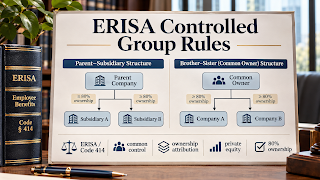
There are two alternate tests to
determine controlled group status under the Code and ERISA: (i) a
parent-subsidiary controlled group test; and (ii) a brother-sister controlled
group test.
Applicability
of Controlled Group Rules
It is often incorrectly assumed that
the ERISA controlled group rules are only applicable for purposes of ERISA
Title IV (defined benefit plan) liability; but, in fact, controlled group rules
are also relevant in a host of contexts (some affecting defined contribution
plans or nonqualified plans as well).
Controlled group rules
under ERISA and related laws apply for: (i) Title IV pension termination
liability under ERISA § 4062(a); (ii) ERISA § 4069(a) (transaction with a
principal purpose to evade pension termination liability); (iii) PBGC premiums
under ERISA §§ 4006 & 4007 (§ 4007(e)(2)); (iv) minimum funding obligations
under Code § 412 (§ 412(c)(11)(B)); (v) Code § 4971 excise tax for failure to
meet minimum funding (§ 4971(e)(2)); (vi) PBGC lien for unpaid contributions
exceeding $1 million (ERISA § 303(k)); (vii) single employer plan distress
termination where all members of the controlled group must be in financial
distress under ERISA § 4041; (viii) multiemployer pension plan withdrawal
liability (ERISA §§ 4201(a) & 4001(b)(1)); (ix) Code § 404(a) limits on
deductions (Code § 404(a) & (g)); (x) qualified plan nondiscrimination
rules, primarily with respect to the minimum coverage tests under Code § 410(b),
the defined benefit plan minimum participation tests under Code § 401(a)(26),
the general test for contributions and benefits under Code § 401(a)(4)
regulations, the benefits, rights and features under Treas. Reg. § 1.401(a)(4)-4
and certain other nondiscrimination and
qualification rules that could be affected by a controlled group affiliate (Code
§§ 414(b) & (c)); (xi) simplified employee pension nondiscrimination
test under Code § 408(k)(3); (xii) Code § 409A limitations on
nonqualified deferred compensation plans (for purposes of the definition of
service recipient, the determination of when a separation from service occurs, plan
aggregation rules, and the six-month delay for specified employees of public
companies) (Code § 409A(d)(6)); (xiii) COBRA continuation coverage (ERISA § 607(4);
Code § 414(t)); (xiv) cafeteria plan nondiscrimination tests
of Code § 125, self-insured medical reimbursement nondiscrimination test of Code § 105(h),
and certain fringe benefit nondiscrimination tests in Code
§ 132 (Code §§ 414(t), 105(h)(8) & 125(g)(4)); and (xv) Affordable Care Act
mandated coverage rules for employers with 50 or more employees on a controlled
group basis, to provide affordable healthcare benefits or pay certain penalties
under Code § 4980H(a) & (b).[1]
The WARN Act also has inter-corporate liability if companies are so intertwined
in their affairs that they appear separate but are actually part of a single
enterprise (caselaw interpreting 29 U.S.C. § 2101(a)(1)).[2]
ERISA
controlled group rules would NOT apply to, e.g., (i) prohibited transactions, (ii)
other excise taxes, (iii) consequences of plan disqualification, [3]
(iv) Title I reporting and disclosure obligations, or (v) contractual
liabilities for promised benefits, etc.
Parent-Subsidiary
Controlled Group Test
Parent-subsidiary
test. A parent-subsidiary controlled group will exist if there is a chain
of entities conducting trades or businesses that are connected through a ”controlling
interest” with a common parent, with controlling interest defined: (i) in the
case of corporation as at least 80% of the total combined voting power of all
classes entitled to vote OR at least 80% of the total value of all shares of
the subsidiary; (ii) in the case of a trust or estate an 80% actuarial interest
in the trust or estate; (iii) in the case of a partnership (or other entity
taxed as a partnership) an 80% interest in profits OR capital of the
partnership; and (iv) in the case of a sole proprietorship 100% ownership of
the trade or business. Code § 1563(a)(1) referenced by Code § 414(b); Treas.
Reg. § 1.414(c)-2(b)(2).
Voting power. Voting power under
Code §§ 414(b) & 1563(a)(1) means the power to control the corporation’s
business through the election of the board of directors, as illustrated in various
cases and rulings.[4]
Parent-child controlled group not
applicable if individual owns the other entities, but there is no entity that
owns the other entities. Parent-child controlled group would not apply if
an individual (not a trade or business) owns the other entities. If an
individual owns individually 80% in several entities, but there is no entity
that owns the other entities, and it’s not the individual’s trade or business
that owns the other entities but rather the individual. However, the
brother-sister controlled group, discussed below, would likely pull the
entities owned by the individual into a single controlled group.
Section 415 50% Standard. For purposes of the Code § 415 limitations on
qualified plan benefits and contributions, the controlling interest for
purposes of the parent-subsidiary test is reduced from 80% to 50%. Code § 415(h);
Treas. Reg. § 1.415(a)-1(f).
Examples of parent-subsidiary
control groups
Parent-subsidiary example 1: Partnership
A owns stock having 80% of the total combined voting power of all classes of
stock entitled to vote of Corporation B. Partnership A also owns 80% of the
profits interest in Partnership C. Partnership A is the common parent of a
parent-subsidiary controlled group of trades or businesses consisting of
Partnership A, Corporation B, and Partnership C. See Treas. Reg. § 1.414(c)-2(e)
Ex. 1. See also, Treas. Reg. § 1.1563-l(a)(2)(ii) Ex. 1 & 2.
Parent-subsidiary example 2: Corporation
A owns 80% of the only class of stock Corporation S1 and of Corporation S2.
Corporations S1 and S2 each own 40% of the only class of stock of Corporation
S3. Corporation A is the common parent of a parent-subsidiary controlled
group consisting of corporations A, S1, S2 and S3 (with the indirect 40%
ownership interests of Corporation S3 combined). See diagram below. See also, Treas.
Reg. § 1.414(c)-2(e) Ex. 2, and Treas. Reg. § 1.1563-l(a)(2)(ii) Ex. 3.
Exclusion of certain remaining ownership
interests in parent-subsidiary test for 50% owned entities. Certain
ownership interests are excluded in determining the parent-subsidiary
controlled group. Specifically, if the parent owns (a) 50% or more of the vote
or value of subsidiary corporation, (b) 50% or more of the actuarial interest
of subsidiary trust or (c) 50% or more of the profits or capital of subsidiary
partnership, then any remaining ownership interest in the subsidiary will be
ignored if the remaining interest is held by (i) principal owner, officers,
partners or fiduciaries of the parent, (ii) employees of the subsidiary if
subject to a “put” to employer on termination of employment or other
substantial restriction, (iii) a trust which is part of a deferred compensation plan of foreign
affiliates or (iv) controlled tax-exempt organizations. Ignoring the remaining
ownership interest will have the effect of increasing the parent’s ownership
interest in the entity, and if the increased ownership interest is 80% or more
of the entity, it could bring the parent and subsidiary entity it into a
parent-subsidiary controlled group. Code § 1563(c)(2)(A); Treas. Reg. § 1.414(c)-3(b).
Brother Sister Controlled Group Test
Brother-sister
test. A brother-sister controlled group exists where there are two or more
trades or businesses which meet two tests: (i) the same five or fewer persons
who are individuals, estates or trusts[5]
commonly own together 80% or more of “control,” as defined above, in each of
the entities; and (ii) these five or fewer individuals, estates or trusts also
own together 50% or more of the “identical” ownership (effective control) in
the entities, with identical ownership meaning that ownership is taken into
account only to the extent it is identical with respect to each of the entities
(i.e., one looks only at the lowest percentage ownership in any of the common
entities and count only that lowest percentage ownership). Code § 1563(a)(2);
Treas. Reg. § 1.414(c)-2(c).
Thus,
the brother-sister test includes an 80% common (combined) control component and
a 50% identical ownership component. Under the identical ownership component, if corporations X, Y and Z are partially
owned by individual A with a 20%, 30% and 40% interest, respectively, the
identical ownership interest that is counted for individual A is only 20%.
Example of brother-sister test. Record
the ownership percentage of each person in the group across all companies. Determine
each person’s lowest ownership percentage across all of the
companies (the identical ownership).
|
Individuals |
Company A |
Company B |
Identical Ownership |
|
Alex |
40% |
50% |
40% |
|
Ben |
50% |
30% |
30% |
|
Total |
90% (common |
80% (common |
70% (identical ownership exceeds 50%) |
Company
A and B are in a brother-sister controlled group since (1) five or fewer
individuals commonly own at least 80% of each of the entities (in the above
example Company A is commonly owned 90% by Alex and Ben, and Company B is
commonly owned 80% by Alex and Ben, both of which equal or exceed 80%); and (2)
when adding up identical ownership in each entity, i.e., the lowest percentage ownership
by each individual in each company, the identical ownership exceeds 50% (in the
above example Alex’s identical ownership in both companies A & B is 40% and
Ben’s identical ownership in both companies A & B is 30%, thus yielding
identical ownership by Alex and Ben of 70% of both companies, which exceeds
50%). See diagram below. See also, examples in Treas. Reg. § 1.414(c)-2(e) Ex.
4 and Treas. Reg. § 1.1563-l(a)(3)(iii) Ex. 1.
Brother-sister test excludes
stock ownership of individuals who do not hold an interest in each of the
entities under Vogel Rule. Under the Supreme Court case of U.S. v. Vogel
Fertilizer Company, 455 U.S. 16 (1982), stock ownership of individuals who do
not hold an interest in all of the entities is disregarded even for the 80% component of the brother-sister test. The
Court in Vogel found that the statutory term “brother-sister
controlled group” connotes a close horizontal relation between the
corporations, suggesting the same persons must satisfy the 80% ownership
requirement for each corporation. Analyzing the structure of the statute, the
Court noted that “five or fewer persons” is the conjunctive subject
for both the 80% test and the 50% test. This structural parallel led the Court
to deduce that the 80% test must also require common ownership among the
shareholders used for the 50% test. The Court invalidated prior Treas. Reg. §
1.1563-1(a)(3), rejecting its “singly or in combination” language.
The Court highlighted that the Treasury Department’s representations before
Congress explicitly included a common ownership requirement in the 80% test,
making the “singly or in combination” language of those regulation
contradictory to those initial proposals. This Vogel clarification has
been incorporated into the more recent version of Treas. Reg. § 1.1563-1(a)(3),
which provides in § 1.1563-1(a)(3)(ii)(C) that the five or fewer persons whose stock
ownership is considered for purposes of the 80% requirement must be the same persons whose stock ownership is considered for purposes of the more-than-50%
identical ownership requirement.
Example of application of Vogel
Rule. For example, if the above example were expanded to include a third shareholder,
Cathy, with a 20% interest in Company B but a 0% ownership in Company A, and
other changes as shown below, we exclude Cathy’s ownership in both companies,
even in Company B, since she does not have any ownership in Company A, and without
counting Cathy’s 20% interest in Co. B, there is not common (combined) control
of 80% or more in Company B, and therefore the brother-sister test for companies
A and B is not met.
|
Individuals |
Company A |
Company B |
Identical Ownership |
|
Alex |
70% |
70% |
70% |
|
Ben |
30%[not counted under Vogel] |
0% |
0% |
|
Cathy |
0% |
30% |
0% |
|
Total |
70% (not including 30% of Ben since he does not have any |
70% (not including 30% of Cathy under “Vogel” since she |
70% |
The regulations as amended in Treas. Reg. § 1.414(c)-2(c)(1),
53 Fed. Reg. 6603 (March 2, 1988) provide, incorporating Vogel: “The term ‘brother-sister
group of trades or businesses under common control’ means two or more
organizations conducting trades or businesses if (i) the same five or fewer
persons who are individuals, estates, or trusts own (directly and with the
application of § 1.414(c)-4) a controlling interest [80% or more] in each
organization, and (ii) taking into account the ownership of each such person
only to the extent such ownership is identical with respect to each such
organization, such persons are in effective control [more than 50%] of each
organization. The five or fewer persons whose ownership is considered for
purposes of the controlling interest requirement for each organization must be
the same persons whose ownership is considered for purposes of the effective
control requirement.”
Note that if Cathy was married to Alex, and ownership
takes into account spousal ownership under Treas. Reg. § 1.414(c)-4(c), Alex
may be deemed to own Cathy’s interest in Company B, but if Cathy had no
interest, employment, management or restriction on sale role in Company B and
Company B majority passive investments, Cathy’s ownership would not be
attributed to Alex. Also, since Cathy has no interest in Company A, there would
not be 80% common ownership in Company A, and therefore Companies A and B would
not be brother-sister entities.
Exclusion of certain remaining
ownership interests in brother-sister test for 50% owned entities
Certain
ownership interests are excluded in determining brother-sister controlled
group. Specifically, if five or fewer persons own 50% or more of an entity, the
remaining ownership is ignored if held by (i) a qualified plan, (ii) employees
of the entity if it is subject to substantial conditions (e.g., an asymmetrical
right of first refusal), or (iii) controlled exempt organizations.
Combined Controlled
Group Rule
Combined Controlled Group. There
is also a combined group test under which a group of three or more
organizations consists of at least one parent-subsidiary group, the parent of
which is a member of a brother-sister group. Code § 1563(a)(2); Treas. Reg. § 1.414(c)-2(d).[6]
Example of combined controlled
group. For example, Walter, an individual, owns a controlling interest in
Partnership X and Partnership Y, and Partnerships X and Y together meet the
requirements for the brother-sister controlled group. Partnership X also owns a
controlling interest in Company Z meeting the requirements for the
parent-subsidiary controlled group. Since Partnership X is the parent of a
parent-subsidiary controlled group and is also a member of a brother-sister
controlled group, Partnership X, Partnership Y and Company Z are members of the
same combined controlled group. See Treas. Reg. § 1.414(c)-2(e) Ex. 8.
Other
Issues Relating to Controlled Group Rules
Treasury stock and nonvoting
preferred stock disregarded. In determining control for the
parent-subsidiary or brother-sister controlled group tests, stock does not
include treasury stock or nonvoting preferred stock. Code § 1563(c)(1)(A);
Treas. Reg. § 1.414(c)-3(a). Thus, stock does not include (i) treasury stock reacquired
and held by the company, or (ii) nonvoting stock that is limited and preferred
as to dividends.[7]
Controlled group for tax-exempt
organizations. In testing common control for tax-exempt organizations
(where there is no ownership control), 2007 regulations provide that common
control exists between tax-exempt organizations if at least 80% of the
directors or trustees of one organization are either representative of, or
directly or indirectly controlled by the other organization. Treas. Reg. § 1.414(c)-5(b),
72 Fed. Reg. 41128 (July 22, 2007) (revised § 403(b) regulations).[8]
Anti-Abuse rule in regulations. There
is also an anti-abuse provision in the regulations for in the section dealing
with tax-exempt organizations, but which would apply to other abuses in the
controlled group area.[9]
Bankruptcy.
On occasion courts have disregarded stock ownership in a bankruptcy context
where there was no actual ownership.[10]
2. Controlled
Group Attribution Rules for Option Holders, 5% Owners and Family Members
Attribution
Rules for Option Holders. Constructive ownership in an entity can exist if
there is an option to acquire a controlling interest of the entity. Code § 1563(e)(1);
Treas. Reg. § 1.414(c)-4(b)(1).[11]
Courts split on whether option
attribution rules can be used to diminish other shareholders’ interests. Courts
are divided on the issue of whether the option attribution rule can be used to
diminish other shareholder interests. Some courts and the PBGC hold that option
attribution can be used to dilute other shareholder interests.[12] Other
courts have taken the view that the option attribution rule may only be used to
increase ownership of the optionee but not to dilute ownership of other
shareholders.[13]
Attribution
rules for 5% owners. For purposes of the parent-subsidiary and
brother-sister tests, the following ownership attribution rules apply to
corporations, partnerships and estates and trusts: If an individual owns 5% or
more of an entity, the individual is deemed to own a proportionate part of any
interests owned by that entity. Code § 1563(e)(2), (3) & (4) and Treas.
Reg. § 1.414(c)-4(b)(2), (3) & (4).[14]
Spousal attribution rules and SECURE 2.0 Changes. For purposes of the
parent-subsidiary and brother-sister tests, the following family attribution
rules apply: an individual is deemed to own the interest in an entity that his
or her spouse owns, provided that they are not divorced or legally separated.
However, the spousal attribution rule does not apply where all of the
following conditions are met: (i) the individual does not actually own any
interest of the entity in which the spouse has an interest (hereinafter
referred to as “such entity”), (ii) the individual is not a director or
employee of such entity, (iii) the individual does not participate in the
management of such entity, (iv) not more than 50% of such entity’s income is
derived from passive sources (such as royalties, rents, dividends, interest and
annuities), and (v) the spouse’s ownership in such entity is not subject to conditions
which substantially restrict or limit the spouse’s right to dispose of such interest
and which run in favor of the individual (or his or her minor children). Code
§ 1563(e)(5); Treas. Reg. § 1.414(c)-4(b)(5). Amendments
made by the SECURE 2.0 Act of 2022 § 315 adding Code § 414(b)(2)(A), effective
for plan years beginning
after December 31, 2023, provide that where the individual and his
or her spouse reside in community property states, the community property laws
can be disregarded for purposes of the § 414(b) controlled-group rules.[15]
Minor child attribution rules and
SECURE 2.0 Changes. An individual is deemed to own stock owned by his
children under age 21. Code § 1563(e)(6); Treas. Reg. § 1.414(c)-4(b)(5). However, as provided by the SECURE 2.0 Act of 2022 § 315
adding Code § 414(b)(2)(B) & (C), effective for plan years beginning after
December 31, 2023, despite the normal attribution of ownership to a minor
child, a business owned by one parent and a business owned by the other parent (not
subject to spousal attribution, e.g., by reason of legal separation or divorce
or other reason) will not be considered to be in the same controlled group
solely by reason of attribution to the minor child.[16]
Parent/child attribution rules.
If an individual owns more than 50% of an entity, he or she is deemed to own
any interests owned in that entity by his adult children, grandchildren,
parents and grandparents. Code § 1563(e)(6)(B); Treas. Reg. § 1.414(c)-4(b)(6)(ii). There is no attribution rule for siblings.
3. Controlled Group Liability
Issues re Individual Owners with an Unincorporated Trade or Business
Individual
owners are generally not liable for a corporation’s ERISA liability. Generally,
an individual owner or shareholder of a corporation are not liable for the
corporation’s multiemployer withdrawal liability or single employer termination
liability under the controlled group rules.[17]
Piercing Corporate Veil. One
exception to the above rule, though, would be where the doctrine of piercing
the corporate veil (alter ego) is applicable, for example, where there is
fraud, disregard by the owner of the separate character of the corporation or
shareholders undercapitalize the corporation.[18]
Liability
of owner if owner engages in an unincorporated trade or business. Another important exception – where an individual
owner (or shareholder if meeting a controlled group test) of a corporation
could be held liable for the corporation’s ERISA termination or withdrawal liability
– would be where the owner also engages in a trade or business as a sole
proprietor (or partnership) and the unincorporated trade or business could make
the owner individually liable for the corporation’s termination or withdrawal liability.[19]
Trade or Business. Neither
ERISA nor the Treasury regulations define “trade or business.” Courts have
generally adopted the standard articulated in the1987 Supreme Court case of
C.I.R. v. Groetzinger, where the Court held that in the context of Code § 162, to
be engaged in a trade or business, the taxpayer must be involved in the
activity with continuity and regularity and that the taxpayer’s primary purpose
for engaging in the activity must be for income or profit; sporadic activity, a
hobby, or an amusement diversion does not qualify.[20]
Several cases have applied Groetzinger in the ERISA context.[21]
Personal liability by reason of
having unincorporated home business activity. A number of courts have found
shareholders liable by reason of some business activity they engaged in as a
sole proprietor, trust or partnership.[22]
See below regarding private equity funds that engage only in passive investing.
4. Controlled Group Liability Issues re Portfolio
Companies of Multiple Private Equity Owners
Whether
private equity funds are a trade or business. As discussed further in this
section, only “trades or business” under common control are treated as part of
an ERISA controlled group. As discussed above, under the Groetzinger standard,
to be engaged in a trade or business, the individual must be involved in the
activity with continuity and regularity and that the taxpayer’s primary purpose
for engaging in the activity must be for income or profit; but sporadic
activity, a hobby, or an amusement diversion do not qualify.[23]
With regard to private equity funds, historically, practitioners had generally taken
the view that since they are generally passive investment vehicles with no
employees and minimal involvement in day-to-day operations, they are not trades
or businesses, and therefore separate portfolio companies owned by a private
equity fund would not be in the same ERISA controlled group. However, the PBGC in
a 2007 PBGC Appeals Board Opinion stated that a private equity fund that owned
80% or more of the portfolio company was a trade or business, because it was
engaged in an activity with the primary purpose of income or profit and
conducted business through an agent (the general partner) who managed fund
investments on a regular basis.[24]
According to this ruling, 80%-owned portfolio companies of a private equity
fund would generally be in the same ERISA controlled group, and only in the
unusual case where the facts and circumstances indicate that the private equity
fund does not meet the Groetzinger standard for a trade or business, it would not
be a controlled group.[25]
Investment plus, e.g., investment
advisory and management services. A 2010 Eastern District of Michigan case,
Board of Trustees, Sheet Metal Workers
National Pension Fund v. Palladium Equity Partners, found the 2007 PBGC
Appeals Board Opinion to be persuasive and “investment plus” is a trade or
business. However, since there was more than one private equity investment
funds and neither owned 80% of the portfolio company alone, there was still a
genuine issue of material fact as to whether the three funds constituted a
partnership or joint venture in fact.[26]
A more recent August 2025 Western District of Missouri case found liability on
the part of limited partnership investor in bankrupt companies, which had triggered
withdrawal liability, since the limited partnership investor was more than a
passive investor, since it actively managed the portfolio companies
(investment-plus).[27]
Partnership-in-fact. Regarding
when multiple funds constitute a partnership in fact, Luna v.
Commissioner, 42 T.C. 1067 (1964) established eight factors to consider: (i)
the agreement of the parties and their conduct in executing its terms; (ii) the
contributions, if any, which each party has made to the venture; (iii) the
parties’ control over income and capital and the right of each to make
withdrawals; (iv) whether each party was a principal and coproprietor, sharing
a mutual proprietary interest in the net profits or losses, or whether one
party was the agent or employee of the other, receiving for his services
contingent compensation in the form of a percentage of income; (v) whether
business was conducted in the joint names of the parties; (vi) whether the
parties filed Federal partnership returns or otherwise represented that they
were joint venturers; and (vii) whether separate books of account were
maintained for the venture; and (viii) whether the parties exercised mutual
control over and assumed mutual responsibilities for the enterprise.[28]
2013 Sun Capital case. A 2013
First Circuit case, Sun Capital Partners
III, LP v. New England Teamsters & Trucking Industry Pension Fund,
found the PBGC Appeals Board Opinion to be persuasive, and confirmed that
private equity funds will be engaged in a trade or business for ERISA
controlled group purposes if there is “an investment plus” by the
fund, e.g., by reason of active involvement in management (as well as control)
of the portfolio companies; but there was still an issue of material fact as to
whether the funds would be considered a partnership-in-fact.[29]
2016 Sun Capital district court case.
A later district court case of Sun Capital Partners held that (i) both funds
(the Sun Fund IV with a 70% investment and Sun Fund III with a 30% investment)
were trades or businesses, and (ii) there was common control under ERISA by
reason of Fund III and IV being a “partnership in fact.”[30]
Reversal by First Circuit in 2019
Sun Capital Case. The First Circuit overturned this decision, however, in
Sun Capital Partners III, LP v. New England Teamsters & Trucking Industry
Pension Fund, 943 F.3d 49 (1st Cir. 2019), cert. denied, 141 S. Ct. 372 (2020),
holding that there was not a partnership in fact because the fund documents did
not state that they were a partnership, the funds had different investors, the
funds filed separate tax returns and the funds did not always make parallel
investments.[31]
Multiple fund structure. Private
equity funds have often structured investment through multiple funds in part to
keep ownership below 80%, and avoid ERISA controlled group liability, but there
is still some uncertainty on the safety of relying on that structure because
they may be trades or business and there may be a partnership-in-fact (although
the 2019 First Circuit Sun Capital Partners case gives some comfort in that
regard).[32]
Affiliated
Service Group Rules
Under Code § 414(m), employees of certain
entities that are part of an “affiliated service group” are also treated as
employed by a single employer, for purposes of nondiscriminatory coverage
testing and other qualified plan rules under the Code (but not for liability
under Title IV of ERISA). The affiliated service group rules will be discussed
in a separate article.
[1]
Regarding
Code §4980H guidance about controlled group, see definition of “applicable
large employer” in Treas. Reg. §54.4980H-1(a)(16) (entity treated as a single “applicable
large employer” with 50 FTEs under Code §§ 414(b), (c), (m) & (o)),
examples in §54.4980H-2(d) (where entities are treated as a single applicable
large employer) and Notice 2011-36 (all entities under Code §§ 414(b), (c) or
(m) are to taken into account in determining whether there is an applicable
large employer with 50 FTE employees)
When
conducting due diligence about a company, it is important to examine not only
if the company has or participates in Title IV plans, but also if any
controlled group members may have or participate in such plans.
[2] Administaff Companies., Inc. v. New York Joint Board, Shirt &
Leisurewear Division, 337 F.3d 454, 457–58 (5th Cir. 2003); Pearson v. Component
Tech. Corp., 247 F.3d 471, 477 (3d Cir. 2001); Adams v. Erwin Weller Co., 87
F.3d 269, 271 (8th Cir. 1996); Chauffeurs, Sales Drivers, Warehousemen &
Helpers Union Local 572 v. Weslock Corp., 66 F.3d 241, 245 (9th Cir. 1995).
[3]
However, because the applicable sections relate to qualification of a
retirement plan, failure to recognize the common or related ownership with the
retirement plan sponsor and other corporations or businesses could result in
disqualification of the plan from inception or in operation.
[4] Voting power under Internal Revenue
Code §§ 414(b) & 1563(a)(1) and analogizing to Code § 1504 re 80% or 50% of
the total combined voting power of all classes entitled to vote – means the
power to control the corporation’s business through the election of the board
of directors, as illustrated in numerous Federal case decisions. See,
e.g., Yaffe Iron & Metal Corp. v. U.S., 78-1 U.S. Tax Cas. (CCH) ¶9314, 41
A.F.T.R.2d 78-1057 (W.D. Ark. 1978), affirmed, 593 F.2d 832 (8th Cir. 1979),
cert. denied, 444 U.S. 843 (with regard to the § 1563 requirement of 80%
control as part of brother-sister test, Tax Court held that a stockholder’s
voting agreement is relevant where the effect of an agreement is to vest to two
individuals with over 80% of the combined voting power of all classes of stock;
Eighth Circuit affirmed and cert. was denied); Central States, Southeast and
Southwest Areas Pension Fund v. CLP Venture LLC, 760 F.3d 745 (7th Cir. 2014),
cert. denied, 135 S. Ct. 964 (2015) (in a case involving multiemployer plan
withdrawal liability, even though a common owner of two corporations owned only
73% of one of the corporations (rather than 80%), the court took into account
an escrow agreement which gave the individual the right to direct voting of the
remaining 27% of the stock and concluded that there was an ERISA controlled
group for purposes of determining withdrawal liability); Erie Lighting Co. v.
C.I.R., 93 F.2d 883, 885 (1st Cir. 1937); Rev. Rul. 69-126, 1969-1 C.B. 218
(participation in management of subsidiary through election of board is
criterion of voting power; upheld by numerous rulings to non-section 1504
cases, e.g., PLR 8128073, PLR 8221112, PLR 7406211920A and GCM 35789); Alumax
Inc. v. C.I.R., 165 F.3d 822 (11th Cir. 1999) (where 50% shareholder had right
to four votes per share including right to elect board members, but for supermajority
matters such as major corporate transactions the 50% shareholder only had one
vote per share, and the board members elected by 50% shareholder likewise had
limits on voting on supermajority corporate transaction issues and were limited
by other directors’ power to delay their actions, the 50% shareholder did not
have requisite 80% voting control for purposes of consolidated returns under Code
§ 1504); Hermes Consol., Inc. v. U.S., 14 Cl. Ct. 398 (1988) (with regard to
Code § 269 voting power is determined not merely by record ownership but by the
ability to approve or disapprove of fundamental changes in the corporate
structure and the ability to elect the corporation’s board of directors).
[5]
This would exclude ownership by partnership or corporations.
[6] The term combined group means any
group of three or more organizations, if (i) each such organization is a member
of either a parent-subsidiary group or a brother-sister group, and (ii) at
least one such organization is the common parent organization of a
parent-subsidiary group and is also a member of a brother-sister group. Treas.
Reg. § 1.414(c)-2(d).
[7]
With regard to “convertible” preferred stock, see Rev. Rul. 71-83, 1971-1 C.B.
268, which held that for purposes of Code § 1504 (which until 1984 was worded
exactly as § 1563), nonvoting preferred stock that is convertible into voting
common stock is still considered “nonvoting stock that is limited and preferred
as to dividends” since at the time the test is made it is still nonvoting, and
therefore should not be counted for the affiliated group rules. However, it is
possible that for purposes of the Code §§ 414 & 1563 controlled group tests, since even stock
options are considered stock under the option attribution rules, convertible
preferred should also be included. See, Williams, “Multiple Corporations,” 55
Tax Management Portfolio § IV.A. On the other hand, the option attribution rule
only applies with respect to options for outstanding stock, which is different
than convertible preferred stock.
[8] A
trustee or director is treated as a representative of another organization if
that person is a trustee, director, agent or employee of the other
organization. Treas. Reg. § 1.414(c)-5(b). A trustee or director is controlled
by another organization if the other organization has the power to remove the
trustee or director and designate a new trustee or director. Id. Whether there
is the power to remove the trustee or director is a facts and circumstances
determination.
[9]
Treas. Reg. § 1.414(c)-5(f) (“If the Commissioner determines that the
principal purpose of a transaction is to avoid the application of section
414(b) or (c), the Commissioner may treat the organizations involved in the
transaction as if the transaction had not occurred, or may otherwise disregard
the transaction or the ownership interests created by the transaction, and may
treat the organizations as members of the same controlled group or as separate
employers, whatever is appropriate to carry out the purposes of section 414(b)
and (c)).
[10] In
re Challenge Stamping and Porcelain Co., 719 F.2d 146 (6th Cir. 1983) (where
company bought parent of sponsor of pension plan while sponsor was in Chapter
11 reorganization, but bankruptcy court then auctioned off sponsor rendering
stock of parent of sponsor worthless, buyer of parent of sponsor was not liable
for controlled group termination liability since owning 100% of parent of
sponsor was meaningless since even at that time bankruptcy court had full
control of sponsor). See similarly, PBGC v. Ouimet Corp., 711 F.2d 1085 (1st
Cir.1983), cert. denied 464 U.S. 961 (1983) (where subsidiary went bankrupt and
terminated underfunded plan after acquisition by controlled group that included
another bankrupt subsidiary, termination liability was allocated only to the
solvent group members, and not bankrupt corporations’ estates, since applying
the bankrupt’s assets to PBGC’s liability would have reduced assets available
to their creditors and inequitably benefited group members; court noted that
ERISA provides a lien on 30% of the net worth, not asset value and a bankrupt
corporation has negative net worth). See also, Sutherland v. C.I.R., 78 T.C.
395 (1982) nonacq. 1986-2 C.B. 1, 1986 WL 713548 (Tax Court has held that businesses
which are unsuccessful and are ceasing to conduct operations are not required
to be included under the Code § 414(b) or (c) test, since to do so would be to
require the inclusion of an employer which will, in effect, be maintaining an
impermanent plan since it will soon be going out of business).
See, however, Pension Benefit
Guaranty Corp. v. East Dayton Tool and Die Co., 14 F.3d 1122 (6th Cir. 1994),
cert. denied 513 U.S. 816 (PBGC sought enforcement that a holding company, the
parent of a sponsoring employer in bankruptcy was responsible for unfunded
benefit liabilities of employer’s pension plan; the court held that 80% control
rule applied, even though holding company did not control voting rights of its
stock in employer; Challenge Stamping, cited above, which held that in a
bankruptcy case the stock purchaser never had actual control over the bankrupt
employer that sponsored the pension plan for termination liability was
different that this case, because here the holding company actually controlled
the employer and its Plan for 2-1/2 years).
[11] Code
§ 1563(e)(1), made applicable by § 1563(d)(1)(B) (if any person has an option
to acquire stock, such stock shall be considered as owned by such person);
Treas. Reg. § 1.414(c)-4(b)(1) (if a person has an option to acquire any
outstanding interest in an organization, such interest shall be considered as
owned by such person). An option to
acquire such an option will also be considered as an option to acquire such
stock or interest. Id.
If the option to acquire stock is
subject to contingencies, there would generally be no attribution. Central
Transport, Inc. v. Central States, Southeast and Southwest Area Pension Fund,
640 F. Supp. 56 (E.D. Tenn. 1986), affirmed, 8 EBC 2519, 1987 WL 36010 (6th
Cir. 1987; unpublished), cert. denied 484 U.S. 926 (1989) (no withdrawal
liability under ERISA § 4201 since stock purchase agreement made conditional on
federal approval was not an option under § 1563(e)(1) since it was contingent
on federal approval and purchaser had no control over contingency, and
therefore company was not in controlled group under rules of § 414(c) and §
1563). However, if the option is exercisable only after a period of time
without any conditions, there would be option attribution. Rev. Rul. 89-64,
1989-1 C.B. 91 (where an option distributed by a company to an officer in
redemption of the officer’s stock was only exercisable only after the lapse of
a fixed period of time, it is still subject to option attribution under Code § 318(a)(4)).
There are several cases that
specifically apply the option attribution rule in an ERISA context (all dealing
with multiemployer withdrawal liability). Tri-State Rubber & Equipment,
Inc. v. Central States Southeast & Southwest Areas Pension Fund, 677 F.
Supp. 516 (E.D. Mich. 1987) (seven companies controlled by an individual are
under common control under § 414(c) and have withdrawal liability under ERISA §
4201; person who had option to purchase stock was constructive owner of such
stock under § 1563(c)(1)); IUE AFL-CIO Pension Fund v. Barker & Williamson,
Inc., 788 F.2d 118 (3d Cir.1986) (withdrawal liability exists under § 4201
where parent owns 75% of stock of subsidiary since option to purchase remaining
25% falls within option attribution rule of § 1563(e)(1)); Chicago Truck
Drivers, Helpers and Warehouse Workers Union (Independent) Pension Fund v.
Brotherhood Labor Leasing, 950 F. Supp. 1454 (E.D. Mo. 1996), denial of
reconsideration, 950 F.Supp.1454 (where there was purchase agreement for
immediate acquisition of withdrawing company (Be-Mac) by shareholders of
defendant companies, this was enough to cause Be-Mac to be in controlled group
under option rule, even if a court had later invalidated the sale, since there
were no contingencies in purchase agreement); Teamsters Pension Trust Fund of
Philadelphia v. Brigadier Leasing Associates, 880 F. Supp. 388 (E.D. Pa. 1995)
(unsigned draft agreement which gave withdrawing employer’s CFO an option to
purchase the other owner’s interest in the corporation did not establish
existing of a binding agreement, and therefore other entities owned by CFO were
not in controlled group); New York State Teamsters Conference Pension and
Retirement Fund v. Express Services, Inc., 426 F.3d 640 (2d Cir. 2005) right of
first refusal held by principals of former participating employer in
multiemployer pension plan with respect to possible affiliates did not
establish constructive ownership over purported affiliates; although statute
defining constructive ownership includes an option to acquire stock, a “right
of first refusal” was not same thing as stock option and statute made no
reference to rights of first refusal).
[12] For
the view that the option attribution rule can be used to diminish other
shareholder interests, see, Sorem v. C.I.R., 334 F.2d 275 (10th Cir. 1964) (in
determining whether a redemption was substantially disproportionate there must
be included the total unissued stock on which other shareholders have stock
options under § 318(a)(4)); Henry T. Patterson Trust by Reeves Banking &
Trust Co. v. U.S., 729 F.2d 1089 (6th Cir. 1984) (unissued stock which minority
shareholders have an option to acquire must be treated as outstanding under §
318(a)(4), which thereby increases the denominator and allows the redemption to
be not essentially equivalent to a dividend, thus benefiting the majority
shareholder in allowing him capital gain rather than dividend treatment); Rev.
Rul. 89-64, 1989-1 CB 91 (stock must be
able to be acquired at the election of the shareholder if there exist no
contingencies with respect to such election; redeemed
shareholder’s option taken into account); Rev. Rul. 68-601, 1968-2 CB 124
(redeemed shareholder’s option, but not unrelated holder’s option are not
affected by redeemed shareholder’s option).
[13] For
the view that the option attribution rule cannot be used to dimmish other
shareholder interests, see, Northwestern Steel and Supply Co., Inc. v. C.I.R.,
60 T.C. 356 (1973) (unexercised stock option owned by minority shareholder
cannot reduce ownership percentage of 80% shareholder under § 1563(e)(1) for
purposes of surtax exemption; note that in this case the option was to acquire
the outstanding shares held by the majority shareholder, rather than an option
to acquire unissued shares); Rev. Rul. 68-601 (unrelated holder’s option not
taken into account).
[14] See
e.g., Paza Staffing Services, Inc. v. C.I.R., 751 Fed. Appx. 223 (3d Cir. 2018)
(Third Circuit upheld Tax Court decision that an ESOP was disqualified for
failing to cover non-highly compensated employees of a related corporation in
violation of Code § 410(b) minimum coverage rules an individual sold all of the
stock of his company Paza Staffing Services to a newly established ESOP in an
ESOP buyout; he then assigned all the employees to Golden Gate, a company he
owned, and then had Paza lease the five employees back from Golden Gate; even
though the stock of the corporation held by the ESOP was not technically a
member of the same controlled group, the court held that, as sole beneficiary
of the ESOP, the owner of Golden Gate was the constructive owner of Paza under
Code § 1563(d)(2) and (e)(3)(A), and therefore the two companies were members
of the same ERISA controlled group, and the employees of Golden Gate were
required to be covered by the ESOP in order to pass IRS nondiscrimination
minimum coverage requirements; therefore the ESOP was disqualified).
[15] These provisions in the SECURE 2.0
Act of 2022 (Division T of the Consolidated Appropriations Act, 2023) signed Dec.
29, 2022, were originally intended to be effective for plan years beginning on
or after December 29, 2022, but the IRS has delayed the effective date for the
controlled group changes in the SECURE 2.0 Act to plan years beginning after
December 31, 2023. The SECURE 2.0 Act also adds Code § 414(b)(3),
that to the extent changes made in new Code § 414(b)(2) result in changes to
the controlled group, the Code § 410(b)(6)(C) transition rule (which allows
disregarding changes until the end of the plan year following the plan year of
specific corporate events) applies until the end of the plan year following the
affected plan year.
[16] SECURE 2.0 Act of 2022 § 315 adding
Code § 414(b)(2)(B) & (C), with a delayed effective date to plan years beginning
after December 31, 2023. Specifically, stock or interests of entities held by
the parents that not attributed to the spouse under the spousal attribution
rules, will not be attributed solely as a result of minor child attribution. New
Code § 414(b)(2)(B). Likewise, stock or
interests of separate entities held by each of the parents that would be
attributed to a minor child by reason of minor child attribution, but is not
subject to spousal attribution, will not cause the entities to be in the same
controlled group solely because of the minor child attribution. New Code § 414(b)(2)(C).
[17]
Connors v. Coal America, Inc., 7 Employee Benefits Cas. (BNA) 1300 (D.D.C.
1986) (individual who was officer and shareholder of corporation is not liable
for multiemployer withdrawal liability where there was no allegation of a basis
for piercing the corporate veil); DeBreceni v. Graf Bros. Leasing, Inc., 828
F.2d 877 (1st Cir. 1987) (no multiemployer withdrawal liability on controlling
shareholders and officers); Debreceni v. Bru-Jell Leasing Corp., 710 F. Supp.
15 (D. Mass. 1989) (95% shareholder not individually liable for multiemployer
withdrawal liability); Scarbrough v. Perez, 870 F.2d 1079 (6th Cir.1989)
(indirect owner not liable for multiemployer withdrawal liability); Wilhelm v.
McAnn’s W. 48th Street Restaurant Corp., 34 EBC 1659, 2004 WL 2658066, 34 (N.D.
Ill. 2004) (a shareholder is not personally liable for multiemployer withdrawal
liability of corporation; even N.Y. law does not hold a shareholder jointly and
severally liable for post-dissolution debts of the corporation).
[18]
See, e.g., the following court cases piercing the corporate veil: Lowen v.
Tower Asset Management, Inc., 829 F.2d 1209 (2d Cir.1987) (pierced corporate
veil so as to hold shareholders jointly and severally liable with the
corporations for fiduciary breaches); Board of Trustees of Teamsters Local 863
Pension Fund v. Foodtown, Inc., 296 F.3d 164 (3d Cir. 2002) (summary judgment
to dismiss piercing corporate veil claim by multiemployer pension fund against
individual defendants not granted; noted that under N.J. law to pierce
corporate veil must show that: (i) the corporation is organized and operated as
a mere instrumentality of the other corporation and (ii) the dominant
corporation uses the subservient corporation to penetrate fraud, to accomplish
injustice or to circumvent the law; with factors to be considered including the
failure to observe corporate formalities and non-functioning of other officers
and directors); Reilly v. Reem Contracting Corp., 380 Fed. Appx. 16 (2d Cir.
2010; unpublished) (plumbing company alter-ego of contracting company and
liable for contributions to union benefit funds); Resilient Floor Covering Pension Fund v. M
& M Installation, Inc., 630 F.3d 848 (9th Cir. 2010) (non-union company may
be liable for withdrawal liability of union company where there was a
commonality between union and non-union firms and an abuse of the union/non-union
structure to avoid payment of withdrawal liability); Trustees of Operating
Engineers Local 324 Pension Fund v. Bourdow Contracting, Inc., 919 F.3d 368
(6th Cir. 2019) (a newly-formed LLC was held to be alter ego of a bankrupt
company that was a signatory to a collective bargaining agreement and was
liable to the union’s pension fund).
See, however, the following court
cases which did not pierce the corporate veil: Reich v. Compton, 57 F.3d 270
(3d Cir.1995) (refusing to impose liability for prohibited transaction on alter
ego of party in interest under federal common law of ERISA); United Union of
Roofers, Waterproofers, and Allied Workers Local No. 210, AFL-CIO v. A.W.
Farrell & Son, Inc., 547 Fed. Appx. 17 (2d Cir. 2013) (the Second Circuit
held that two businesses that were affiliated and owned by different family
members but were not members of the same controlled group should not be treated
as a single employer for purposes of joint withdrawal liability from a
multiemployer pension plan; the court considered the following factors in
making its determination: (i) interrelation of operations, (ii) management,
(iii) centralized control of labor relations, (iv) common ownership, (v) the
use of common office facilities and equipment, and (vi) family connections
between and among the various enterprises).
[19]
When TWA entered bankruptcy with two pension plans underfunded by $1.2 billion,
the PBGC threatened to pursue Carl Icahn, the 80% shareholder of TWA and his
other corporations. Carl Icahn reached an agreement with the PBGC to make loans
and guarantees to the plans to keep them operating. See, N.Y. Times, Dec. 8,
1992, p. D-5. Also, in 2006, in
connection with the bankruptcy of one of the plants of R.G. Steel, which had a
$100 million underfunded pension plan, the PBGC filed a lawsuit against the
parent, Renco Group seeking to a lien on its assets as well as on the Hamptons
estate of Renco Group’s founder, and the PBGC settled with the Renco Group
after it agreed to continue to be liable for the underfunded plan and
contribute $20 million to it. NY Times, April 1, 2006. In 2012 the PBGC filed a
suit in the S.D.N.Y. in connection with the bankruptcy of R.G. Steel, a
subsidiary of Renco Group, alleging that Renco Group entered into a transaction
with a principal purpose of evading $97 million unfunded benefit liabilities,
unpaid minimum funding contributions and termination premiums. BNA Pen. &
Ben. Rptr. (Feb. 5, 2013). In 2016 Renco settled with the PBGC to restore the
pension plans of 1,350 retirees of RG Steel. NY Times, March 4, 2016.
[20]
C.I.R. v. Groetzinger, 480 U.S. 23, 35, 107 S. Ct. 980, 987, 94 L. Ed. 2d 25
(1987). This is applied in the ERISA context by, e.g., Central States,
Southeast and Southwest Pension Fund v. Personnel, Inc., 974 F.2d 789 (7th Cir.
1992); Connors v. Incoal, Inc., 995 F.2d 245 (D.C. Cir. 1993).
[21] The
Groetzinger case is applied in the ERISA context by, e.g., Central States,
Southeast and Southwest Pension Fund v. Personnel, Inc., 974 F.2d 789 (7th Cir.
1992) and Connors v. Incoal, Inc., 995 F.2d 245 (D.C. Cir. 1993).
[22]
E.g., Central States, Southeast and Southwest Pension Fund v. Personnel, Inc.,
974 F.2d 789 (7th Cir.1992) (no nexus required to show ERISA affiliation;
corporation withdrawing from a multiemployer pension plan, where the
corporation’s sole shareholder held certain real estate investments, withdrawal
liability could be imposed on the sole shareholder since the real estate
investment leasing activities constituted a trade or business); Connors v.
Incoal, Inc., 995 F.2d 245 (D.C. Cir. 1993) (no economic nexus required for
determining trade or business under ERISA; a corporation which withdrew from a
multiemployer pension plan, which was owned by a family that also held the
partnership interests in a farm could cause the shareholder to be liable);
Pension Ben. Guar. Corp. v. Center City Motors, Inc., 609 F. Supp. 409 (S.D.
Cal. 1984) (genuine issue of material fact existed as to whether rental
property proprietorship was a trade or business); Board of Trustees of Western
Conference of Teamsters Pension Trust Fund v. Lafrenz, 837 F.2d 892 (9th Cir.
1988) (unincorporated truck leasing operation of husband and wife was a trade
or business, and thus affiliated with a commonly controlled corporation that
withdrew from a multiemployer plan); Central States, Southeast & Southwest
Areas Pension Fund v. Neiman, 285 F.3d 587 (7th Cir. 2002) (the owner of a
defunct trucking company was personally liable for the trucking company’s
multiemployer withdrawal liability because he had an unincorporated trade or
business of providing consulting services to a real estate management company
and to a subsidiary trucking company); Minnesota Laborers Health and Welfare
Fund v. Scanlan, 360 F.3d 925 (8th Cir. 2004) (owner personally liable to
multiemployer plan where he signed collective bargaining agreement as owner of
an unincorporated business, and not merely as an officer of one of the other
unincorporated entities); Central States, Southeast and Southwest Areas Pension
Fund v. SCOFBP, LLC, 668 F.3d 873 (7th Cir. 2011), cert. denied, 566 U.S. 1022
(2012) (where an entity ceased making contributions to a multiemployer plan,
that two other entities were under common control were also liable; the owner
of all three entities filed for personal bankruptcy and the entities, which
were limited liability companies, were subject to the individual’s ownership;
the two affiliated companies were engaged in a trade or business by virtue of
their regularly leasing real estate holdings to other entities and were not
mere passive investment vehicles and were all subject to multiemployer
withdrawal liability); Central States, Southeast and Southwest Areas Pension
Fund v. Messina Products, LLC, 706 F.3d 874 (7th Cir. 2013) (a husband and wife
who owned a trucking company that incurred ERISA withdrawal liability for
withdrawing from a multiemployer pension plan were held personally liable for
the withdrawal liability since the individual owners were engaged in a trade or
business by renting several properties to the trucking company and were not
merely passive investors, since renting property to one’s own business is
activity for the primary purpose of income or profit performed with continuity
and regularity under the Groetzinger test); Central States, Southeast and
Southwest Areas Pension Fund v. Nagy, 714 F.3d 545 (7th Cir. 2013) (company ceased
employing covered workers and incurred ERISA withdrawal liability; court held that
the individual owner of the company is liable for withdrawal liability since the
individual owner leased property to the company; therefore the individual owner
was engaged in a trade or business); Pension Benefit Guaranty Corporation v.
Findlay Industries, Inc., et al., 902 F.3d 597 (6th Cir. 2018) (the court held
that a family was personally liable for the underfunding of a pension plan; a
privately owned business was under the control of the family; the court held
that the family was personally liable for the underfunding for the commonly controlled
entities; that also made the entities liable for successor liability under
ERISA § 4069(a) for transactions entered into to avoid liability); Local No.
499, Board of Trustees of Shopmen’s Pension Plan v. Art Iron, Inc., 117 F.4th
923 (6th Cir. 2024) (multiemployer pension plan sought withdrawal liability, after
Art Iron, Inc. withdrew from the plan, from the company, as well as from its
sole shareholder Robert Schlatter and his wife Mary Schlatter; court stated
that a trade or business depends on the continuity and regularity of the
activity and whether it was primarily for income or profit; court held that
Robert Schlatter consulting work for the company, which occurred over a number
of years, including the year of pension withdrawal, was a trade or business and
therefore he could be held personally liable for the company’s withdrawal
liability; but his wife’s jewelry business was not a trade or business since it
was not operated with regularity and continuity and therefore she was not
liable).
But see, Textile Workers Pension
Fund v. Oltremare, 764 F. Supp. 287 (S.D.N.Y. 1989) (mere ownership of real
property without economic nexus to commonly controlled entity not enough to
constitute trade or business); Central States, Southeast and Southwest Areas Pension
Fund v. Fulkerson, 238 F.3d 891 (7th Cir. 2001), cert. denied, 534 U.S. 821 (bankrupt
trucking company owner’s other leasing activities were merely passive holdings
for investment and not a trade or business for purposes of controlled group
multiemployer withdrawal liability); Central States, Southeast and Southwest
Areas Pension Fund v. White, 258 F.3d 636 (7th Cir. 2001) (bankrupt trucking
company owner’s apartment rental activities were not a “trade or business”
under ERISA § 4001(b)(1) for purposes of multiemployer withdrawal liability).
[23] C.I.R.
v. Groetzinger, 480 U.S. 23, 35 (1987), cited above.
[24] PBGC
Appeals Board Opinion dated Sept. 26, 2007, www.pbgc.gov/prac/appeals-board/appeals-decisions
(a single private equity fund owned 80% or more of a portfolio company, and the
portfolio company was liable to the PBGC for pension termination liability; the
issue was whether the private equity fund was a “trade or business” under the
standard set forth in Groetzinger that “trade or business” depends on (i)
whether the taxpayer is engaged in an activity with the primary purpose of
income or profit, and (ii) whether the act is conducted with continuity and
regularity; in the facts of that letter the private equity fund engaged in an
activity with the primary purpose of income or profit, and it conducted its
business through an agent (the general partner) who managed the fund’s
investments on a regular basis; the private equity fund was therefore held to
be in the same controlled group as the portfolio company that sponsored a
pension plan).
[25] See
ABA JCEB Q & As for PBGC (May 2008), Q & A 11, that it is likely that a
private equity fund would be a trade or business, absent unusual facts and
circumstances.
[26] Board
of Trustees, Sheet Metal Workers National Pension Fund v. Palladium Equity
Partners, LLC, 722 F. Supp. 2d 854 (E.D. Mich. 2010) (genuine issue of material
fact existed as to whether three Palladium limited partnerships, as well as
Palladium Equity Partners, LLC which served as advisor, were an ERISA
controlled group parent liable for ERISA multiemployer withdrawal liability of
the Haden group of companies; the court found the 2007 PBGC Appeals Board
Opinion to be persuasive that although investment alone is not a trade or
business, where there is “investment plus,” e.g., investment advisory and
management services by the fund for the benefit of its partners and
compensation for the investment advisory and management services, this would
constitute a trade or business; court found there was a genuine issue of
material fact as to whether the Palladium funds had a business purpose other
than merely investment; the Palladium funds joined their investments to exert
power over financial and managerial activities of the portfolio companies,
selected five of the seven board members and set up several committees to
control the internal operations of the portfolio companies; in terms of
considering the four partnerships as a single partnership for the
parent-subsidiary controlled group test, the court stated that there was a
genuine issue of material fact as to whether the three LP funds constituted a
partnership or joint venture in fact under the Luna standards discussed below; the
facts before the court did not clearly establish whether the Palladium entities
acted as a joint venture or partnership concerning their portfolio companies;
the terms of their agreement and their conduct must be analyzed; there was also
general issue of material fact regarding alter-ego liability).
[27] Longroad Asset
Management LLC v. Boilermaker Blacksmith National Pension Trust, No. 4:23-cv-00738-DGK
2025 WL 2406740 (W.D. Missouri Aug. 19, 2025) (Longroad Capital Partners III,
LP (“Longroad LP”) set up a 95% controlled subsidiary Broad Street Tank Holding Co., Inc. (“Broad Street”) in order to
acquire through the purchase of the outstanding debt and receipt of all the
assets of the distress company Brown-Minneapolis Tank – Northwest, LLC
(“BMT-NW”), through a special entity BMT -NW Acquisition; in
addition, Broad Street acquired Graver Tank Co. Both BMT-NW Acquisition and
Graver Tank Co. went bankrupt and thereby withdrew from the multiemployer
pension plan; the court held that the Longroad LP and its 95% controlled Broad
Street were a trade or business under the investment-plus analysis and were
jointly and severally liability for the withdrawal of their portfolio companies
BMT-NW Acquisition and Graver that went bankrupt; the asset manager and general
partner were not part of the controlled group).
[28]
Luna
v. C. I. R., 42 T.C. 1067 (1967) (a lump-sum settlement payment received by
petitioner from an insurance company, Pioneer Life & Casualty Co., in
settlement of petitioner’s right to receive renewal commissions on special type
insurance policies, conceived by termination of petitioner’s employment
contract with the insurance company, was taxable to petitioners as ordinary
income; court concluded that petitioner and Pioneer were not partners or
joint venturers and that no part of the lump-sum settlement paid to petitioner
was proceeds from the sale or exchange of an interest in a of a capital asset
or an interest in a joint venture or partnership and it could not be taxed as a
capital gain).
[29] Sun
Capital Partners III, LP v. New England Teamsters & Trucking Industry
Pension Fund, 724 F.3d 129 (1st Cir. 2013), cert. denied, 134 S. Ct. 1492
(2014) (two private equity funds managed by Sun Capital, Sun Fund III and Sun
Fund IV owned 70% and 30%, respectively, of Scott Brass, Inc. which withdrew
from a multiemployer pension plan prior to filing for bankruptcy; the district
court at 903 F.Supp.2d 107 (D. Mass. 2012), had granted the Sun Capital
Partners equity funds’ motion to dismiss since the private equity funds were
passive investors and not a trade or business and the 2007 PBGC Appeals Board
Opinion was unpersuasive because activity of the general partner should not
have been attributed to the investment fund and continuity and regularity of an
activity should not be found merely based on the size of the investment and
profitability; however, the First Circuit reversed and held that at least the
larger of the two Sun funds (Fund IV) was engaged in a trade or business under
an “investment plus” analysis since there was more than mere passive
investment, noting that the funds sought out potential portfolio companies that
were in need of extensive management intervention, the general partners of the
funds had wide-ranging management authority, the funds had the power to appoint
a majority of board members, the general partners of the funds could make
decisions regarding hiring, termination and compensation of employees in the
portfolio companies, and at least with respect to Sun Fund IV (the 70% owners)
the active investment in management provided a direct economic benefit that an
ordinary passive investor would not derive, i.e., management fees the fund
otherwise would have needed to pay its general partner of the fund was offset
by fees the portfolio company was paying to the general partner; thus Fund IV
and possibly Fund III were a trade or business; the purchase of Scott Brass,
Inc. in a 70%-30% split was not done with a principal purpose to evade or avoid
liability under ERISA § 4212(c), because disregarding a 70%-30% split would
leave zero ownership; the court, however, remanded the case to the district
court to determine if Fund III was also a trade or business and to determine if
there was common control by the 70%-30% ownership by reason of being considered
a partnership in fact).
[30] Sun
Capital Partners III, LP v. New England Teamsters and Trucking Industry Pension
Fund, 172 F. Supp. 3d 447 (D. Mass. 2016) (on remand, the district court held:
(i) that under the “investment plus” analysis not only was Sun Fund
IV a trade or business, but Sun Fund III was also a trade or business because
it too had a direct economic benefit that a passive investor would not have,
i.e., an offset of fees otherwise owed by Sun Fund III to its general partner
for managing the investments indirectly paid by the underlying company; and
(ii) with regard to common ownership of SBI, while not specifically meeting the
requirements for an ERISA controlled group because there was no 80% controlling
interest, nevertheless Sun Fund III and Sun Fund IV are a jointly controlled
entity where there was a deemed) partnership-in-fact under tax-law principles
since the two funds often co-invest together, and the general partners were
controlled by the same two people, and despite the lack of permanently fixed
co-investing, these Sun Funds should be considered as joining together as a
“partnership-in-fact” to invest in Scott Brass; the district court
noted that the fund split in ownership was done because the fund was nearing
the end of its investment cycle, a preference for income diversification and a
desire to keep ownership below 80% to avoid ERISA withdrawal liability (though
avoiding controlled group liability was not the principal purpose of the
transaction for purposes of ERISA § 4212(c)).
Some have questioned the
partner-in-fact theory for controlled group liability because (i)
partnership-in-fact is tax law or state-law concept that may not automatically apply
to ERISA controlled group liability situations, and (ii) the bright line ERISA
controlled group test was being expanded in a way not contemplated by the
statute or regulations, or by ERISA § 4212(c).
[31]
Sun
Capital Partners III, LP v New England
Teamsters & Trucking Industry Pension Fund, 943 F.3d 49 (1st Cir. 2019),
cert. denied, 141 S. Ct. 372 (2020) (court found that private equity funds did
not form a partnership-in-fact to acquire SBI under Code § 7701(a)(2) because a
number of factors in the Luna test had not been met since (i) the funds
disclaimed any sort of partnership, (ii) most of the entities or persons who
were limited partners in Sun Fund IV were not limited partners in Sun Fund III,
(iii) separate tax returns, separate books and separate bank accounts were
maintained and (iv) the funds did not operate in parallel, i.e., they did not
invest in the same companies at a fixed or even variable rate, which shows some
independence in activity and structure; therefore the court held that the
funds; therefore most of the Luna factors were not met; also there is not a
firm indication of Congressional intent that withdrawal liability would be
imposed on these private investors absent guidance from the PBGC; therefore the
funds are not jointly liable for the ERISA withdrawal liability).
[32]
In certain cases, it may be advisable to
specify in agreements with representations about controlled group members that representations
are (or are not) made with regard to private equity investors and other
portfolio companies.