
Compliance Update: The Rapidly Expanding Scope of the
IRC § 162(m) Limit
on Deductibility of Compensation in Excess of $1 Million
By Charles C. Shulman, Esq.
cshulman@ebeclaw.com
201.357.0577
Feb. 11, 2026
The Internal Revenue Code § 162(m) $1 Million Deduction Limit if a
Publicly Held Corporation Is in the Group. Businesses can usually deduct the
full amount of salaries and bonuses they pay to their employees as a necessary
business expense. However, Section 162(m) of the tax code creates a massive
exception for public companies. It provides that once a “covered employee”
(typically a top executive) makes more than $1 million in a single year, the
company can no longer deduct any pay above that $1 million threshold. This
means the company must pay corporate income taxes on that “excess” pay as if it
were profit, which effectively increases the cost of employing top talent.
While this rule was once a simple calculation for the CEO and a few top
officers, recent laws have expanded it to cover more employees and even private
companies that are part of a larger business group.
Executive Summary. The federal tax landscape for executive compensation
has shifted dramatically over the last few years. While the $1 million
deduction limit under IRC § 162(m) was once a predictable math exercise for
public companies, a number of developments have significantly widened the
regulatory net: (i) the One Big Beautiful Bill Act of 2025 (“OBBBA”) expansion
pulls in private entities and non-corporate businesses that are affiliated with
publicly held corporations; (ii) the American Rescue Plan Act of 2021 (“ARPA”)
“Next Five” rules target non-officers; and (iii) the September 2024 IRS Audit
Technique Guide threatens legacy contracts. Starting in 2026, many previously
exempt private entities will find themselves subject to these limits for the
first time. This memo outlines the critical changes your tax and HR teams must
address immediately to avoid unexpected tax hits.
1. The OBBBA Expansion: Controlled Group Aggregation (Effective 2026). The One Big
Beautiful Bill Act of 2025 (Pub. L. 119-21, § 70603), signed into law on July
4, 2025, represents the most significant recent change to § 162(m) since 2017.
It moves the law from “Affiliated Groups” to the much broader “Controlled
Group” definition found in IRC § 414(b), (c), (m), and (o). Historically, only
corporate subsidiaries were usually included, but now partnerships and LLCs
with 80% common control are pulled in under IRC § 162(m)(2). Also, this change
means a public company’s $1 million limit must be shared across every member of
that group that pays the executive. Companies can no longer isolate
compensation in a private subsidiary to preserve a deduction. This expansion
brings partnerships and unincorporated trades or businesses under common
control into the regulatory net if they are affiliated with a public
corporation, meaning a private subsidiary’s deduction may be limited even if it
is not the public entity itself.
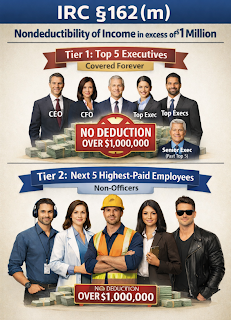
2. The Tier 2 Revolution: The Next Five (Effective 2027). Under the American
Rescue Plan Act of 2021, the definition of a “covered employee” expands for tax
years beginning after December 31, 2026 (i.e., 2027 for calendar-year
corporations). ARPA creates a two-tiered system for tracking high earners.
Specifically: (i) Tier 1 includes the CEO, CFO, and the three other
highest-compensated executive officers (as determined under SEC rules), who
remain “covered employees” permanently under the “once a covered employee,
always a covered employee” rule; (ii) Tier 2 adds the next five highest-paid
employees, who need not be officers; and (iii) unlike Tier 1, Tier 2 employees
remain covered only for the years in which they rank among the top five
highest-paid employees.
The January 2025 proposed amendments to Treas. Reg. § 1.162-33 (90 Fed.
Reg. 4691 (Jan. 16, 2025)) provide interpretive guidance on how Tier 2
employees are identified and ranked. The proposed regulations clarify that Tier
2 employees are ranked using tax-based compensation principles (e.g., Form W-2
Box 1 wages), rather than the SEC proxy disclosure framework used for Tier 1
determinations. They also include an anti-avoidance rule under which
individuals are treated as employees if they perform “substantially all”
services for the corporation, even if they are technically paid by a
Professional Employer Organization (PEO). In addition, multinational groups
must aggregate foreign-paid compensation from Controlled Foreign Corporations
(CFCs) when determining the “Next Five.” Because Tier 2 status is not
permanent, a one-time compensation spike does not result in a lifetime
deduction limitation for that employee.
3. IRS Audit Focus: The Death of Negative Discretion. For companies still
relying on “grandfathered” contracts in effect on November 2, 2017, the margin
for error has vanished. The September 2024 IRS Section 162(m) Audit Technique
Guide (Publication 6014) imposes rigorous scrutiny on these legacy awards, namely:
(i) it focuses on negative discretion, i.e., the committee’s power to reduce a
formula-based bonus payout; (ii) the IRS now argues this power means the
contract was not “binding” back in 2017 because the amount was not fixed; and
(iii) any material modification, like moving up a payment date without a
discount for the time value of money, will eliminate the grandfathered status
and lose the deduction. One has to be extremely careful with any changes to
these old deals to ensure no inadvertent modifications have occurred.
Immediate Action Items. To prepare for these shifts, we
recommend the following steps: (i) map out your entire organizational structure
under the § 414 controlled group rules to identify every entity now subject to
proration; (ii) begin “shadow tracking” your top five non-officer earners now
to prepare for the 2027 Tier 2 list; (iii) have counsel review any remaining
grandfathered awards against the 2024 Audit Guide; and (iv) identify any high
earners formally employed by third parties (like PEOs) who may now be subject
to the limit. Early coordination among payroll, benefits, and finance teams is
essential. The controlled group aggregation rules already apply for taxable
years beginning after December 31, 2025, and the Tier 2 rules take effect for
taxable years beginning after December 31, 2026, so systems should be updated
now rather than at year-end.