
Forfeitures in Qualified Plans: (i)
Proposed Regulations; and (ii) Fiduciary Class Action Suits
By Charles C. Shulman, Esq.
November 7, 2025
I. Part 1 – 2023 Proposed Regulations Regarding Forfeitures
2023 Proposed Regulations Regarding Forfeitures. The IRS has
long permitted using forfeitures of defined contribution plans to pay plan
expenses or reduce future contributions (and not just to reduce plan expenses),
as long as this is documented in the plan. See, e.g., Rev. Rul. 71-313; Rev.
Proc. 2016-51 § 6.02(4)(c); IRS newsletter, Retirement News for Employers
(Spring 2010). In February 2023, the IRS issued proposed regulations with
specific rules for forfeitures of defined benefit plans and for forfeitures of
defined contribution plans. Prop. Treas. Reg. §1.401-7, 88 Fed. Reg. 12282
(Feb. 27, 2023). These regulations are proposed to apply for plan years
beginning on or after January 1, 2024,
once finalized, and they have not yet been finalized. But Prop. Treas. Reg.
§1.401-7(d) and the Preamble provide that taxpayers may rely on these proposed
regulations for periods preceding the effective date of the regulations.
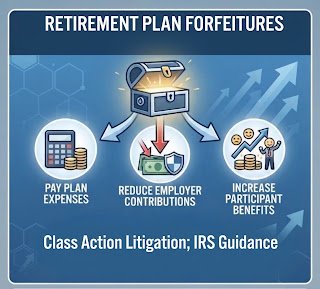
Three Options For Forfeitures In Defined Contributions Plans. The 2023
proposed regulations provide that for forfeitures under a qualified defined
contribution plan, the plan must provide that forfeitures will be used for one
or more of the following purposes: (i) to pay plan administrative expenses;
(ii) to reduce employer contributions under the plan; or (iii) to increase
benefits in other participants’ accounts (in a nondiscriminatory fashion) in
accordance with plan terms. Prop. Treas. Reg. §1.401-7(b)(1).
12-Month Deadline to Allocate Forfeitures in Defined Contribution
Plans. The 2023 proposed regulations also provide that for defined
contribution plans, the forfeitures must be used no later than 12 months
following the close of the plan year in which the forfeitures were incurred
under the plan, and this rule must be stated in the plan. Prop. Treas. Reg.
§1.401-7(b)(2).[1] As stated in
the Preamble, this deadline is intended to simplify administration by providing
a single deadline for the use of forfeitures that applies for all types of
defined contribution plans and to alleviate administrative burdens that may
arise in using or allocating forfeitures if forfeitures are incurred late in a
plan year. Forfeitures incurred during any plan year that begins before January
1, 2024, will be treated as having been incurred in the first plan year that
begins on or after January 1, 2024. Prop. Treas. Reg. §1.401-7(c).
The Preamble gives an example that if there are $25,000 of
forfeitures in a plan year, and the plan incurs only $10,000 in plan
administrative expenses before the end of the 12-month period following the end
of that plan year, there will be $15,000 of forfeitures that remain unused
after the deadline established in these proposed regulations, and the plan
would incur an operational qualification failure because forfeitures remain
unused at the end of the 12-month period following the end of that plan year.
Forfeitures in Defined Benefit Plans may not be Used to Increase
Benefits to any Employees under the Plan but are Instead Utilized as an
Actuarial Gain That Reduces Future Required Employer Contributions. Code §401(a)(8)
provides that a defined benefit plan will not be qualified unless the plan
provides that forfeitures must not be applied to increase the benefits any
employee would otherwise receive under the plan. The 2023 proposed regulations
provide that for forfeitures in defined benefit plans the plan must provide
that forfeitures may not be applied to increase the benefits any employee would
otherwise receive under the plan, unless there is a plan termination or freeze
of contributions the plan. Prop. Treas. Reg. §1.401-7(a). This rule is also in
the original 1963 Treas. Reg. §1.401-7. (The proposed regulations do not
contemplate using forfeitures in defined benefit plans to offset plan expenses,
because actuarial assumptions regarding future contributions already account
for the forfeitures.)
The Proposed 2023 Regulations Provide that Forfeitures in Defined
Benefit Plans may be Used to Reduce Future Contributions. Prop. Treas.
Reg. §1.401-7(a). However, in contrast to the original 1963 regulations, which
stated that defined contribution plan forfeitures must be used as soon as
possible to reduce the employer’s contributions under the plan, the proposed
2023 regulations have removed this requirement because reasonable actuarial
assumptions under the Internal Revenue Code already account for the forfeitures
as an actuarial gain that reduces future required employer contributions.
Instead, the proposed regulations provide that for defined benefit plans, the
effect of forfeitures may be anticipated in determining the costs under the
reasonable actuarial assumptions set forth in IRC §§430(h)(1), 431(c)(3)
433(c)(3). Prop. Treas. Reg. §1.401-7(a). As noted above, taxpayers may rely on
these proposed regulations for periods preceding the effective date of the
regulations.
II. Part 2. Recent Wave of Litigation re Use of Plan Forfeitures to
Reduce Employer Contributions Rather than to Reduce Participant Administrative
Expenses
Forfeiture Class Action Litigation. Class action
litigation related to retirement plan forfeitures has surged
dramatically since late 2023 and continued through 2025. The primary trend
involves lawsuits challenging the common practice of using forfeited, unvested
employer contributions to offset future employer contributions to the
retirement plans (for example the employer match in 401(k) plans), rather than
using them to cover plan expenses that otherwise may be charged to
participants’ accounts.
Dozens of Class Action Lawsuits. Close to 80
class action lawsuits have been filed since September 2023 in the U.S.
regarding use of forfeitures of retirement plans to reduce future contributions
rather than to reduce administrative claims that may be charged to participants,
including cases against HP Inc., Intuit, JPMorgan Chase and Qualcomm (all
discussed below). Plaintiffs argue that the decision on how to use forfeitures,
when a plan document provides discretion, is a “fiduciary
act” under ERISA. They contend that fiduciaries breach their duty of
loyalty and prudence by choosing to benefit the employer (by reducing employer
contributions) over plan participants (by reducing participant-borne
administrative fees).
Some District Courts Have Summarily Dismissed the Claims and Others
Have Allowed Claims to Proceed to Litigation. District
court rulings in forfeiture class actions have been inconsistent, with some
cases dismissed in favor of plan sponsors. See, e.g., Hutchins v. HP
Inc., 767 F. Supp. 3d
912 (N.D. Cal. 2025) (in putative class action by former employee alleging
breach of fiduciary duties when plan sponsor decided to use 401(k) plan
forfeitures to reduce employer contributions rather than to pay administrative
costs, the court found that the employer’s use of forfeitures to reduce future
employer contributions did not breach fiduciary duties, as it complied with the
plan document and ERISA requirements; case is being appealed by the plaintiffs
in the Ninth Circuit, and the DOL has filed an amicus brief in favor of HP Inc.); Sievert
v. Knight-Swift Transportation, 780 F. Supp. 3d 870 (D. Ariz. 2025) (the
court dismissed the suit, finding that the plan document permitted the use of
forfeitures to reduce future employer contributions; the decision was further
supported by longstanding IRS regulations allowing such practices in defined
contribution plans); Wright v. JPMorgan Chase & Co et al., 2025 WL
3798391 (C.D. Cal. June 13, 2025) (dismissed with prejudice so that it cannot
be refiled in the district; court ruled that the 401(k) fiduciaries properly
followed the plan’s explicit terms, which granted discretion to use forfeitures
to offset employer contributions).
Others forfeiture class action district court cases have allowed the
cases to proceed. Buescher v. North American Lighting, 2:24-cv-02076,
2025 WL 1927503 (C.D. Ill. June 30, 2025) (the court allowed the case to
proceed, finding that the plaintiff had sufficiently alleged that the plan
committee used an imprudent process in allocating forfeitures, which could
support a breach of fiduciary duty claim); Perez-Cruet v. Qualcomm,
23-cv-1890-BEN, 2024 WL 2702207 (S.D. Cal. May 24, 2024) (the court allowed the
case to proceed, finding that the use of forfeitures to reduce future employer
contributions instead of offsetting plan expenses could have eliminated
participant fees, which is partially passed onto employees); Rodriguez v.
Intuit, Inc., 744 F. Supp. 3d 935 (N.D. Cal. 2024) (motion to dismiss
largely denied; one of the first high-profile companies hit with this type of
lawsuit; district court initially denied most of its motion to dismiss in 2024,
giving the plaintiffs an early win and validating the legal theory; case
ultimately settled in 2025).
The outcomes often hinge on the specific language of the plan
documents.
Some Dismissed District Court Cases Are Being Appealed to the
Federal Courts of Appeal. Several dismissed forfeiture cases are currently on appeal in the Ninth
Circuit (Hutchins v. HP Inc., discussed above), Third Circuit (Cain
v. Siemens Corp. and Barragan v. Honeywell Int’l), Eighth Circuit (Matula
v. Wells Fargo) and Eleventh Circuit (Cano v. Home Depot, Inc.). These
appellate decisions in late 2025 and 2026 will likely bring greater clarity to
the legal landscape.
DOL Amicus Brief in Support of Plan Sponsors in Hutchins v. HP Inc.
The DOL, in a July 9, 2025 amicus brief No. 25-826 for Hutchins
v. HP Inc., before the Ninth Circuit Court of Appeals, on appeal from
dismissal by district court in 767 F. Supp. 3d 912 (N.D. Cal. 2025), supported
the plan sponsor, stating that while the allocation of
expenses is a fiduciary decision, the plan language in that specific case gave
the plan sponsor, in its non-fiduciary “settlor” capacity, control
over funding decisions. The DOL’s stance suggests a high bar for plaintiffs to
plead a breach of duty.
IRS Rules Allow Forfeitures to Reduce Employer Contributions. The IRS has
long permitted using forfeitures of defined contribution plans to pay plan
expenses or reduce future contributions (and not just to reduce plan expenses),
as long as this is documented in the plan. See, e.g., Rev. Rul. 71-313; Rev. Proc.
2016-51 § 6.02(4)(c); IRS newsletter, Retirement News for Employers (Spring
2010). The IRS has long permitted using forfeitures of defined
contribution plans to pay plan expenses or reduce future contributions (and not
just to reduce plan expenses), as long as this is documented in the plan. See,
e.g., Rev. Rul. 71-313; Rev. Proc. 2016-51 § 6.02(4)(c); IRS newsletter,
Retirement News for Employers (Spring 2010). Also, Prop. Treas. Reg.
§1.401-7(b)(1), 88 Fed. Reg. 12282 (Feb. 27, 2023), which may be relied up
currently, specifies that for forfeitures under a qualified defined
contribution plan, the plan may provide that forfeitures will be used for one
or more of the following purposes: (i) to pay plan administrative expenses;
(ii) to reduce employer contributions under the plan; and/or (iii) to increase
benefits in other participants’ accounts (in a nondiscriminatory fashion) in accordance
with plan terms.
Risk Mitigation by Providing Plan Language Giving Order of Priority
for Treatment of Forfeitures. To mitigate litigation risk, plan sponsors are advised to amend
plan documents to explicitly state the order of forfeiture allocation, such as
first reducing employer contributions, followed by covering plan expenses.
Sponsors should also ensure forfeitures are used promptly to avoid issues with
unallocated funds, in light of proposed Treasury regulations that could impose
a deadline of December 31, 2025, for compliance.
[1] Rev. Rul. 80–155, 1980–1 CB 84, discusses
distribution of forfeitures with respect to distributions to participants and
that plans should be valued at least annually. As noted in the Preamble, an IRS
newsletter, Retirement News for Employers (Spring 2010) noted that although
some defined contribution have forfeited amounts in a plan suspense account
accumulating over several years, the Internal Revenue Code does not allow this
practice, and it is advisable that no forfeitures in a suspense account should remain
unallocated beyond the end of the plan year in which they occurred or the
immediately succeeding plan year, and the treatment of the forfeitures should
be described in the plan.